
Executive summary
Searching many components of a large neural network for interesting patterns also produces chance findings. CUTTIE examines how selection can be supported statistically. It tests groups within a predefined hierarchy and accounts for multiple testing. The important quality-management boundary is the scope of the guarantee: under assumptions, selection of informative components is controlled. A compelling interpretation of those components remains a separate descriptive step and does not automatically establish a confirmed causal mechanism.
FQI takeaway
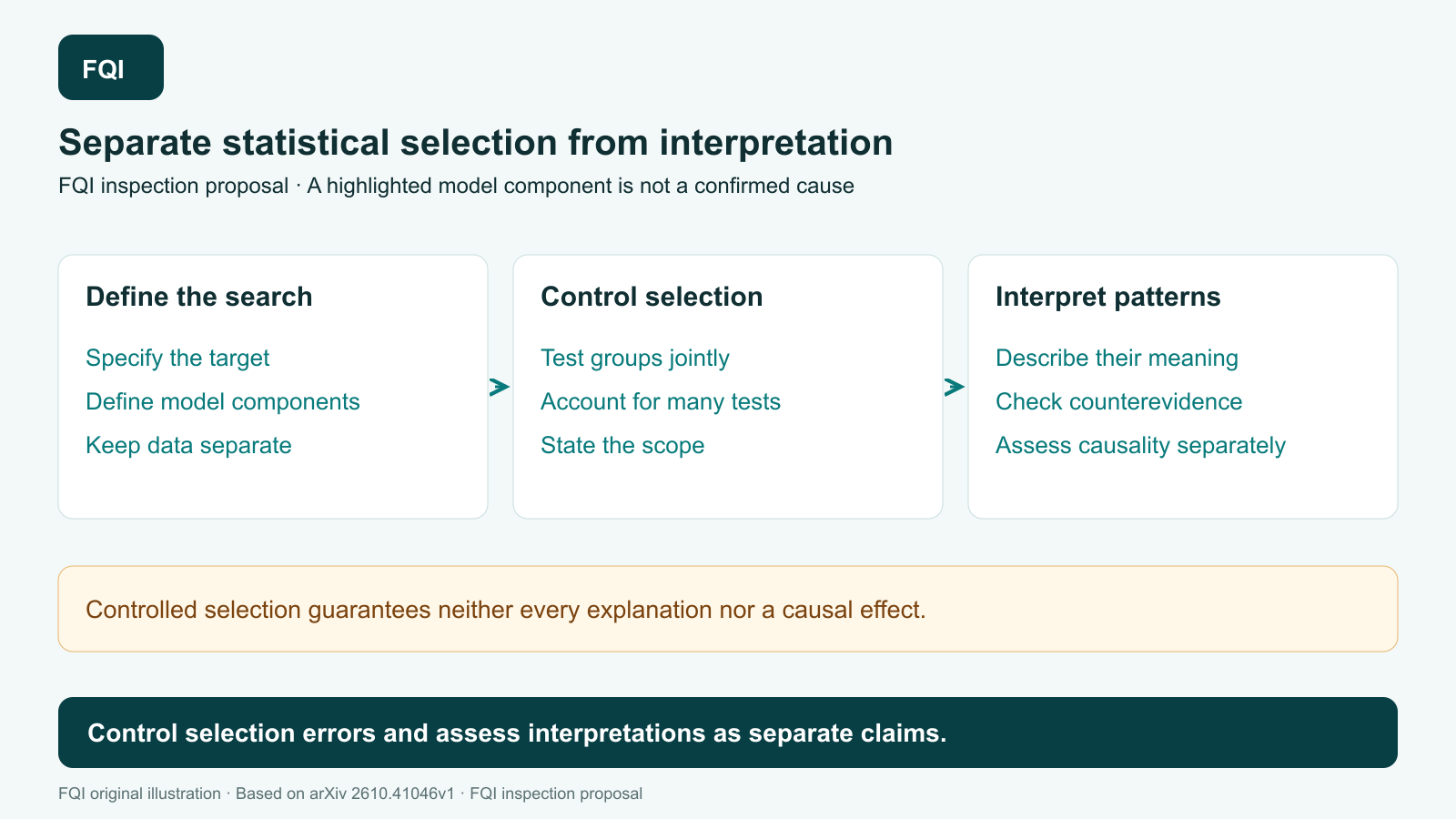
- Separate construction of the search hierarchy from statistical test data.
- Account for the full family of related tests when controlling errors.
- Document statistical selection, visual explanation and causal assessment separately.
The principle at a glance
A neural network processes inputs through many connected units. A unit can respond to a pattern without contributing information beyond other units. CUTTIE asks whether a group still contains information about the target after accounting for the rest of the same layer.
Groups form a tree. A large group is tested first, with smaller descendants examined only after rejection of the parent hypothesis. Provided the individual tests are valid, the procedure controls the probability of at least one false rejection across the specified family.
Deep dive
Huryn and colleagues separate three data roles. One sample trains the neural network, another determines the grouping tree and an independent inference sample supplies the statistical tests. The network and hierarchy are therefore fixed before the decisive test values are calculated.
This prevents the same cases from both selecting a persuasive grouping and confirming it. Tree construction still affects which information can be detected. It belongs in the documented assessment configuration rather than being treated as an irrelevant implementation choice.
The paper compares unit activations with calculated contributions to particular model outputs. These address two questions: which units encode information and which the model uses in the computation considered. Controlled simulations and a biological DNA-sequence model provide the empirical evaluation.
In simulation, highly related units can be detected jointly even when they cannot reliably be separated individually. In the biological application, attribution maps are subsequently compared with known regulatory motifs. Agreement supplies an additional plausibility check, but the selection guarantee does not automatically cover these motif interpretations.
FQI proposes a corresponding evidence plan for an artificial intelligence (AI) explanation method. Define the components being searched, the target being assessed and the data distribution for which the statement is intended. Then specify how many layers and groups belong to the combined testing problem. A guarantee for one layer must not silently become a guarantee for all searched layers.
Technical interpretation follows selection. In an industrial image model, a selected group might respond to a surface pattern. That initially establishes a relationship within the assessed model. Whether the pattern causes a defect or merely tracks acquisition conditions requires another experiment. This manufacturing example is an FQI illustration, not an application studied by the authors.
A practical report can therefore distinguish the statistically selected component, its interpreted meaning and the outstanding technical evidence. An attractive visualization cannot fill the last field. If correlated units can only be identified jointly, the report should retain that group-level resolution instead of claiming to have isolated one decisive neuron.
The same principle applies to changes of operating conditions. A component selected for one inference distribution does not automatically retain its meaning after a new camera, material or acquisition protocol is introduced. Such changes require a clearly scoped follow-up assessment.
Limitations and risks
Error control depends on valid individual tests and suitable modeling assumptions. Strongly correlated units can limit localization. A rejection concerns a fixed network, layer and inference distribution. The empirical application covers biological sequence models rather than manufacturing. Attribution maps and motif matching remain descriptive; they do not independently demonstrate causality. The power of the procedure also depends on the estimated conditional relationships and the chosen hierarchy.
FQI conclusion
An explanation becomes more accountable when its selection is itself examined. CUTTIE offers a procedure with a precisely limited statistical claim. FQI recommends preserving that boundary rather than extending it to every later interpretation. Operational decisions need the selection rule, independent inference sample and technical countercheck together. An interesting model component then becomes a testable investigation lead without prematurely being presented as the confirmed cause of a defect.
Sources & transparency
Primary source: Localizing predictive concepts encoded in neural representations via hierarchical testing; versioned full text reviewed. Relevant methods, results and limitations were reviewed on 2 November 2026. Scientific preprint; FQI has not independently reproduced the findings. Operational inspection plans and examples are FQI interpretations, not additional experiments reported by the authors.
Artificial intelligence assisted preparation. Johann Fischer explicitly approved this article package for publication on 2026-11-02.