
Executive summary
An unusual measurement can justify checking the measurement system or intervening in the process. A revised research paper on Cali examines when data-driven root-cause analysis can distinguish these cases. It models both the underlying state and its recorded observation. For quality management, the explicit limits of distinguishability are particularly useful. Artificial intelligence (AI) can prioritize an investigation, but an unusual value and a model label do not automatically establish a confirmed sensor failure.
FQI takeaway
- Keep measurement error and process change as separate anomaly hypotheses.
- Ask whether additional observed variables can distinguish the hypotheses at all.
- Keep unidentifiable cases open and obtain independent reference measurements.
The principle at a glance
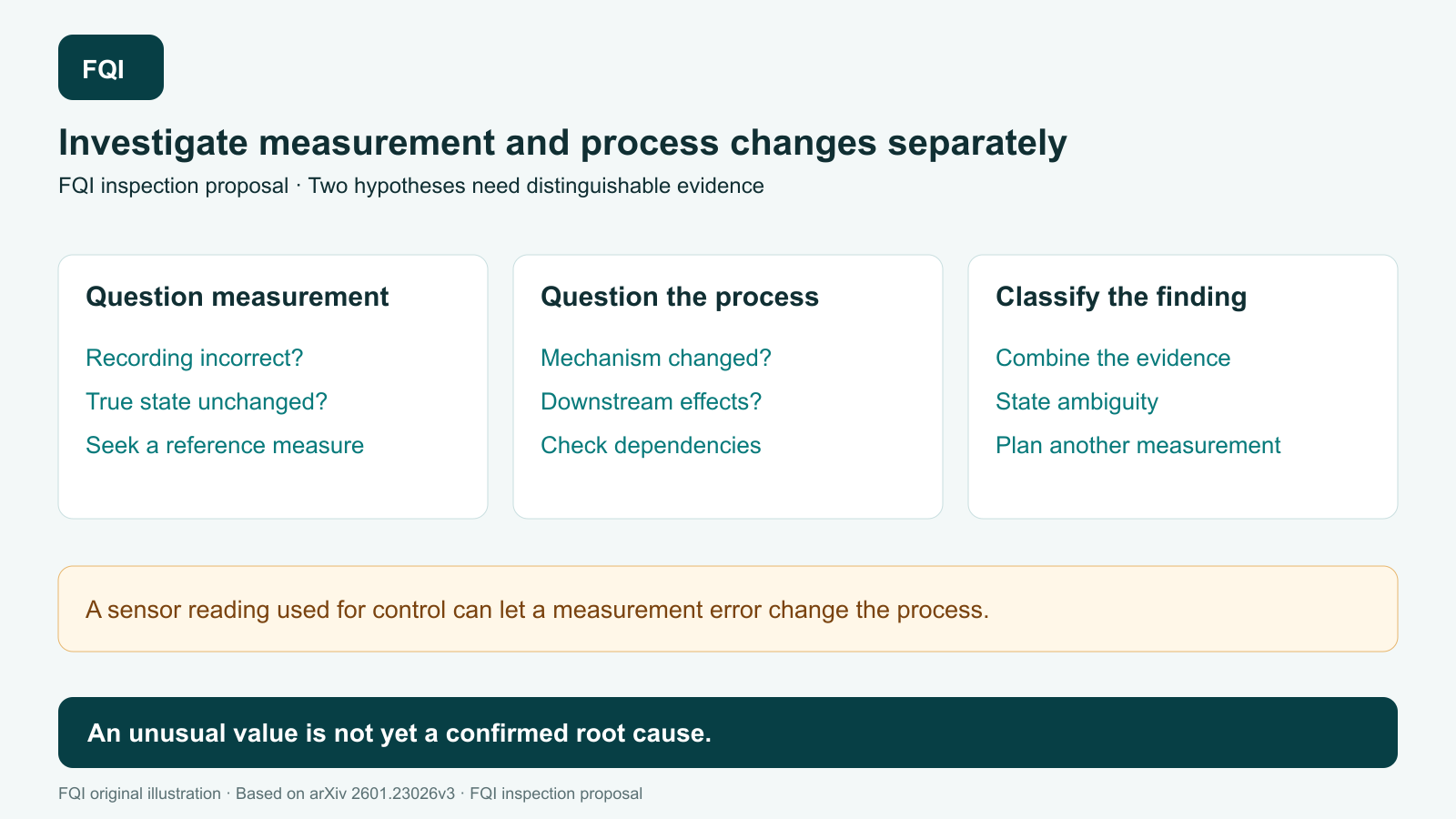
The method represents variables and their directed dependencies in a causal graph: an explicit description of assumed cause-and-effect relationships. A changed process state may affect downstream variables. An incorrectly recorded value leaves the underlying process unchanged in the model.
That separation requires assumptions. If a faulty sensor reading feeds directly into a controller, the measurement itself affects subsequent process behavior. It is then no longer merely a passive record of the state.
Deep dive
Suhr, Kaltenpoth and Vreeken model anomalies as interventions on either latent true variables or observed measurements. Cali infers a suitable assignment of the anomalies. The AI contribution concerns learned models and statistical inference of causal structure, rather than a language model writing a plausible fault narrative.
Evaluation uses synthetic data with known interventions and data from causal experimental environments. The authors compare variants with supplied and learned graphs. This distinction matters: good results with known relationships do not show that those same relationships can reliably be reconstructed from contaminated operating data.
A further taxi-data example examines inconsistent time, distance and fare records. It illustrates how a faulty observation could be distinguished from a different pricing mechanism. These interpretations are plausible, but they are not independently confirmed causes for every record and do not establish performance on a manufacturing line.
A central limit concerns variables without observed descendants. At these endpoints, measurement errors and process changes can have identical observable effects. More data alone cannot resolve structural unidentifiability. Even elsewhere, the distributions of competing assignments can overlap, so perfect classification is not guaranteed.
FQI proposes a bounded investigation informed by documented plant knowledge. The team identifies variables representing process states, values that are merely recorded and measurement signals that influence controllers. It compares model hypotheses with maintenance findings, independent references and known interventions.
For an unusual pressure reading, an independent measurement could be obtained while examining downstream variables expected to respond to a real pressure change. This is an FQI inspection example, not an industrial experiment performed by the authors. Where no suitable downstream observation exists, the report should explicitly name that evidence gap.
The subsequent action remains separate from the model result. Correcting a record needs a confirmed recording error and a documented replacement rule. Adjusting a process needs a confirmed mechanism. Both decisions should later be checked against their expected effects. Otherwise, a convenient correction could erase evidence of an actual process change.
This structure also gives unresolved cases a useful outcome: the team can state which additional observation is required, instead of forcing a definitive label from insufficient information. A ranking of plausible causes remains useful without pretending to establish certainty.
Limitations and risks
Cali requires a suitable directed acyclic graph. Unobserved common causes, incorrect dependencies and unsuitable noise assumptions can weaken the result. Ordinary measurement uncertainty is not fully represented in the formal baseline model. The practical algorithm also uses a computational approximation rather than exact probabilities over every possible causal assignment. The boundary between measurement and process is especially important when recorded values influence downstream mechanisms.
FQI conclusion
The most useful question is which observation separates competing explanations, rather than which fault label sounds most plausible. Cali provides an explicit research model and identifies cases that cannot be resolved from available observations. FQI recommends recording that limitation as a result. AI can then help sequence the investigation while data corrections and process interventions remain tied to independently checkable technical evidence.
Sources & transparency
Primary source: Root Cause Analysis of Measurement and Mechanistic Anomalies; versioned full text reviewed. Relevant methods, results and limitations were reviewed on 2 November 2026. Scientific preprint; FQI has not independently reproduced the findings. Operational inspection plans and examples are FQI interpretations, not additional experiments reported by the authors.
Artificial intelligence assisted preparation. Johann Fischer explicitly approved this article package for publication on 2026-11-02.