
Executive summary
An artificial intelligence (AI) agent has stopped a task. Who can restart it, which fault must first be corrected, and what evidence shows that the prohibited action never took effect? These questions form a testable part of Na Young Ahn’s governance proposal. The paper sets out a protocol for stopping and resuming work and suggests acceptance tests. Its contribution to quality management is a specification of the evidence needed for recovery. The proposed protocol still awaits an operational evaluation.
FQI takeaway
- Compare the agent’s message with an observable state in the affected process.
- Require evidence of remediation, the reviewed rule or software version and independent approval for restart.
- Report the blocking of permitted tasks separately from missed prohibitions.
The principle at a glance
An agent can describe the action it intends to take. In Ahn’s design, a separately governed control checks whether that action is authorised. It can allow, hold or deny the request. While a request is on hold awaiting missing information, it must have no external effect. A critical violation gives the system another obligation. It must reach a safe state defined in advance for that application. Rejecting a single request leaves open whether the wider process has actually reached that state.
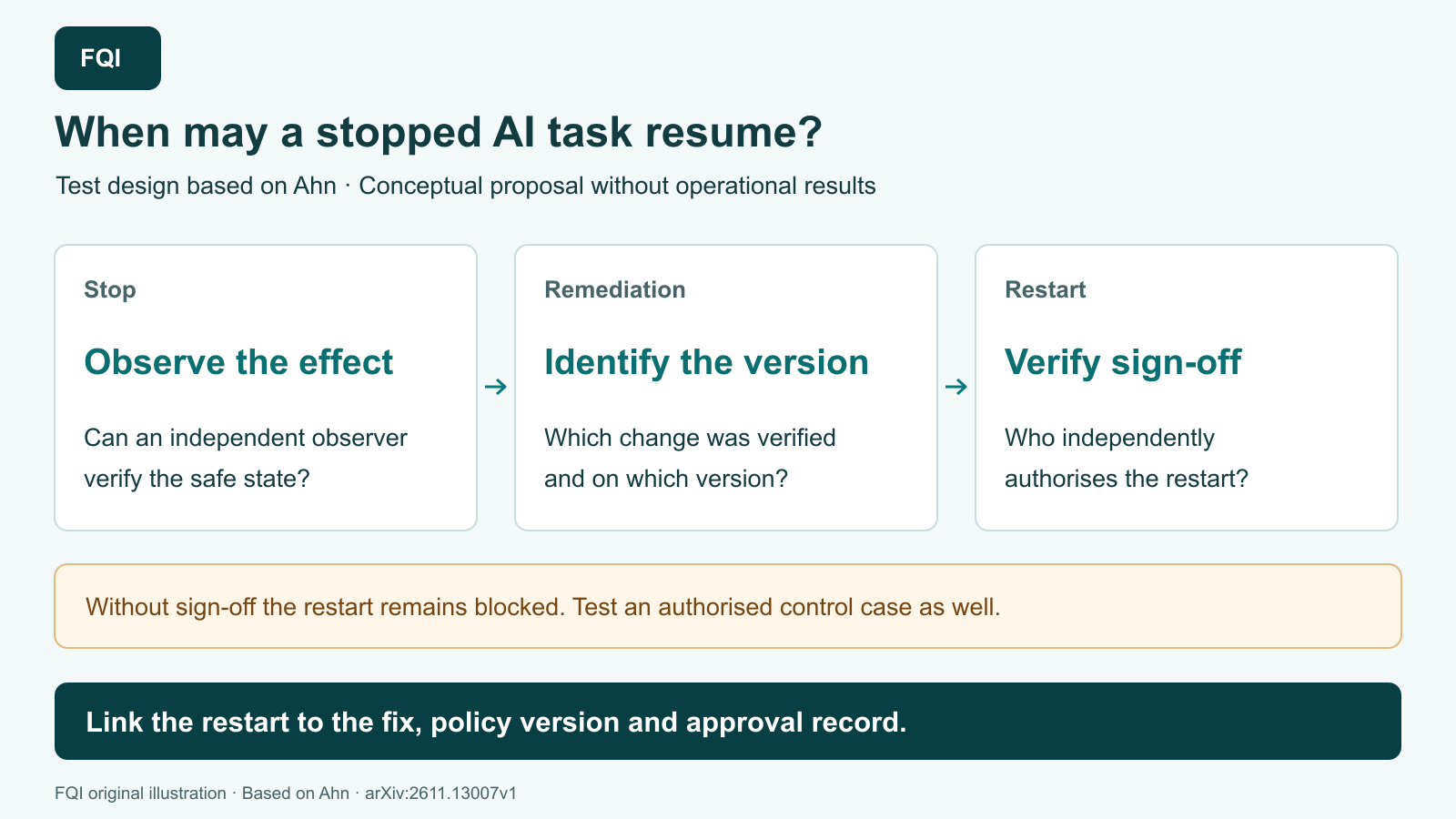
Ahn treats recovery as a separate decision. The person handling the incident needs to produce evidence of the correction. Someone in a separate role must assess the restart. An auditable record connects that decision with a particular version of the rules. It should be possible afterwards to tell whether the fault was repaired or someone simply acknowledged a warning.
Deep dive
The paper illustrates the distinction using confidential patent documents. An assistant can be authorised to analyse them without being authorised to send unpublished material to an unapproved address. Someone evaluating the control must be able to observe the point at which a document could leave the system. A message from the assistant saying that delivery was blocked cannot establish what happened at the destination. The patent case is a worked example in the paper.
A quality team could build an acceptance test with a harmless document. Before starting, it records an allowed destination, a prohibited destination, the responsible people and the expected state. To conclude the test the reviewers must be able to establish whether the document reached the destination. Missing observations leave the result open. Absence of a delivery confirmation alone would be an inadequate basis for recording a successful block.
For the next part of the test, the independent restart approval is initially withheld. Even after someone corrects the recipient rule, the previous request should remain suspended. A permitted test run follows documented remediation and approval. This supplies a necessary cross-check. A system that blocks every request could show an impressive block rate for prohibited actions while preventing all legitimate work. The permitted run tests a different part of the promise.
Limitations and risks
A responsible person must determine which interruption is safe for each process. A delay in an authorised transfer can have consequences of its own. Ahn therefore distinguishes the time to reach a decision from the time to observe the safe state. The proposal gives no operationally verified limit for either quantity. Coverage of external effects also needs to be established for each application before the recovery procedure can be evaluated.
FQI conclusion
A restart decision needs a traceable account of the interrupted task, the state actually observed, the review of the repair and the version covered by approval. Checking those records on a concrete case gives a team a way to test the proposed protection before relying on it in service.
Sources & transparency
Na Young Ahn sets out obligations O4 and O5, observable test outcomes in Table 8A and a worked patent example. The preprint presents a conceptual proposal. FQI devised the two-part acceptance exercise.
Codex assisted with drafting and checked the claims against the cited original work. Johann Fischer authorized publication on 2026-11-11.