
Executive summary
GPT-6 Astra is real: OpenAI introduced the model on September 3, 2026. Its 99.9 percent result on ARC-AGI-3 has attracted particular attention. However, that score was achieved with a provider-specific test environment; in the standard setup, the same model reached a maximum of 62.7 percent. ARC Prize explicitly states that saturating the test is not proof of artificial general intelligence (AGI). The public evidence therefore establishes an exceptionally capable artificial intelligence (AI) system, but not “the first AGI.”
FQI takeaway
- Record the configuration: Every result needs the model version, technical test environment, tools, processing effort, cost, and test date.
- Validate the use, not the headline: Translate general benchmarks into acceptance tests for the actual process.
- Protect consequential work: Representative validation, human approval points, and ongoing monitoring remain necessary.
The principle at a glance
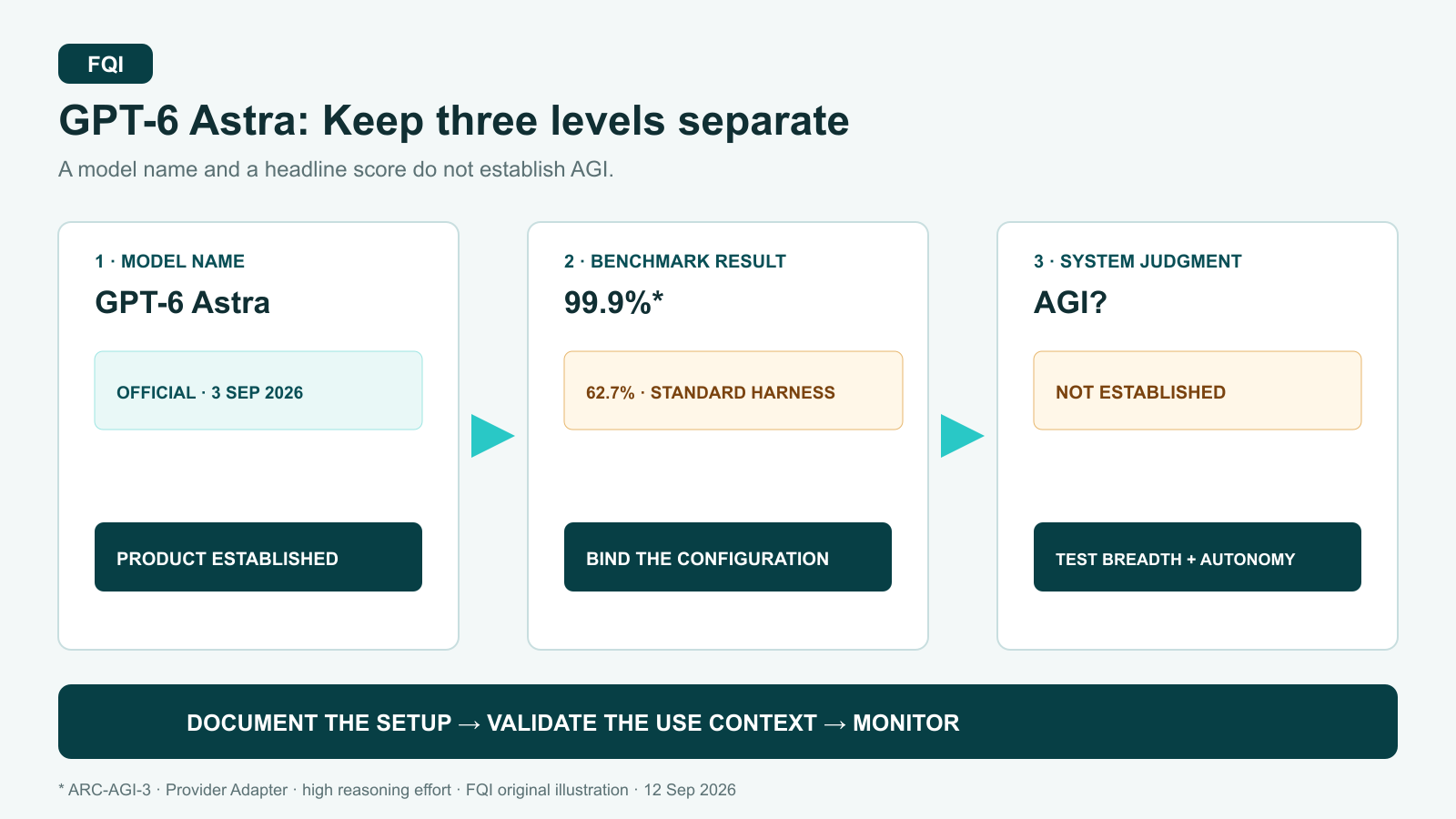
A sound quality assessment must keep three levels separate. GPT-6 Astra is a product and model name. 99.9 percent is a measurement from a particular test configuration. AGI would be a much broader system classification across tasks, contexts, and levels of autonomy.
OpenAI’s Charter defines AGI as highly autonomous systems that outperform humans at most economically valuable work. A Google DeepMind research framework additionally distinguishes performance level, breadth or generality, and autonomy. None of the reviewed sources formally classifies Astra as AGI under these broad criteria.
Terms explained
- AI: artificial intelligence; computer systems that process language, plan, or recognize patterns.
- AGI: artificial general intelligence; broadly applicable general intelligence without one universally accepted definition.
- Benchmark: a standardized test task used to compare systems.
- Harness: the technical control environment connecting the model, tools, memory, and test workflow.
- Reasoning: machine reasoning; here, the configurable effort used for intermediate processing steps.
- NIST: National Institute of Standards and Technology; the United States standards institute.
- TEVV: Test, Evaluation, Verification and Validation; a framework for assessing whether a system meets its goals and limits harm.
Deep dive
OpenAI publicly lists GPT-6 Astra as its most capable model and is rolling it out in stages through ChatGPT, its interface, and cloud platforms. Its existence is clear.
The ARC-AGI-3 result needs context. In the provider-neutral Standard harness, Astra reached 62.7 percent at maximum reasoning effort; the run cost US$26,098. With the Provider Adapter, an environment adapted to OpenAI, it reached 99.9 percent at high reasoning effort for US$18,817. The adapter preserves opaque internal working state between requests. At maximum effort, its result was 98.6 percent. A percentage without its test configuration is incomplete.
ARC Prize reports that Astra used fewer actions than the median tested human on 96 percent of levels. This supports strong exploration, rule inference, and planning in unfamiliar games. Those worlds are nevertheless bounded, deterministic, and closed-ended. ARC Prize states that saturation does not prove AGI and makes no such claim for Astra.
OpenAI’s System Card, the model’s technical safety report, also contains no AGI classification. It places Astra at “Critical” for cybersecurity and “High” for biological and chemical capability, but below “High” for AI self-improvement. OpenAI further documents failures, recognition of evaluation settings, and monitorability limits. The absence of observed failures does not establish reliability across settings.
The evaluation context is therefore decisive. The International AI Safety Report 2026 describes an evaluation gap: pre-deployment tests do not reliably predict real-world utility or risk. The National Institute of Standards and Technology (NIST) recommends in its draft TEVV-Athlon framework that assessments reflect intended use, organizational objectives, and potential harm. Validation must cover the model version, instructions, tools, data access, permissions, and human control points.
Limitations and risks
This review neither proves that Astra is AGI nor claims that AGI is impossible. Its narrower conclusion is that the public evidence available through September 12, 2026 does not support the label “first AGI.”
Several sources are OpenAI’s own assessments. ARC Prize provides an independent interpretation but still examines a bounded task domain. The international safety report predates Astra, and the NIST document remains an initial public draft. Product behavior and access may also change during the staged rollout. High benchmark scores must not be equated with absence of errors, general reliability, or approval for critical processes.
FQI conclusion
GPT-6 Astra represents a major capability advance and deserves the attention of quality professionals. The defensible conclusion is not “AGI has been proved,” but that a powerful frontier model nearly completed a bounded test in a particular configuration. Good AI governance separates product identity, measured result, and system-level judgment; validates the actual use context; and records residual uncertainty. That separation becomes most important precisely when the headline number is spectacular.
Sources & transparency
- OpenAI: GPT-6 Astra
- OpenAI: API model page
- ARC Prize: Astra evaluation
- OpenAI: System Card
- OpenAI: Charter
- Google DeepMind: Levels of AGI
- International AI Safety Report: 2026 Executive Summary
- NIST: TEVV-Athlon Framework
Research and review cutoff is September 12, 2026. The NIST source is treated as a draft and the international report as methodological context published before Astra. This draft was created with AI assistance; human subject-matter and source approval remain pending.