
Executive summary
Since 2 August 2026, the European Union has applied the transparency obligations in Article 50 of its AI Act. For certain AI-generated publications, an important question is whether substantial human review and editorial control take place. From a quality-management perspective, this creates a process requirement: review criteria, competence, source verification, release authority and evidence must be defined. Merely clicking “approve” is not effective control.
FQI takeaway
- Human review is a quality-relevant process step: It needs requirements, qualified reviewers, decision-making authority and objective evidence.
- Editorial control must be effective: The reviewer must be able to amend or reject content and verify its sources.
- Governance cannot end with labelling: Versioning, release status, accountability and escalation belong in the Control Plan.
The principle at a glance
The European Commission published guidelines on transparency obligations for providers and deployers of certain AI systems. Article 50 has applied since 2 August 2026. It covers, among other matters, information about direct AI interaction, machine-readable marking of AI-generated or manipulated content, and disclosure obligations for deepfakes and certain texts concerning matters of public interest. The precise legal application depends on the individual case. This article provides a quality-method perspective, not legal advice.
Terms explained
- AI: Artificial intelligence; systems that derive patterns from data or support tasks automatically.
- FMEA: Failure Mode and Effects Analysis; a method for proactively assessing risks.
- prompt: A task instruction or input for an AI system; it describes the task, rules, context and expected result.
Deep dive
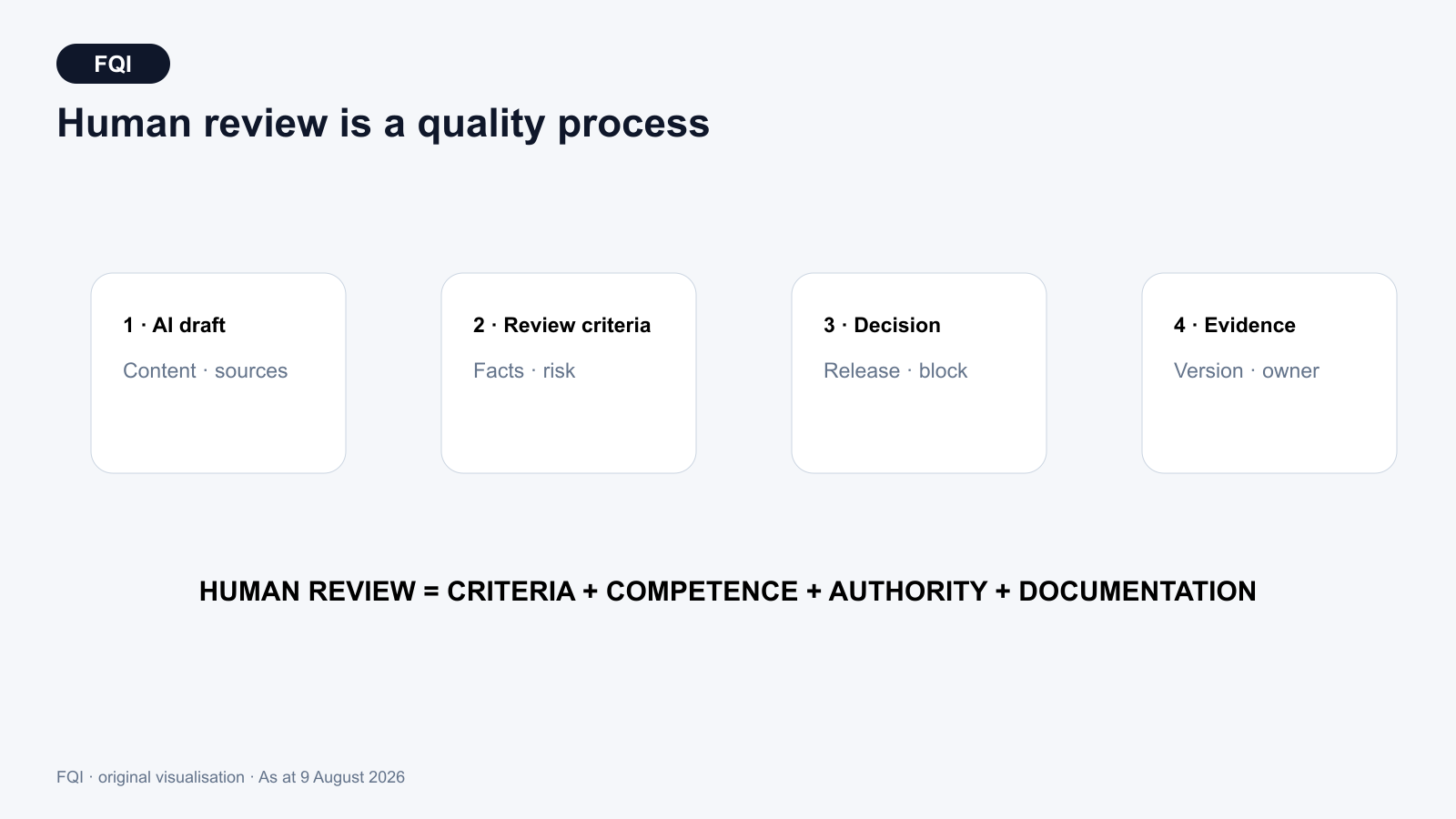
The guidelines matter to quality management because they make the often vague concept of “human in the loop” more concrete. Human participation is not automatically effective control. According to the Commission’s explanation, human review requires deliberate and substantial examination by knowledgeable people. Editorial control further requires that a person or organisation can genuinely decide whether content is approved, amended or rejected. Spelling and grammar checks alone are insufficient.
Human review thereby becomes an inspection and release process. As with a technical release, characteristics and criteria must first be defined. For an AI-generated technical article, these may include source accuracy, factual completeness, separation of facts from interpretation, correct figures, legal sensitivity, conflicts of interest and appropriate conclusions. Without defined criteria, approval depends on spontaneous attention and is neither repeatable nor auditable.
The second element is reviewer qualification. A linguistically polished text can still be technically wrong, so competence must match the risk. An article about FMEA requires different reviewer knowledge from a publication about employment law or medicine. In a quality management system, roles, a competence matrix and deputy arrangements would control this assignment. Particularly critical content may require a four-eyes principle or additional legal review.
Third, the process needs clear decision-making authority. The reviewer must be able not only to comment, but also to reject the content or require changes. This is the editorial equivalent of placing a product on hold. If content is published despite an open deviation, the record must show who accepted that deviation and on what basis.
Fourth, objective evidence is required. A suitable record contains at least the AI and prompt version used, the source status, generated version, changes, reviewers, review dates, result, release status and responsible organisation. Not every internal edit needs to be public. Internally, however, it should be clear which version was actually released. This prevents later AI-generated changes from silently replacing the reviewed version.
Two practical models are possible. An FQI technical article can use a digital checklist containing mandatory criteria, risk class and release decision. Automated checks identify missing sources or formal inconsistencies; professional assessment remains with the accountable person. An internal AI system that summarises inspection reports can use a risk-based workflow: purely informative summaries receive sample review, while deviation decisions or release recommendations are always reviewed in full.
Quality management should also measure effectiveness. Suitable metrics are not the number of ticked boxes, but factual errors discovered after release, rejection rate, lead time, recurring error types, the proportion of unreviewed changes and the escape rate of published errors. These measures turn human review from an organisational ritual into a controlled quality action.
Limitations and risks
First, the legal scope of Article 50 depends on specific roles, content and use contexts. Not every AI-assisted edit creates the same obligations. Applying a label to all content indiscriminately can be as imprecise as applying none.
Second, extensive documentation can become disproportionate. Control effort should be based on reach, potential harm and the degree of automation.
Third, human review does not automatically prevent errors. Time pressure, confirmation bias, automation bias and missing expertise can sharply reduce effectiveness. Sampling the quality of reviews and feeding back lessons from errors remain necessary.
Fourth, there is a risk of sham control when reviewers are formally responsible but have neither source access nor genuine authority to require changes.
FQI conclusion
Article 50 highlights a central quality question: who actually assumes responsibility for an AI-generated result, and how is that responsibility exercised effectively? For organisations, the robust answer is not a disclosure banner but a risk-based release process. Human review needs the same basic elements as any other quality inspection: specified characteristics, qualified reviewers, suitable inspection resources, an unambiguous decision, documented deviations and evidence of effectiveness.
Sources & transparency
- European Commission: Guidelines on transparency obligations for providers and deployers of certain AI systems, current August 2026.
- European Commission: Transparency obligations under Article 50 of the AI Act, current July 2026.
- Legal status: The guidelines support interpretation of the EU AI Act; the applicable obligation must be assessed case by case.
- FQI transfer: Applying the guidance to Control Plans, competence management, release and effectiveness metrics is a quality-method inference.
- Legal notice: This article provides professional orientation and does not replace legal advice.
- This article was researched and written with AI support. Human professional, source and legal-plausibility approval was documented on 10 August 2026, and the article is approved for publication.
- Approval status: First-use explanations and the glossary were reviewed by a human and approved for publication on 17 August 2026. Approved by: Johann Fischer.