
Executive summary
A model of a welding workshop can run smoothly and still blame the wrong crane for delays. A study of SimuLean, a simulator designed for artificial intelligence (AI) agents, found that one agent built valid models in 93 of 108 attempts. The remaining errors produced plausible output. Comparison with reference models revealed them. For planners about to buy more capacity, a practical check is to trace exactly which crane is occupied during each step of a job.
FQI takeaway
- Define the production decision and the accuracy it needs before building the model.
- Check critical resource assignments against an independently established sequence of operations.
- Document agreement between models and agreement with the physical workshop separately.
The principle at a glance
In discrete-event simulation, the state of a workshop changes at particular events. A job arrives, a machine becomes available or a transfer ends. An agent can translate a written account of those events into instructions for a simulator. These instructions record how the model was built. They can also preserve a mistaken assumption in great detail. A crane assigned to a job in another bay will appear busy even while an operator in its own bay would see it standing idle.
The engineer therefore has two questions to answer. Does the program follow the specified rules? Do those rules describe the real process? Two separately programmed models can agree if their builders received the same mistaken instruction.
Deep dive
Javier Pernas-Álvarez and Diego Crespo-Pereira tested 18 tasks ranging from single machines to production lines. In a separate industrial case, agents reconstructed a published welding workshop using different tools. Their own checks caught problems including double booking of a rework area. Those repairs gave the researchers a working model to inspect. They also illustrated how a real correction can coexist with another error that remains undetected.
In the workshop case, three models built in SimPy consistently predicted slower production than the published reference. A stage-by-stage comparison led back to the original expert model. During fit-up of tubular parts it reserved a crane in the wrong bay. After the correction, this operation used the crane in the assembly bay. The nine agent-built models of the corrected specification then predicted production times between 0.3 percent below and 0.4 percent above the corrected reference value. This comparison measures agreement about a simulated workshop under specified conditions. An estimate of the error against real production requires shop-floor observations.
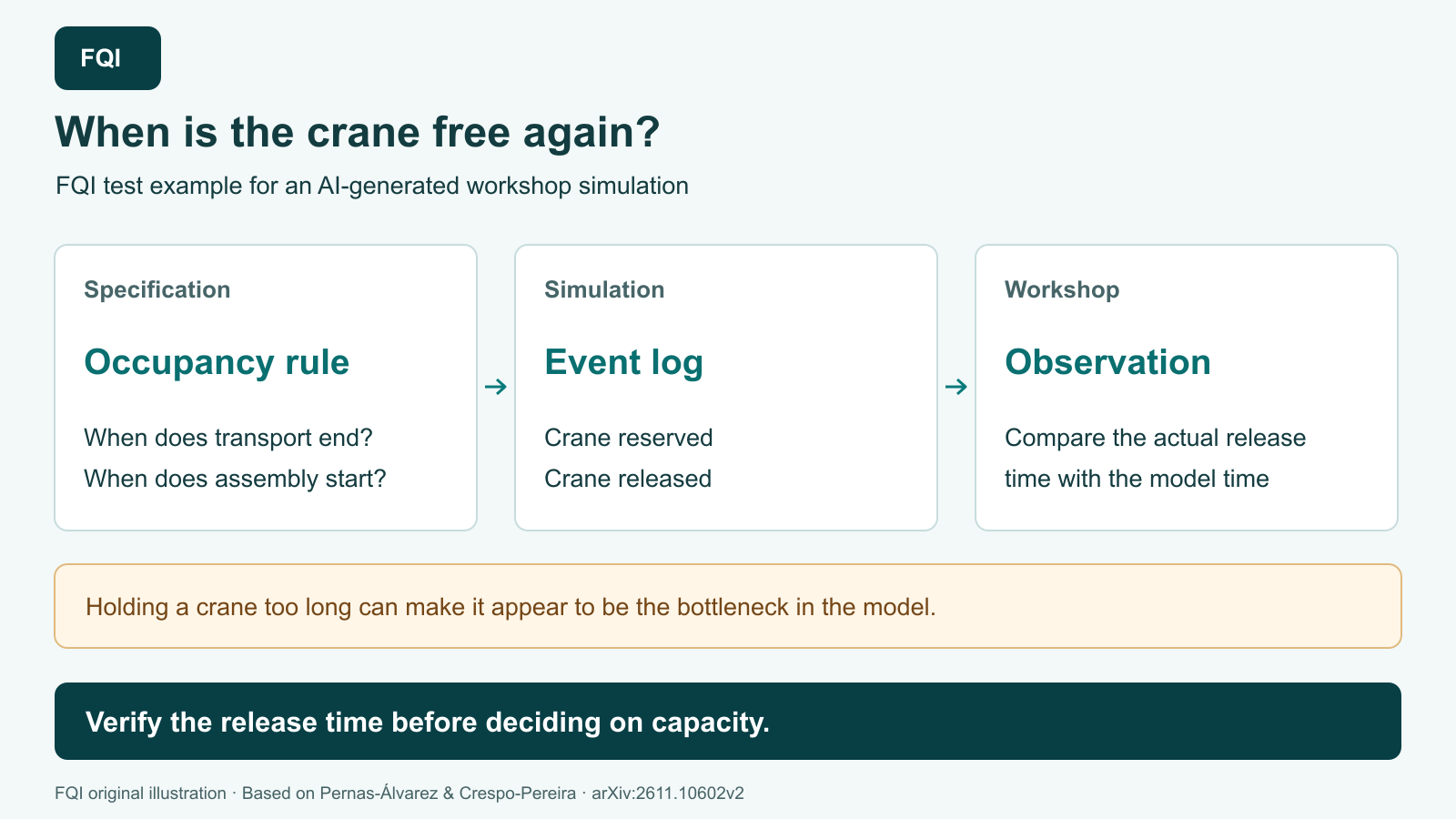
For a local acceptance check, an engineer could choose two consecutive jobs that need the same lifting equipment. Before opening the simulation output, the engineer would record which crane must be available at each operation, when it becomes occupied and when another job may use it. These transitions could then be compared with the event log. Even a plausible daily throughput deserves investigation if the assignments disagree. An offsetting time error at a different station could conceal the discrepancy in the total. Only after that check would it make sense to assess the benefit of a second crane.
Limitations and risks
The authors designed the tasks, reference models and criteria. One also contributed to the earlier industrial study. The experiments used two models from one provider and one workshop with a detailed specification. Simulated vehicle movements were themselves predictions. An investment decision at another site would still need observed assignments, actual release times and records of exceptions. A successful comparison on the normal shift may say little about days when a crane or operator is unavailable.
FQI conclusion
Choose a reference observation that could change the capacity decision. In this example it is the identity of a crane and the interval when it is occupied. Verifying that small part of the event sequence can clarify whether another crane belongs in the investment plan.
Sources & transparency
Pernas-Álvarez and Crespo-Pereira, preprint version 2. The benchmark, workshop comparison in section 6.4 and limitations in section 7.3 support the reported findings. FQI devised the two-job check.
Codex assisted with drafting and checked the claims against the cited original work. Johann Fischer authorized publication on 2026-11-11.