
Executive summary
An artificial intelligence (AI) agent proposes a formula that gives more accurate results on cases held back from training. Which of those gains survives a fresh test? Chandrasekhar and Barati Farimani studied a formula for calculating electronic energies. In an external evaluation, the clearest benefit appeared for the total energies of heavy atoms. The change in the main aggregate measure was statistically inconclusive. For a team considering a new formula, the decision depends on which quantities it needs to predict and for which chemical systems.
FQI takeaway
- Record the initial screening and the final physics calculation as separate stages.
- Compare a new term with a version that omits the term and has its remaining parameters fitted again.
- Inspect each property relevant to the intended application before accepting a favourable overall score.
The principle at a glance
Calculations of material properties need an approximation for how electrons interact. One part of that approximation is called an exchange–correlation functional. The researchers used language models to propose changes to such a functional. A numerical evaluator compared the proposals with reference data. This division of labour gives the team something concrete to examine when a model offers a plausible explanation for a change. It can calculate the predictions and compare their errors with those of an existing formula.
Screening many candidates calls for an economical calculation. The final assessment also asks what happens when the formula changes the electron density used in the calculation itself. A self-consistent calculation repeatedly updates the mutually dependent quantities until they agree within a specified tolerance. A candidate that passes the faster screening stage can lose some of its advantage during this test.
Deep dive
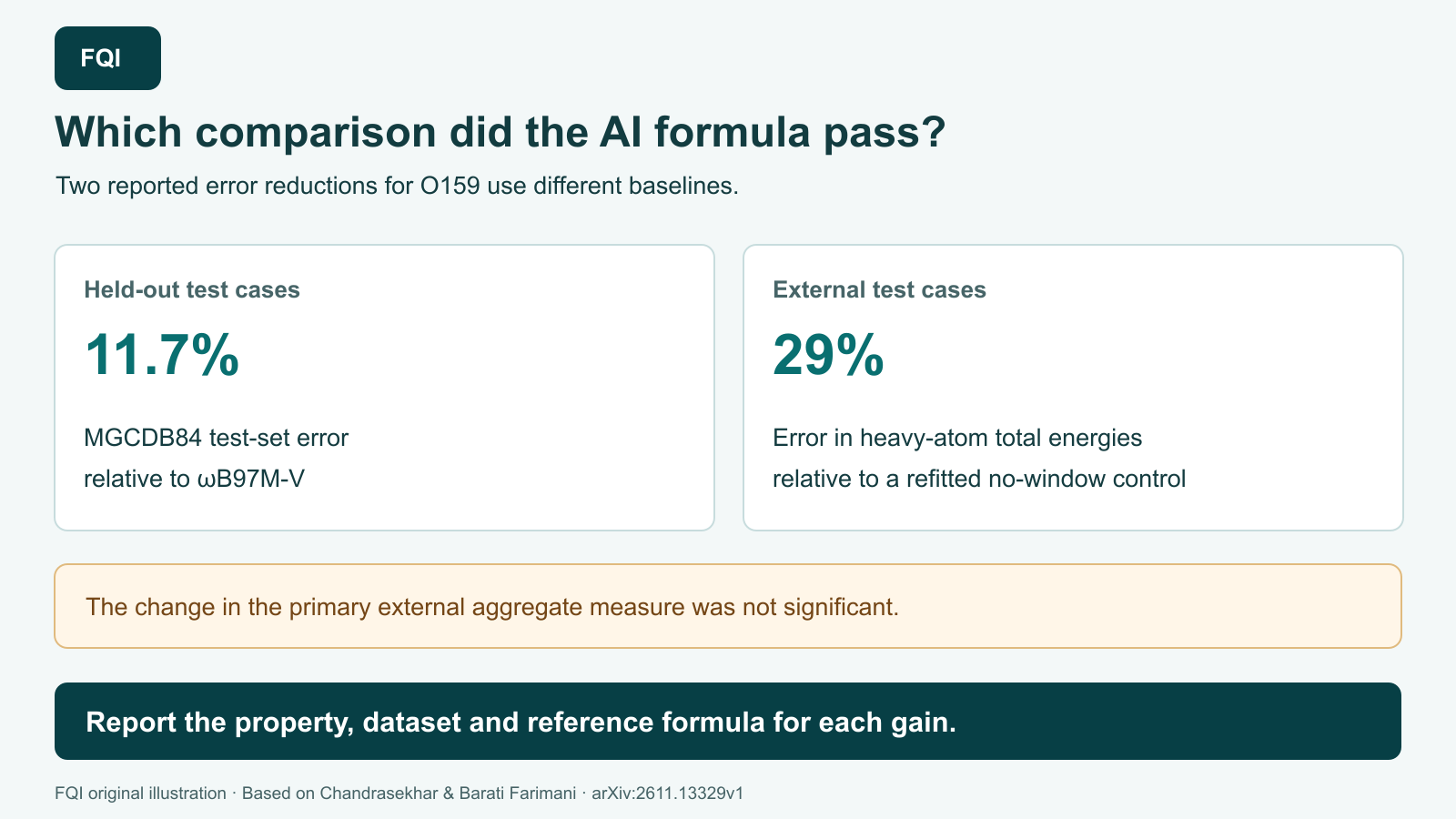
The search produced O159, a candidate with 13 parameters. This was the only candidate taken forward to the self-consistent evaluation. On the held-out MGCDB84 test set, its weighted error was 11.7 percent lower than that of the reference functional ωB97M-V. Another comparison formula, GAS22, still achieved a lower test error than O159. The chosen reference therefore matters even when every candidate is evaluated on the same cases.
The researchers also asked what the additional density-dependent term contributed. Simply removing a term leaves the remaining parameters at settings chosen for a different formula. A stronger control gives the reduced formula a chance to fit the training data again. Against this refitted control without the density window, O159 reduced the mean absolute error for heavy-atom total energies by 29 percent on the external data. This figure describes a different reference, error measure and set of cases from the 11.7 percent figure.
For a quality review, a team could draw up a short table before seeing the results. Each row would name a property it plans to use, its comparison formula and the deterioration it could tolerate. The evaluator could then place gains and losses side by side. In this study the heavy-atom benefit transferred more clearly than other gains. Vibrational frequencies were among the weaknesses of the additional window. A team relying on frequency predictions would need to examine that outcome on its own terms.
Limitations and risks
The external evaluation covered 36 datasets and excluded larger systems. The change in its primary aggregate measure was not statistically significant. The comparison of agents in the search used particular tools, budgets and families of candidate formulas. A single successful candidate gives limited information about how often a future search will succeed under different conditions.
FQI conclusion
A decision about the new term needs a named comparator and a named prediction task. Refit the competing formula, check the predictions on untouched cases and look at the property that matters in the intended application. This makes it possible to approve one use while leaving another open.
Sources & transparency
Chandrasekhar and Barati Farimani describe the search, controls and evaluation in Sections 3.1–3.7. The decision table is an FQI proposal.
Codex assisted with drafting and checked the claims against the cited original work. Johann Fischer authorized publication on 2026-11-11.