
Executive summary
A seemingly harmless agent step can trigger an unwanted effect later. JANUS therefore studies an AI guard that predicts possible consequences from the observed trajectory and includes them in its safety assessment. AI stands for artificial intelligence; the guard itself is a trained language model.
This creates a distinct quality-management question: are the predictions valid, and do they support appropriate intervention? A plausible forecast is not an observed effect. FQI recommends separate evidence for context, predicted consequence, safety decision and preserved usefulness on permitted tasks.
FQI takeaway
- Label predicted consequences as forecasts and distinguish them from observations.
- Examine how the forecast contributes to the safety judgment.
- Assess prevented harm together with unnecessarily blocked permitted tasks.
The principle at a glance
JANUS trains two connected tasks. First, the model summarizes possible safety-relevant continuations. It then assesses the observed trajectory together with that prediction. The resulting guard system is called Vanguard.
During operation, the guard cannot know the actual future. It uses the available context and its own forecast. This creates additional uncertainty: a safety judgment can depend on an outcome that sounds plausible but would not occur under the real conditions.
Terms explained
- Trajectory prefix: The part of an agent run already available at a decision point.
- Anticipation: Predicting possible later events from the observed trajectory.
- False blocking: Stopping a permitted task without sufficient justification.
Deep dive
Training data are generated in a simulated environment. Tools are not actually executed; another model supplies appropriate observations. The authors distinguish risks arising from user requests, the environment and agent behavior. They report 75,180 training examples. Safety labels come from a language model rather than a consistently independent human reference.
The guard is evaluated on four public task collections. Vanguard produces lower attack success rates than the compared protection methods. The 15.9 percentage points highlighted in the abstract refer to an average across six comparison methods and four collections. This is not a uniform margin over the strongest competitor in each case.
The separate utility assessment deserves attention. On AgentDojo, performance on permitted tasks is 0.680, matching the reference without a guard. The reported 5.1 percentage-point utility improvement refers to the average of protection methods on this collection. It does not establish a general utility improvement across all four collections.
Removing the future summary worsens observed performance. Another comparison gives the guard the actual later continuation. This is an unavailable upper comparison condition: an operational guard cannot possess that information. The study also shows that less available context makes delayed risks harder to recognize.
A simplified FQI example concerns an agent updating software on a shared inspection station. The change could affect an older inspection procedure. An anticipatory guard would need to recognize the dependency and identify its possible consequence. Whether that dependency really exists, however, requires appropriate configuration and compatibility evidence.
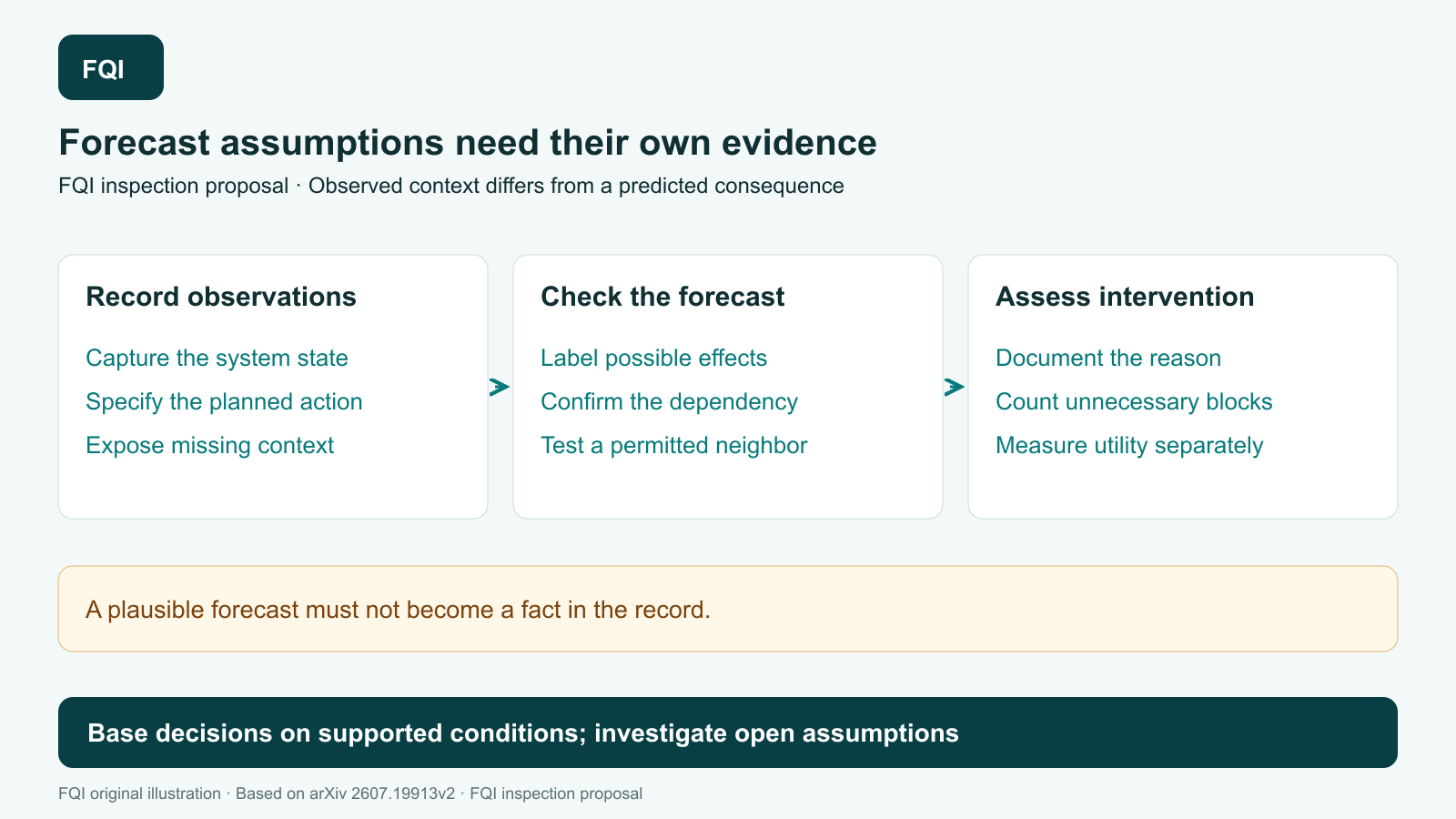
FQI therefore proposes separate fields for the observed system state, proposed change, predicted consequence, supporting evidence and decision. A forecast must not silently become an established fact in the record. Unconfirmed assumptions first require targeted checking.
Qualification needs cases with confirmed delayed effects alongside suitable permitted neighboring cases. Intervention might be justified when a real dependency is affected but unnecessary when a description merely sounds similar. Such pairs test whether the guard recognizes relevant relationships or reacts only to conspicuous wording.
The same case should also be tested with different amounts of available context. This reveals which information is necessary for a defensible decision. FQI recommends treating missing context as an operating limit and obtaining human judgment when appropriate. The source does not establish the safety of this proposed operational procedure.
Limitations and risks
Simulated tool observations and model-generated labels can share errors. Comparing with a known continuation during training does not match the information available in operation. A convincing explanation can therefore conceal an incorrect prediction.
Measured improvements apply to the examined tasks and settings. They establish neither industrial production approval nor elimination of every delayed risk. FQI has not independently reproduced the results.
FQI conclusion
Anticipatory AI guards extend assessment to possible later consequences. That extension requires additional evidence: the prediction must be technically defensible, and intervention must appropriately preserve permitted work. A strong overall score does not answer those questions for every individual case.
Quality practitioners should record observation, forecast and decision separately. A bounded pilot with confirmed dependencies and permitted counterexamples can show where the guard helps and where necessary context is missing.
Sources & transparency
Preliminary research; no independent reproduction. Operational examples and inspection proposals are FQI interpretation. AI-assisted article, approved for publication by Johann Fischer on 2026-10-26.