
Executive summary
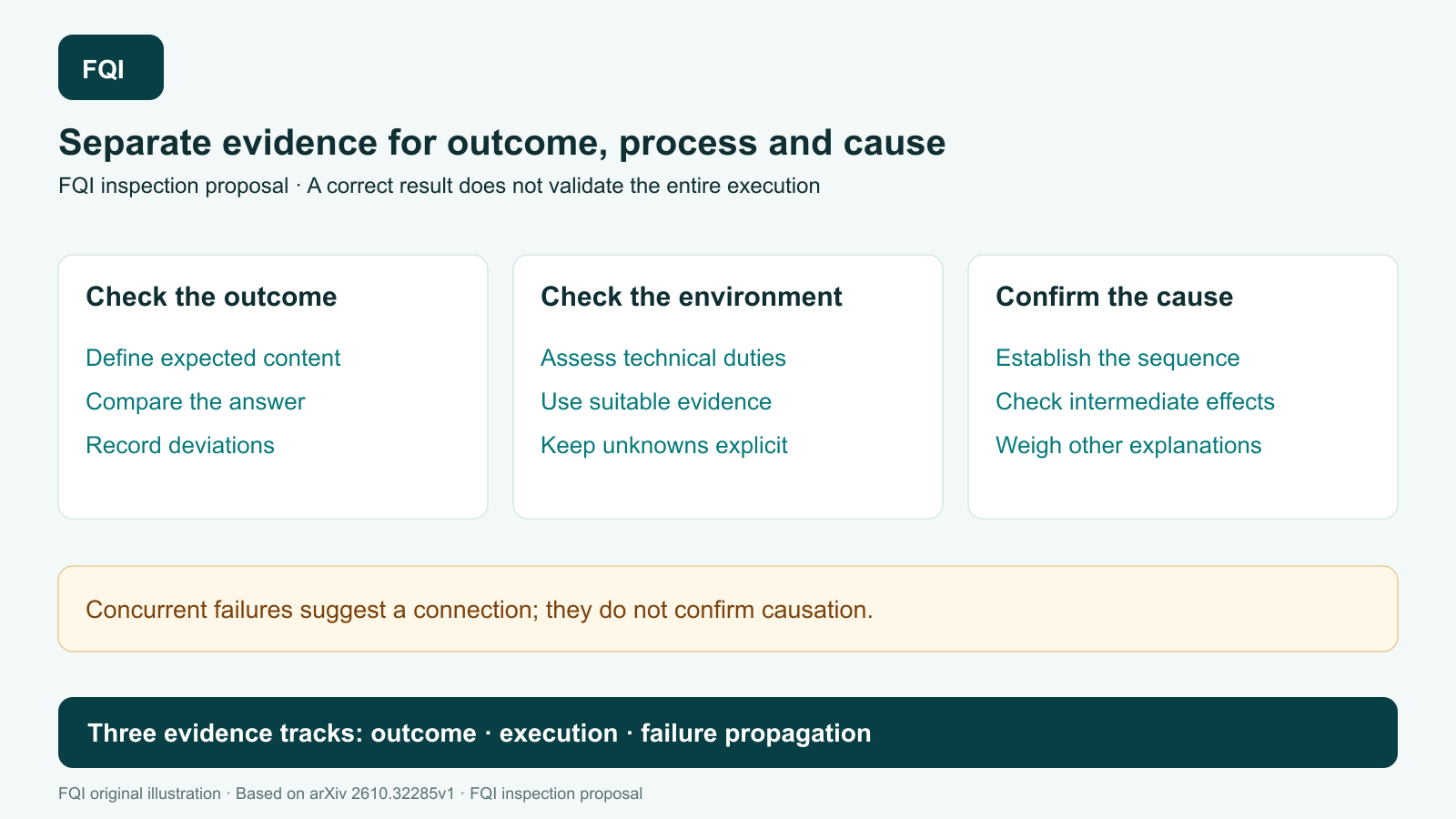
An AI agent (AI: artificial intelligence) can deliver the right result even when its technical execution environment violates a requirement. Conversely, two simultaneous failures do not establish a shared cause. TraceTrial-Bench therefore separates outcome assessment, environment criteria and causal review.
This creates a concrete inspection decision for quality practitioners: a useful final document confirms neither reliable delivery of tool results nor a suspected failure chain. Each claim needs appropriate observations. The reported figures describe a selected research collection rather than a general product ranking.
FQI takeaway
- Assess task outcomes and technical execution conditions against separate criteria.
- Distinguish missing observations, failed criteria and confirmed technical defects.
- Confirm suspected failure chains using time-ordered intermediate states.
The principle at a glance
The execution environment connects the language model to tools, memory, permissions and running processes. The paper calls it a harness, a technical control environment coordinating execution. An agent might correctly describe a failed process even though the environment did not forward a structured failure status. The answer would be correct while a technical obligation remained unmet.
TraceTrial-Bench evaluates these levels separately. Additional causal review asks whether an established environment failure actually caused the agent’s error. An automatically assigned causal label is explicitly insufficient.
Terms explained
- AI: Artificial intelligence; here a model planning tool operations and processing results.
- Harness: The execution system connecting model calls, tools and process states.
- NIST: National Institute of Standards and Technology, the US institute providing voluntary guidance on assessing AI risks.
- Execution trace: A time-ordered record of observed messages, actions and results.
- Causal candidate: A suspected connection between failures that still needs confirmation.
Deep dive
The study examines 95 tasks, nine model configurations and four execution environments, producing 3,420 selected runs. In 1,065 runs, or 31.1% of the collection, all agent criteria pass while at least one environment criterion does not. This exposes a gap between successful delivery and a fully passed process assessment.
The 31.1% figure is not a confirmed product defect rate. A negative environment result can also mean that the selected evidence does not establish compliance. The procedure furthermore treats unexercised mechanisms according to the agent’s outcome. The assessment axes are recorded separately but are not statistically independent.
For a failure chain, the test specifies two criteria and the suspected intermediate mechanism in advance. When the relevant failures occur together, their connection is flagged as a candidate. Only manual checking of the individual judgments, appropriate evidence sources and a temporally plausible intermediate effect supports the stronger claim of confirmed failure propagation.
A simplified FQI example concerns an assistant producing an inspection report. Data retrieval fails, but the environment reports only a generic completion. The assistant then uses older values. Three questions require separate answers: is the report incorrect, was the retrieval status communicated correctly, and does the trace show that the missing error message led to using old values? The last claim requires more than two failed checkboxes.
FQI proposes an assessment sheet with separate areas. The first records expected content and the delivered document. The second records agreed technical properties, such as unchanged tool responses and explicit completion messages. The third records the causal hypothesis, timestamps, intermediate states and competing explanations. An unknown state remains unknown rather than being replaced by a plausible story.
Evidence must also fit the question. The actual process state establishes whether the process failed. The transmitted message establishes what the model could observe. A later session transcript may represent these differently. Teams should therefore avoid treating those sources as interchangeable without checking.
After a correction, suitable tasks are repeated with recorded configurations. A single run without the error does not establish stable improvement. The voluntary framework of the National Institute of Standards and Technology (NIST), the US standards institute, supports documenting assessment methods and context-specific performance evidence. It confirms no TraceTrial-Bench performance claim.
Limitations and risks
Each combination contains one selected execution, sometimes following recovery of earlier runs. Task versions, runtime settings and evaluation budgets vary. Repeatability and effects of individual architectural choices are therefore not comprehensively established.
Semantic judgments come from a fixed evaluation model. The paper provides no comprehensive accuracy measurement for automatically activated causal links. It is published under TraceLite AI with listed university and institute affiliations. FQI has not independently reproduced the results.
FQI conclusion
A correct final result and a controlled execution process require different evidence. Quality practitioners should examine both before assessing causation. This prevents a successful report from concealing technical weaknesses or coincident failures from being mistaken for a causal explanation.
A practical starting point is a small collection of clearly defined tasks with traceable individual criteria. A confirmed failure chain connects these criteria through observable intermediate effects. It does not emerge merely from an overall assessment field.
Sources & transparency
Published under TraceLite AI, with listed university and institute affiliations. Preliminary research; no independent reproduction. Operational examples and inspection proposals are FQI interpretation. AI-assisted article, approved for publication by Johann Fischer on 2026-10-26.