
Executive summary
Image-analysis AI can react more strongly to combined small changes in images and instructions than separate tests suggest. AI means artificial intelligence. MoST investigates these combinations in models that process images and language together.
For quality practitioners, the implication is a concrete addition to the test plan: examine image capture, work instructions and their interaction. At the same time, an incomprehensible test input must not automatically count as a model failure. The study concerns object localization in research datasets and does not establish industrial defect-detection performance.
FQI takeaway
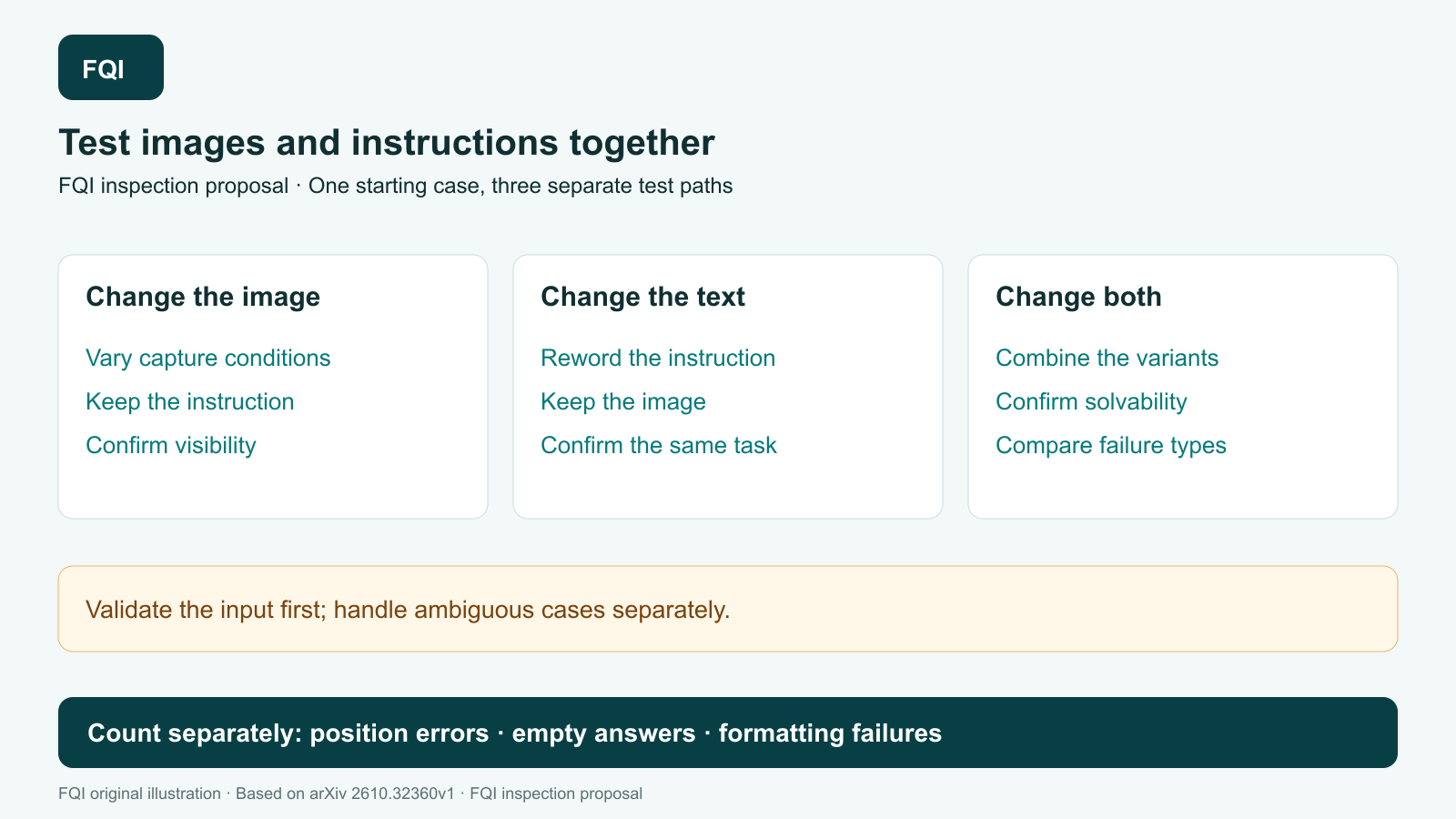
- Compare image changes, text changes and their combination using the same starting case.
- Distinguish wrong object positions, empty answers and unusable output formats.
- Confirm that changed inputs still define an unambiguous, solvable inspection task.
The principle at a glance
A vision-language model (VLM), meaning a model processing images and language together, receives an image and an instruction. In this experiment it must mark the positions of specified objects. MoST changes both inputs and searches for cases where performance deteriorates while changes remain as small as possible.
The search has three modes: image only, text only and both together. The result describes sensitivity under the tested conditions. It does not automatically explain which internal model components caused a failure.
Terms explained
- VLM: A model connecting visual information with a task described in language.
- Modality: An input type, here an image or text.
- Reference position: The specified object location used to assess the output.
Deep dive
The authors examine four models on ImageNet images and a driving dataset. An image is retained for a model only if the unchanged output already reaches a specified minimum agreement with the reference. Each model therefore receives its own suitable subset. Direct comparison between models can be affected by differences in starting-case difficulty.
The search combines three objectives: worse object localization, small image changes and small linguistic deviations. The distance measures used are approximations. A small numerical distance establishes neither preserved image meaning nor an unchanged task.
The study distinguishes several failure definitions. An incorrect object boundary differs from an empty answer. An output format that cannot be evaluated is another category. The reported search success rate changes depending on which cases are combined. Quality practitioners should therefore read the definition alongside every figure.
For several model and scene combinations, joint changes produce similar or higher failure rates with smaller changes per input type. This does not mean combined changes are always superior. Adding the internal perturbation budgets also produces no common physical measure, because images and language are modified differently.
Human assessment covers 144 generated cases with 2,976 ratings. Depending on the model, roughly 60–76% of ratings describe the modified task as understandable. Agreement between raters remains limited. These findings validate neither every generated case nor 2,976 independent test tasks.
In a simplified FQI pilot, an image assistant could mark the position of a component feature. The team first chooses unchanged cases with confirmed references. It then creates permissible lighting variations, technically equivalent instructions and combinations of both. Shared starting cases and recorded modifications make the three test paths comparable.
Before assessing the model, specialists determine whether the feature remains visible and the task unambiguous. Unclear variants receive a separate status. Position errors, missing answers and formatting failures are then counted separately. Combined changes can reveal an additional testing gap without hiding different failure modes in a single rate.
Confirmed weaknesses require a targeted response: better capture conditions, clearer instructions or an additional expert check. The chosen response must be tested again on the common case collection. The search method provides suspected failures rather than an automatic release decision.
Limitations and risks
The work examines object localization, not industrial component release or reliable naming of defects. The localization measure deliberately ignores output class names. A correct position therefore does not establish a correct technical classification.
Search method, budget, initial filtering and selection of evaluable outputs shape the results. Human assessment covers a sample and shows limited agreement. This draft includes neither independent reproduction nor industrial validation.
FQI conclusion
When AI processes images and instructions together, its test plan should include joint changes. The additional insight comes from comparing three clearly defined test paths, rather than maximizing a perturbation success rate.
Technically valid inputs remain a prerequisite. A deviation can be meaningfully attributed to the model only when the expected result remains justified after modification. Separate failure categories and appropriate denominators turn discovered examples into a traceable inspection task.
Sources & transparency
Research from the Technical University of Munich and fortiss. Preliminary research; no independent reproduction. Operational examples and inspection proposals are FQI interpretation. AI-assisted article, approved for publication by Johann Fischer on 2026-10-26.