
Executive summary
Several AI agents (AI: artificial intelligence) can recognize an error yet collectively retain the wrong decision. A new study examines these communication sequences and distinguishes the initial mistake from failed correction. Here, several language models exchange information while solving a task.
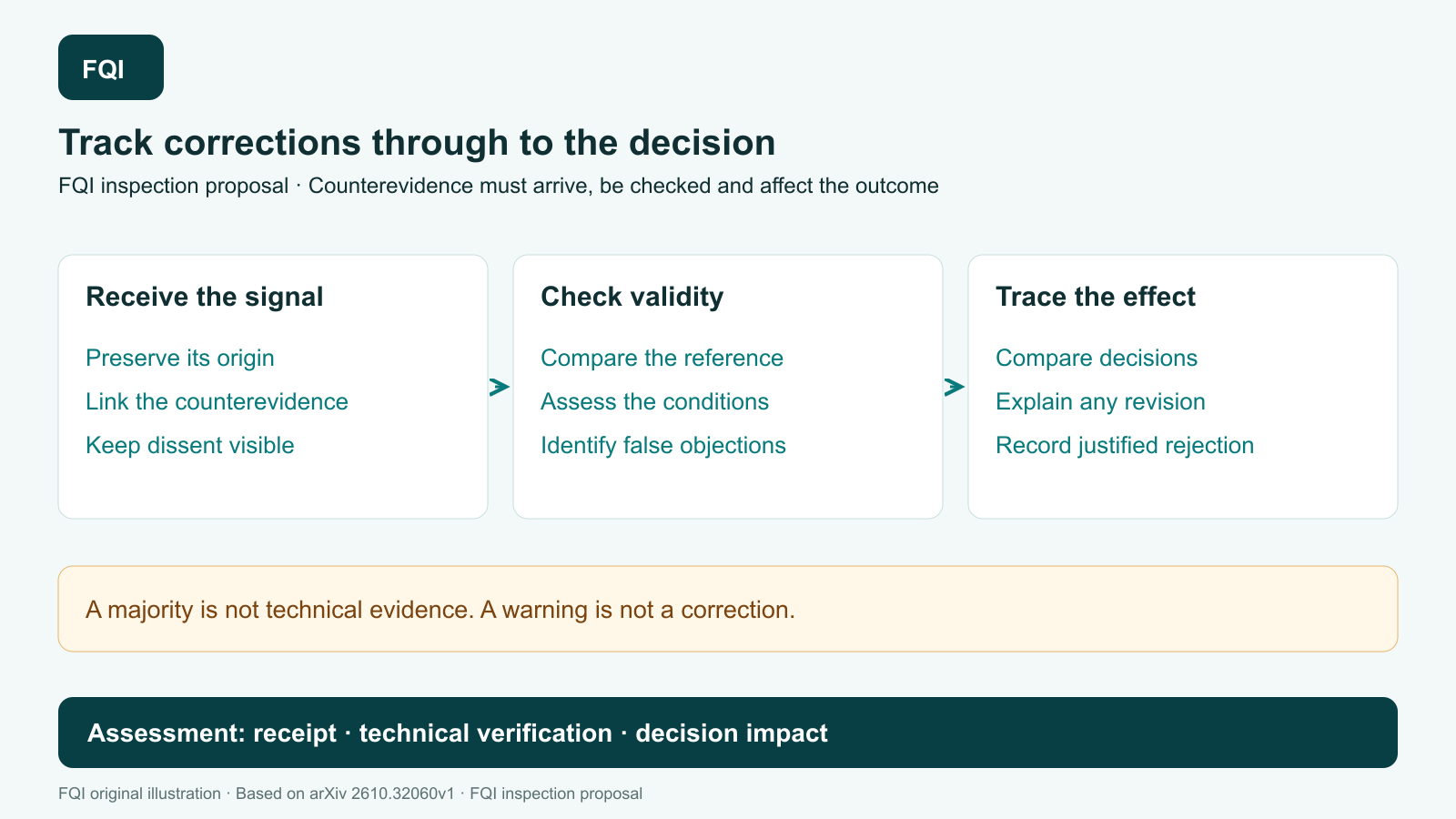
For quality management, this raises an additional question: does a technically correct observation reach the final decision? FQI proposes tracking corrections and minority positions throughout the process. The research offers a failure taxonomy and preliminary observations, but no evidence that a proposed operational intervention is effective.
FQI takeaway
- Record which counterevidence actually changes a shared decision.
- Assess technically correct minority positions independently of their vote count.
- Separate prediction of a communication failure from its successful correction.
The principle at a glance
“Understanding Communication Failures in Multi-Agent LLM Systems” examines repeated discussions between large language models. LLM stands for large language model, a system generating and revising text. These systems can compare, correct and update statements. Agreement alone does not establish that new evidence was processed.
A failure taxonomy distinguishes premature consensus, ignored corrections and persistent misunderstanding of the problem. Several categories can occur together. This creates a diagnostic tool for the process rather than an automatic declaration of a single cause.
Terms explained
- LLM: A language model whose plausible output can still contain technical errors.
- Correction effect: A demonstrable change in a decision following suitable counterevidence.
- Minority signal: A dissenting position whose correctness requires separate assessment.
Deep dive
The authors report 7,300 task instances. They build the taxonomy using 3,211 incorrect trajectories involving more than one discussion round. This selection deliberately concentrates on failures. Frequencies of individual failure categories must therefore not be interpreted as general failure probabilities for agent teams.
Human checking uses 200 randomly selected unsuccessful trajectories, each assessed by three annotators. They first describe the problems without seeing the taxonomy and then assign categories with the taxonomy available. This examines both coverage and interpretability of the classification.
A further comparison includes 500 successful trajectories. The assessment finds intermediate errors even in these successful cases. The relevant distinction is therefore not simply whether an error ever occurs, but whether the process corrects it or carries it into the final answer. The authors explicitly warn that temporal sequences do not establish causality.
In the analysis of initial majorities, correct minority answers are suppressed more often overall than they successfully shape the group decision. FQI does not infer that dissenting opinions should automatically take precedence: a minority can also be wrong. The inspection question is whether the dissenting evidence was technically assessed before rejection.
A simplified FQI example concerns a shared complaint investigation. Several agents suspect a material defect. Another finds a relevant measurement suggesting an incorrect setting instead. A sound process must retain this observation, its origin and its scope. The final account should explain why it changes the hypothesis or why it is technically unsuitable.
For a pilot, the quality team first prepares cases with confirmed correction signals. These include correct and incorrect counterevidence and observations that apply only under a particular condition. Assessment distinguishes receipt, verification and decision impact. This reveals whether the system ignores evidence, accepts it uncritically or interprets it appropriately.
The test should also include cases where the initial majority is already right. A system accepting every new objection is unreliable. Reference cases must cover both necessary revision and justified retention of the original decision. Longer discussion cannot replace this distinction.
The authors additionally test warning models on 304 discussions paired by question and correctness. They attempt to detect a failure one round before it occurs. This does not establish that an intervention triggered by the warning would remove the failure. In the FQI pilot, warning quality, actual correction effect and additional review effort remain separate outcomes.
Limitations and risks
The study focuses on communication-intensive discussions. Long tool workflows, shared files and production business processes receive limited coverage. Further language models contribute to parts of the taxonomy and annotation; shared assessment errors remain possible.
The research establishes neither the superiority of larger teams nor a general benefit from suggested interventions. The operational example is FQI interpretation and has not been experimentally tested. No independent reproduction was performed.
FQI conclusion
The ability to correct mistakes is a separate quality property of agent teams. Logged counterevidence is useful only when its validity is checked and its effect on the decision remains traceable. Another discussion round or majority vote cannot establish this alone.
Quality practitioners can start with a few technically confirmed cases and follow each correction signal. The resulting evidence shows whether the team processes errors. It complements assessment of the final answer and makes targeted improvement verifiable.
Sources & transparency
Preliminary research; no independent reproduction. Operational examples and inspection proposals are FQI interpretation. AI-assisted article, approved for publication by Johann Fischer on 2026-10-26.