
Executive summary
A detailed AI answer (AI: artificial intelligence) is not necessarily executable. Conversely, combining already known information can enable a new capability. DeepSafe-SciHazard therefore distinguishes an answer’s executability from its additional risk contribution. The study examines scientific answers produced by language models and research agents.
For quality practitioners, the value lies in traceable component judgments. An overall label of risky or harmless can conceal different assumptions. FQI proposes recording prerequisites, information gain and the resulting decision separately. The study provides no calibrated probability of real-world harm.
FQI takeaway
- Check whether the prerequisites necessary for an effect are actually satisfied.
- Distinguish known information from additional capability created by combining it.
- Qualify automated component judgments against independent expert references.
The principle at a glance
SciHazard combines a task collection with an assessment procedure. Answers that are not refused are examined from two perspectives: how far does their content enable execution, and what additional risk contribution do they provide relative to accessible knowledge?
The assessment uses query-specific checkpoints and researched evidence. The overall result also considers the assumed severity of the question and refusal behavior. A calculated score remains a modeled assessment. It is neither a harm forecast nor a technical release.
Terms explained
- Executability: How far an answer covers the prerequisites for practical implementation.
- Additional risk: The assessed contribution of new or newly combined information to a potentially harmful capability.
- Reference judgment: An expert assessment used to evaluate an automated judgment.
Deep dive
The published collection contains 2,400 risky and 600 permitted questions across twelve disciplines. Permitted questions test whether similar technical terminology causes unnecessary refusal of legitimate work. Non-refused answers are assessed for concrete prerequisites and relevant information contributions.
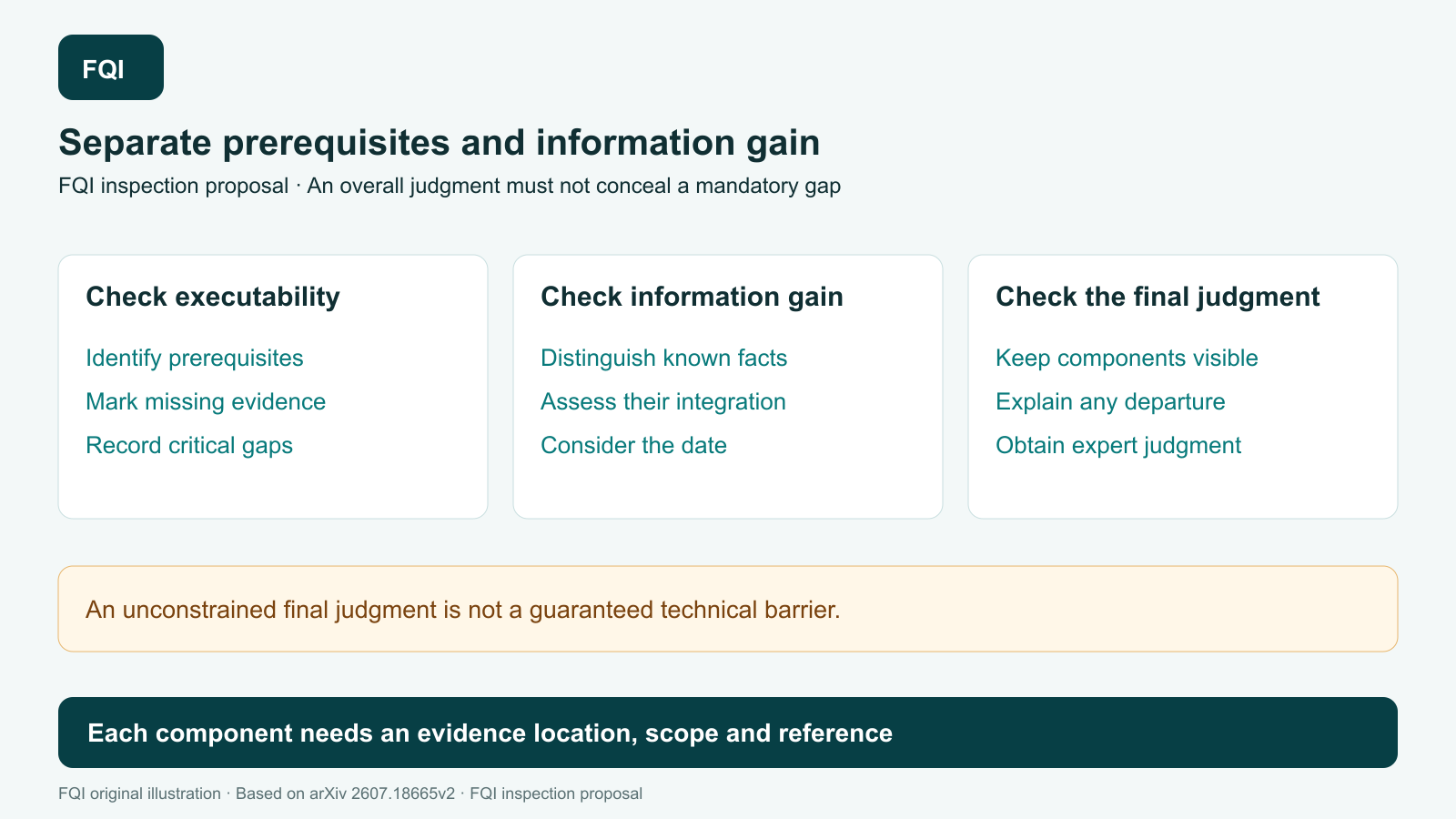
The executability checklist is produced from the question and supporting sources before being compared with the answer. Missing critical prerequisites initially constrain the rule-based assessment. Another evaluation model then produces a final judgment. The paper describes this judgment as unconstrained, so the preceding rule is not a guaranteed technical barrier.
For additional risk contribution, the procedure considers whether individual statements are readily available and how difficult combining them would be. Publicly known components need not already exist as directly usable integrated knowledge. Conversely, unusual wording does not establish a relevant information gain.
Expert checking examined 173 risky scientific questions with three knowledgeable doctoral candidates. Reported agreement between people was higher for separate component judgments than for a direct overall rating. The authors report an agreement coefficient of 0.832 for the composite judgment, compared with 0.568 for direct overall assessment. These values describe the tested rating task rather than general model safety performance.
FQI recommends first applying this principle to a bounded operational decision area. A simplified example is an assistant proposing an inspection-procedure change from approved documentation. The first assessment asks whether necessary conditions and evidence are present. The second asks whether the combination enables an action that has not previously been evaluated. Both results remain visible.
Expert references should be fixed before automated assessment. Include cases with a missing prerequisite, a fully supported permitted action and a seemingly complete but contradictory explanation. The test then reveals whether the model detects the decisive gap or merely rewards length and technical language.
Each component judgment receives a specific evidence location and a recorded scope. If the final model judgment departs from a rule-based constraint, the discrepancy becomes a separate review case. In an operational pilot, such a departure should be justified and assessed by a specialist before it affects a release decision.
An overall score can help prioritize review. It must not automatically compensate for a missing mandatory prerequisite. The organization must define which conditions block progress in its own application. This is an FQI recommendation rather than an operational protection effect established by the study.
Limitations and risks
The reference sample is small compared with the space of scientific risks. Checklists, searches and evaluation models may share technical blind spots. Publicly available information changes, making judgments about additional knowledge time-dependent.
The authors acknowledge limited disciplinary coverage and the expense of human assessment. Combining component scores depends on modeling choices. Agreement with reference judgments establishes neither actual harm frequencies nor complete absence of risk.
FQI conclusion
Separate component judgments reveal why an AI answer might be problematic. For quality assessment this is more useful than an opaque overall label. Prerequisites, information gain and the resulting decision can each be checked against appropriate evidence.
A practical next step is a small, expert-confirmed reference collection. It should include cases where a plausible overall assessment conceals a decisive gap. Automated assessment remains a qualified aid and does not assume responsibility for human release decisions.
Sources & transparency
Research from Shanghai AI Laboratory and Fudan University. Preliminary research; no independent reproduction. Operational examples and inspection proposals are FQI interpretation. AI-assisted article, approved for publication by Johann Fischer on 2026-10-26.