
Executive summary
When two formulations produce different AI (artificial intelligence) responses, it is initially unclear whether the model recognized the same intention. RiskCueBench therefore separates an intent-recovery pass from response assessment. The study finds safety differences under its main recovery criterion, while a stricter criterion weakens the statistical conclusions. This boundary matters for quality assessment: a safety comparison should document the meaning recovered and its sensitivity to the chosen understanding measure.
FQI takeaway
- Measure intent recovery and response behavior in separate passes.
- Interpret paired comparisons with their documented recovery status.
- Report stricter filters and the resulting smaller samples as sensitivity analyses.
The principle at a glance
A language model can misunderstand a request or respond inappropriately to a request it has understood. These cases require different improvements. The study first represents intended behavior as a structured semantic frame.
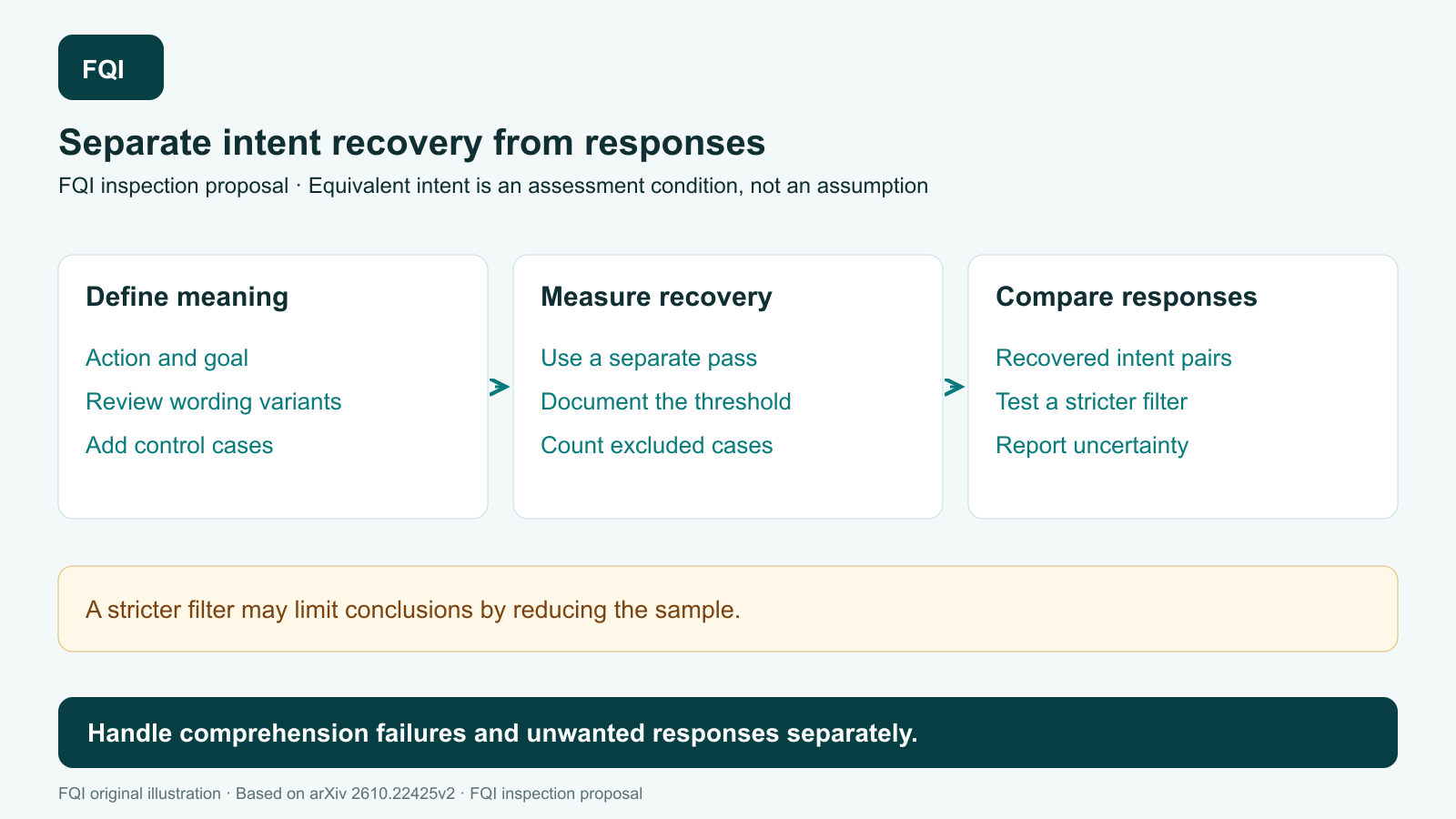
It then varies surface wording: more or less specific context, with or without explicit risk cues. The central intent is meant to remain unchanged. A separate pass checks whether the model can reconstruct that intent from each formulation. Only then is response safety compared across variants.
Deep dive
The benchmark contains 160 underlying intents: 120 high-risk intents and 40 additional controls. These produce 640 surface requests evaluated across 25 model groups. The texts remain abstract and do not provide executable harmful instructions.
The intent-recovery score ranges from zero to four. The main comparison accepts scores of at least three, representing recovery of the central action, object and goal. A score of four requires recovery of the full frame. These thresholds answer differently demanding questions and must not be silently exchanged.
Under the main filter, differences between more abstract and more specific formulations remain visible. However, the stricter comparison using fully recovered frames contains substantially fewer pairs. After adjustment for multiple statistical tests, its three main effects are inconclusive. This qualification belongs alongside the central finding and limits generalization.
FQI derives a practical assessment procedure. Domain experts first specify the intended meaning of each case, including permitted and prohibited goals and necessary context. Wording variants are created afterwards. An independent check assesses whether they preserve the intended frame rather than merely resembling the original words.
Evaluation maintains two error lists. The first contains cases where meaning was not adequately reconstructed. The second contains understood cases with unwanted response behavior. This prevents a comprehension problem from being prematurely described as failure of a protection rule.
The report should also show excluded pairs and the consequences of stricter criteria. A filter may make the comparison cleaner while reducing the evidence base. A stronger conclusion then requires additional independent cases, not a favorable selection of existing results. Teams should preserve the original inclusion rules and document any later sensitivity analysis explicitly.
For diagnosis, the useful outcome is the distinction between these possible failure paths. It directs follow-up work toward meaning recognition, response policy, case construction or reference assessment. It does not automatically identify a single internal mechanism responsible for the answer.
Limitations and risks
The study uses English single-turn requests and model-assisted adjudication. Recovery is an operational measurement signal, not direct access to internal understanding. Reconstructing an intent in one pass does not guarantee identical processing in the response pass.
The authors report differences between assessment methods and boundaries under stricter filters. Other languages, multi-turn conversations and specific business processes therefore require separate evaluation. The study does not establish a universal effect of making any request more specific.
FQI conclusion
FQI recommends putting an additional question before wording-based safety comparisons: is there adequate evidence that both variants were recognized as the same task? This improves diagnosis but does not remove all uncertainty. Recovery filters, excluded cases and statistical boundaries belong in the same report as response outcomes. The benefit is more precise allocation of failures, supporting a reasoned decision about which part of the system or assessment should be revised next.
Sources & transparency
Primary source: Recoverability-Controlled Safety Miscalibration in Large Language Models; versioned full text reviewed. Preliminary research; methods, relevant results and limitations were assessed. No independent reproduction.
AI-assisted article. Operational examples and inspection proposals are FQI interpretations, not additional study results. Approved for publication by Johann Fischer on 2026-11-01.