
Executive summary
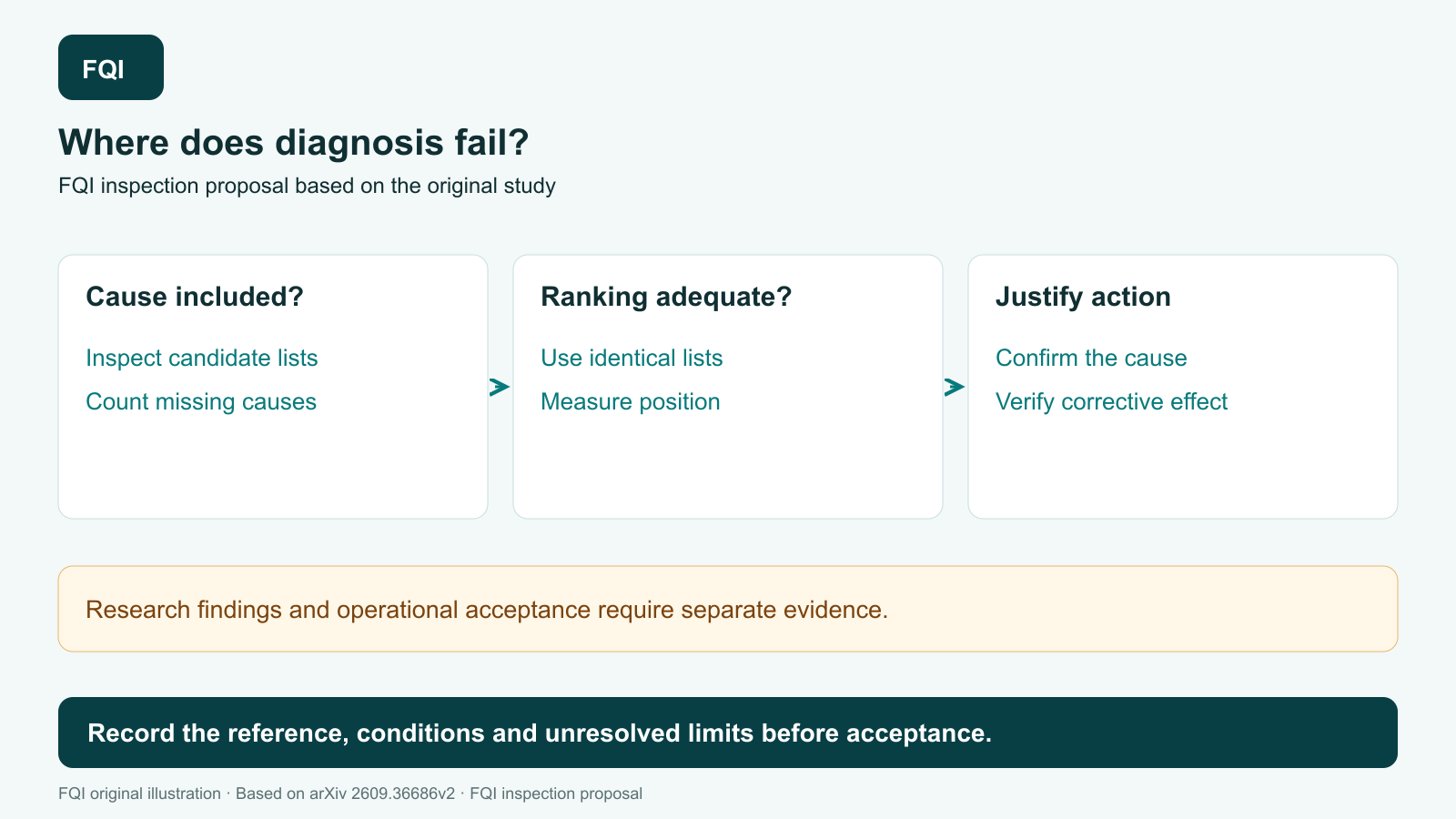
A cause list can fail because the true cause never enters the candidate set or because it is ranked too low after retrieval. A research study separates these failures in automated root cause analysis. It compares statistical methods, learned causal graphs and ranking by a large language model. For quality practitioners, the first question is whether the correct candidate reaches the model at all. The findings come from research datasets and do not replace technical confirmation of a cause in a production process.
FQI takeaway
- Measure how often the confirmed cause is absent from the candidate list.
- Compare ranking methods on the same candidates as well as end to end.
- Keep experiments that guarantee inclusion of the cause separate from ordinary runs.
The principle at a glance
Several sensors can react to one fault. Some reflect its origin; others reflect consequences. Automated diagnosis first selects relevant signals and then orders possible causes. The paper calls these stages retrieval and reranking: finding candidates and ordering them again.
The language model performs the second stage. It receives structured evidence about deviation magnitude, onset and state changes. An optional system description adds domain knowledge. Its role is to rank technical hypotheses, rather than turn any unusual reading into a proven cause.
Deep dive
The authors use four dataset families containing six evaluation suites. Three represent distributed software services. The industrial suites cover water distribution, water treatment and building systems. The distinction matters: an injected software fault may produce a strong local deviation, while a physical fault may appear as a state change or an expected change that never occurs.
With a budget of 15 candidates, deviation magnitude alone retrieves the cause in nearly all cases in the software suites. In the industrial suites, it retrieves roughly 35 to 64 percent. A better language model cannot rank a cause that never appears in its input.
Complementary signals help differently across datasets. One timing-based improvement depends on the ordering of tied onsets. The tie-breaking rule therefore belongs in the evaluation record. Treating every timing gain as a stable property would overstate the result.
The researchers also guarantee a place for the true cause and ask all methods to rank identical pools. This isolates ranking performance. With a system description, the language model improves on the compared baselines in this controlled setting. However, guaranteed inclusion makes this a different task from an ordinary end-to-end investigation. Additional domain information also means that the gain cannot be attributed solely to the model.
FQI proposes a two-stage inspection record. For known faults, record whether the confirmed cause enters the candidate list and then record its position. Freeze the data window, candidate budget and system description. This lets the process owner decide whether to improve information coverage, the selection rule or the ranking method. It is a practical interpretation of the research, not a demonstrated industrial improvement.
Limitations and risks
Some industrial suites contain only a few dozen cases. Their scores are not general success probabilities for manufacturing plants. The methods do not all consume the same types of additional knowledge. A correct ranking also does not establish a causal mechanism in a new process; corrective action needs further technical evidence. This is a preprint, and FQI has not independently reproduced its experiments.
FQI conclusion
The strongest contribution is a way to locate information loss in diagnosis. A poor final score does not automatically justify replacing the model. Check the candidate set first, then the ordering. Separate records make improvement work more targeted and prevent controlled experiments from being mistaken for operational performance. The final decision about a cause and a corrective action must remain tied to corroborating process evidence.
Sources & transparency
- Where Root Cause Analysis Fails: A Retrieval-Reranking Decomposition · Full text
- arXiv · Version history
Codex drafted this article and checked the cited original sources. FQI applications are editorial interpretation; the experiments were not independently reproduced.
Codex assisted with drafting and checked the claims against the cited original sources. Johann Fischer authorized publication on 2026-11-18.