
Executive summary
Checking a data handoff early can catch errors sooner without substantially improving an AI (artificial intelligence) system’s answers. A study of multistage language-model workflows separates these effects by comparing architectures. This matters for quality assurance because a control needs a success criterion that matches its purpose.
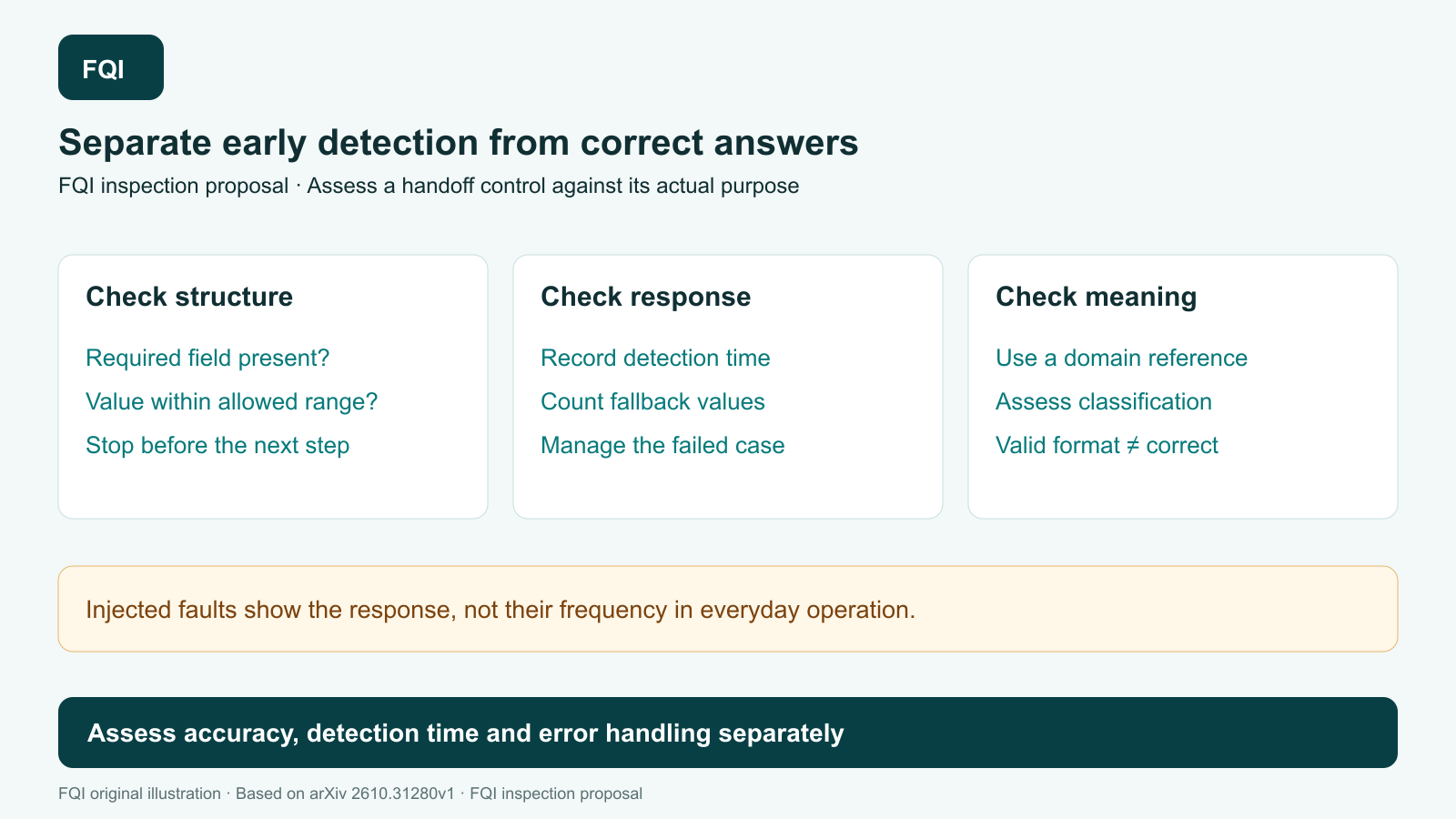
FQI proposes assessing answer accuracy, detection time and handling of unusable results separately. Higher overall performance alone does not establish which component produced the improvement or whether the handoff control performed its intended role.
FQI takeaway
- Compare task decomposition and handoff validation through separate variants using the same cases.
- Insert known errors into intermediate values to test when they are detected and what happens next.
- Count fallback values, omitted cases and retries as part of total process performance.
The principle at a glance
A large language model (LLM), a system that generates text from learned patterns, first classifies requirements. A subsequent call processes that intermediate result. A typed handoff specifies permitted fields, data types and value ranges in advance.
In a simplified FQI example, an assistant classifies a deviation report and then proposes an action. A number outside its permitted range can be detected structurally. A correctly formatted but substantively wrong classification can pass the same check. These errors require different references.
Terms explained
- Typed state: An intermediate result with an explicitly defined structure and permitted values.
- Schema: The testable description of that structure, including required fields and boundaries.
- Fault injection: Deliberately inserting known errors in a test environment to observe a control’s response.
Deep dive
The work compares a single model call with two variants using two calls. One passes an unchecked intermediate state; the other validates it earlier against fixed requirements. Evaluation uses three small language models and a requirements dataset. The additional accuracy difference associated with typed state is small and statistically significant in only one of six comparisons.
A separate campaign with 13 injected faults demonstrates earlier detection. This establishes a particular control benefit, not the frequency of those faults in everyday use. The architectures also share parts of their error handling, so every observed difference cannot be attributed exclusively to typing.
For an operational pilot, FQI recommends a precise control claim. For example, an invalid intermediate value should be detected before a chargeable subsequent call starts. Define the error response and where it can be observed. “More quality” would be too vague as an acceptance criterion.
Build a small fault catalogue covering absent required fields, invalid values, conflicting field combinations and structurally valid substantive errors. Assign an expected outcome to each probe. A technical error may require a controlled stop; a validly structured but incorrect answer requires a separate check. This makes each control’s actual coverage visible.
Log the first detection point, work already performed, resources consumed and final case status. An error must not silently become a plausible default answer. Likewise, a lost case must not disappear from the denominator of a success rate. Decide beforehand when to correct, retry or refer the case to a domain expert.
Assess meaning separately on expert-confirmed reference cases. Check whether the classification is correct and the proposed action fits the case. Agreement between several models does not establish correctness without such references. Include examples that meet all structural rules while making a false substantive claim.
Keep model version, inputs and scoring rules as constant as possible across variants, and record unavoidable differences. This component comparison is an FQI proposal. The study does not establish the general superiority of multistage workflows.
Limitations and risks
The investigation covers one dataset and a small model group. Task decomposition, wording and other workflow details sometimes change together. Repeating an experiment with a newer server version also limits direct comparability.
Injected faults demonstrate responses to selected probes, not real-world error rates. Some prioritization analysis uses agreement without an independently correct ranking. FQI did not reproduce the results.
FQI conclusion
A handoff check should be assessed against what it can control: permitted structure, timely detection and managed error handling. Substantive correctness needs an additional reference assessment. This distinction prevents exaggerated accuracy claims while recognizing useful controls whose value lies in stopping sooner.
A small, traceable component comparison provides more decision support than a single aggregate score. It shows which control handles which fault and identifies the remaining checks needed before an operational release.
Sources & transparency
- Zuppardo and Garcia: Beyond Accuracy; version 1, sections 4–5, 6.5–6.6 and 7–8.
Reported research; no independent reproduction. The fault catalogue and operational component comparison are FQI proposals. AI-assisted article, approved for publication by Johann Fischer on 2026-10-24.