
Executive summary
When artificial intelligence (AI) assigns complaints or interview passages to categories, examples and instructions affect the result. Smart Coder investigates a structured workflow with a human reference. FQI derives an organizational acceptance rule: cases used to improve instructions must not also serve as independent evidence of success. Repeated answers can reveal unstable assignments, but they cannot replace a technical reference. The following operational proposal applies this idea to quality assurance of text analysis.
FQI takeaway
- Separate development examples from an untouched acceptance sample.
- Send unstable assignments for targeted human assessment.
- Report agreement by category and for complete documents separately.
The principle at a glance
Text coding assigns statements to categories using defined rules. A codebook describes meanings, boundaries and examples. In the studied approach, a language model performs assignments under human guidance. The study uses 72 interview transcripts: twelve for development and calibration and 60 for evaluation. It compares instruction and response strategies, reporting larger differences from refined instructions and smaller, topic-dependent effects from repeated answers.
Deep dive
The following FQI proposal uses complaint analysis as a simplified example. Categories might include packaging, delivery condition and functional deviation. Before testing, a technical team determines whether several categories may apply simultaneously. It must also decide how to handle a suspected cause. A complaint about a damaged component does not automatically establish a packaging defect.
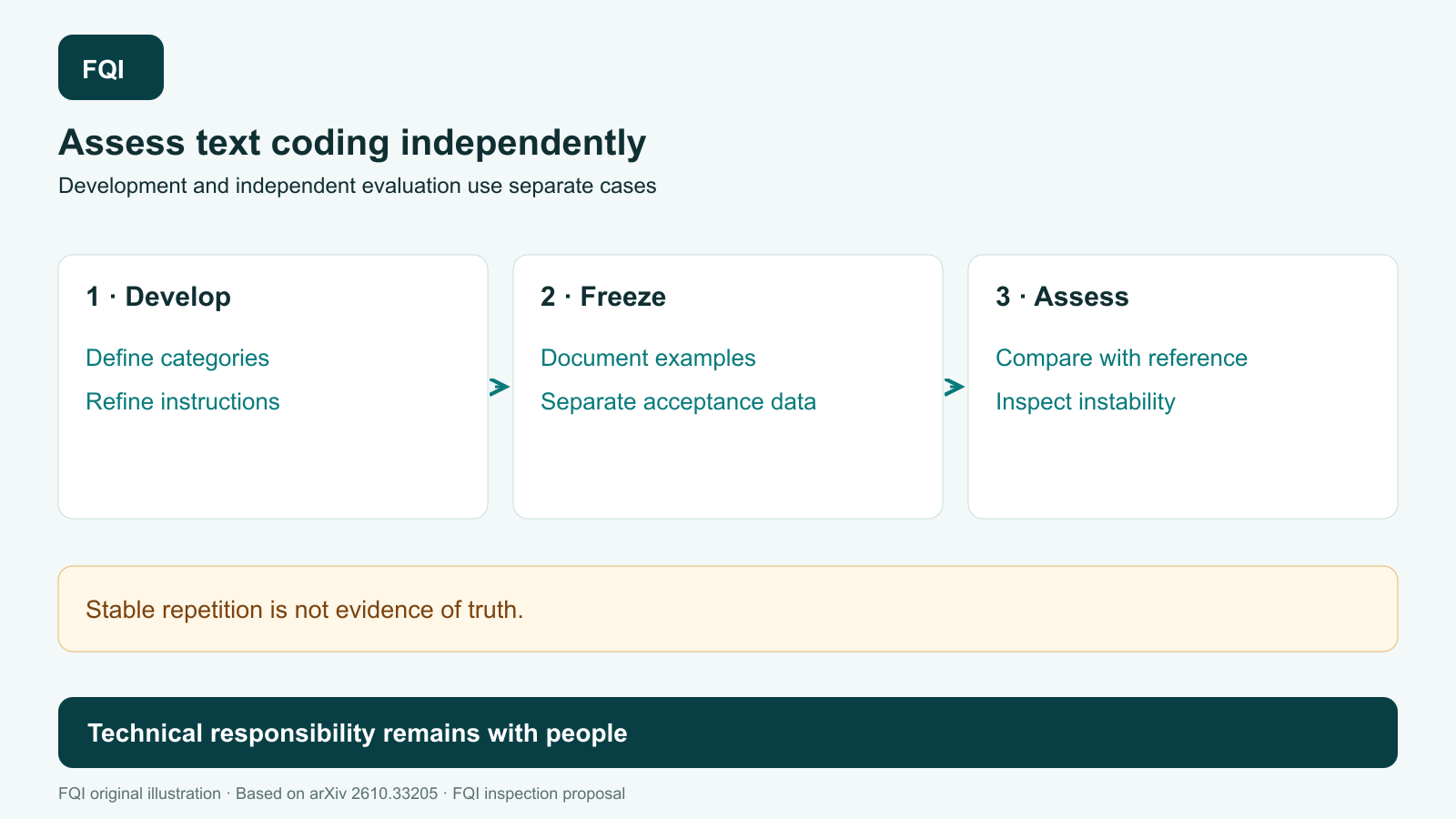
Development cases should include common expressions and difficult boundaries. For each example, record the relevant passage and the assignment rationale. Version changes to the codebook. Better performance on these known cases initially shows that instructions were adapted to them, not that new complaints will be handled correctly.
Prepare a separate acceptance sample. Responsible specialists assess these cases without seeing an AI answer as an initial suggestion. Record disagreements and resolve them technically. The result is a justified reference for this experiment, not infallible truth. Especially disputed cases should remain separately visible in the report.
The AI then receives the frozen instruction revision. One overall score is insufficient. Check which categories are missed or assigned too often and how many documents have every category correct. A frequent, easy category must not conceal errors in a rare but consequential deviation.
Use repeated answers as an additional diagnostic. If a case switches between categories, human assessment is warranted. A consistently wrong assignment does not become valuable through stability. Repeated votes must therefore not be treated as independent expert judgments.
Following acceptance, specify which decisions still require human confirmation. A new product group or complaint language needs another sample. Revised instructions also create a new configuration. Document model identity, codebook, examples and evaluation rules together. This makes later changes reviewable and prevents an old result from being silently attached to a different workflow.
Limitations and risks
The source studies one educational dataset and one model. Its comparisons are descriptive and do not establish general superiority for industrial texts. Human consensus remains tied to the codebook. Author affiliations include Rethink Learning Labs. The voluntary NIST (National Institute of Standards and Technology) risk-management framework independently supports documented roles and context-specific assessment; it confirms no product performance. FQI has conducted no coding experiments.
FQI conclusion
AI text analysis becomes more reviewable when development, reference construction and acceptance are separate responsibilities. FQI recommends starting with a small frozen codebook and distinct case sets. Alternative instructions can then be compared meaningfully. Instability is a useful warning, but stable repetition is not proof of correctness. Responsibility for meaning, boundaries and assignment consequences remains with the people accountable for the process.
Sources & transparency
Methods, evaluation and limitations reviewed on 3 November 2026. Scientific preprint; no independent reproduction by FQI. Operational examples and inspection proposals are FQI interpretations, not additional experiments in the study. Artificial intelligence assisted preparation. Johann Fischer explicitly approved this article package for publication on 2026-11-04.