
Executive summary
Artificial intelligence (AI) supports the tasks described here.
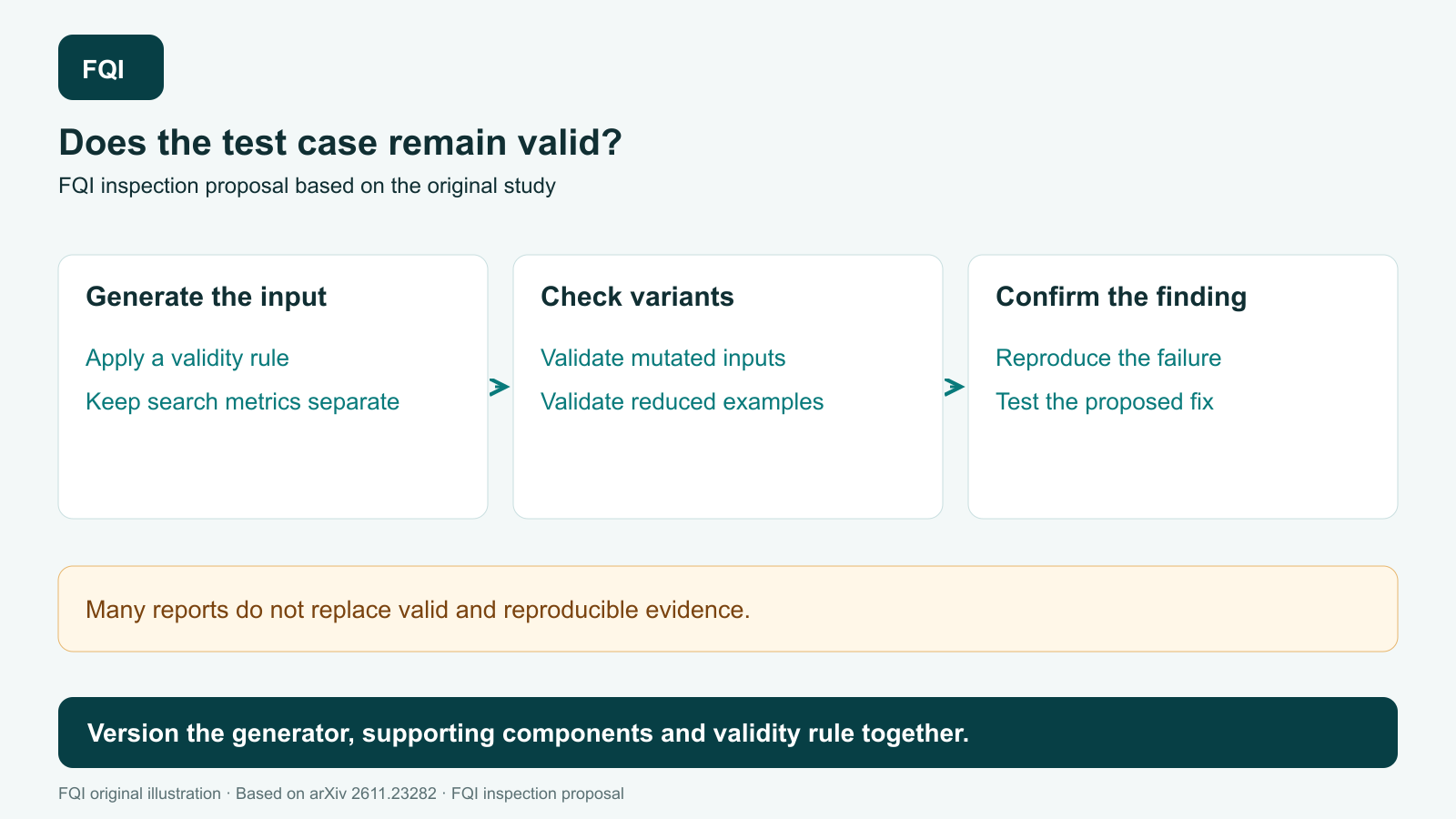
AI can write programs that generate many software tests. The quality question then shifts from individual cases to the generator and its supporting components. Ephyra describes a library that checks generated inputs, mutations and reduced failure examples against explicit validity rules. For FQI, search effectiveness and correct test construction must be evaluated separately. A large number of findings becomes useful only when the tests are valid and the failures reproducible.
FQI takeaway
- Define validity independently of the desired bug discovery.
- Check mutated and reduced inputs as well as generated ones.
- Keep reproducible evidence separate from the handling status of a finding.
The principle at a glance
Property-based testing checks a general requirement against many automatically produced inputs. A generator produces the inputs, a mutator changes them to explore further cases, and a shrinker reduces a failing case to a simpler example.
Each component can be faulty. A generator may create invalid files; a shrinker may lose the condition that caused the failure. Ephyra combines AI-assisted component synthesis with executable validity checks and observable search metrics. The intended process is a controlled loop of proposal, testing and improvement.
Deep dive
The paper describes programmable combinations of generation, mutation and shrinking. A validity predicate is an executable function that accepts or rejects an input. Separate search metrics can measure input characteristics or reached program regions. A metric used to improve search and a rule establishing admissibility serve different purposes.
The described component check normally examines 10,000 generated inputs. It additionally checks initial shrink candidates, repeated shrinking, several mutations and finite metric values. These are bounded dynamic tests, not a mathematical proof covering every possible input. Their value is to detect component defects before a larger campaign.
In preliminary studies across 14 open-source systems, the authors report 349 found bugs and 300 submitted reports. These are author-reported totals for the overall effort, not a controlled estimate of productivity improvement. Campaigns differ in steering, budget and target system.
For FQI, the follow-up verification is more useful than the total count. A finding is replayed, reduced and tested against a proposed fix. Known issues, invalid tests and genuinely new defects must be distinguished. If the expected verdict is wrong, the test setup needs correction rather than an unsupported accusation against the software.
An operational pilot might generate valid interchange files for an interface. A validity rule checks the agreed format, while a separate property checks that reading and rewriting preserve relevant content. This is a simplified FQI illustration. Generator, rule and reference implementation should not all be accepted from the same unchecked AI answer.
The voluntary NIST (National Institute of Standards and Technology) AI RMF Playbook recommends independent assessment roles under MEASURE 1.3 and documentation of tests, metrics and tools under MEASURE 2.1. This supports the proposed review discipline; it does not substantiate Ephyra’s performance figures. Independent checks should examine the specific findings and validity rules needed for the intended use.
Limitations and risks
The paper comes from the presented tool’s development environment and reports preliminary case studies. Linked individual findings improve inspectability but do not replace an independent equal-effort comparison. A reference implementation can itself be wrong. Greater code coverage also does not guarantee better coverage of substantive requirements. Validate the relevant evidence in the intended setting before choosing a tool. FQI has not independently reproduced the experiments.
FQI conclusion
An AI test generator should be treated as a changing inspection instrument. Its qualification binds the generator, validity rule, supporting functions and documented test scope. Ephyra’s useful contribution is joint checking of generation, mutation and shrinking. This helps prevent an initially valid test from losing its meaning while becoming a persuasive small example. Finding counts remain secondary to evidence that is reproducible, substantively valid and attributable to the correct cause.
Sources & transparency
Source 1 · Source 2. Author manuscript accessed on 20 November 2026; methods, experimental setup, results and limitations reviewed. Findings and FQI proposals are distinguished above. AI-assisted editorial draft, checked by Codex; no independent replication.
Codex assisted with drafting and checked the claims against the cited original sources. Johann Fischer authorized publication on 2026-11-20.