
Executive summary
Artificial intelligence (AI) supports the tasks described here.
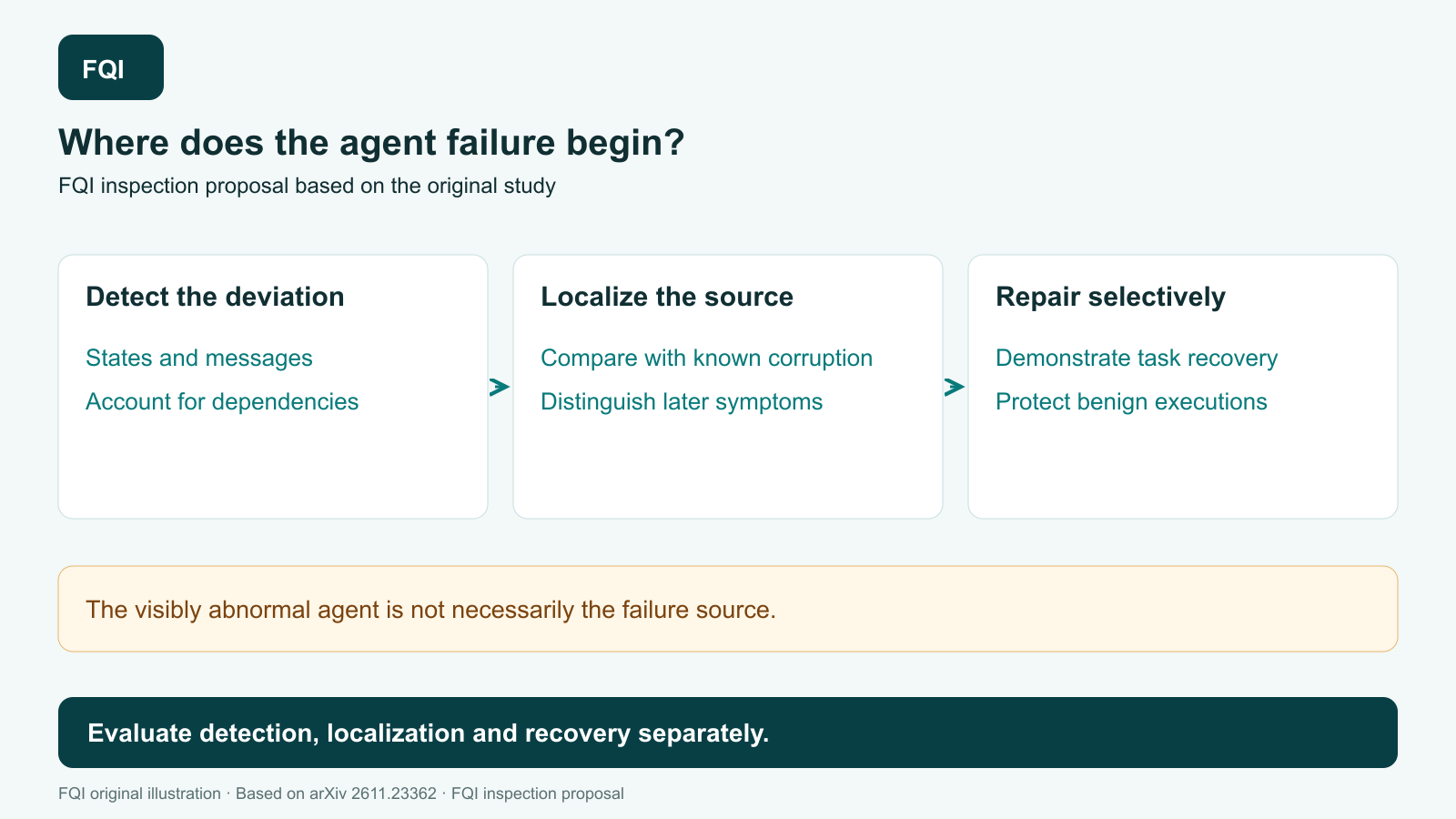
A faulty message in an AI agent team can influence several downstream responses. The last visibly abnormal agent is therefore not necessarily the failure source. TRACE-MAS studies this distinction using a learned model of normal collaboration that covers agent states, messages and task dependencies. For FQI it suggests a concrete evaluation sequence: detect the deviation, localize its possible source, and assess a bounded intervention by the task performance it actually restores.
FQI takeaway
- Record messages and task dependencies as well as agent answers.
- Evaluate detection and source localization against separate references.
- Check preserved task capability after an intervention.
The principle at a glance
An agent team distributes roles and exchanges intermediate results. An unusual answer may originate in an agent’s state, an altered incoming message or an incorrect task order. Monitoring agents alone conflates these causes.
TRACE-MAS learns compatible state changes, message transitions and task progress from benign executions. It follows deviations through an event graph that records dependencies. The method then looks for the event whose restoration best explains the reduction of downstream deviations. Its learned reference describes collaboration, not merely the wording of one agent’s reply.
Deep dive
The authors evaluate five benchmarks involving multi-agent inference, information retrieval and tool use. Controlled corruptions target agent states, exchanged messages or task dependencies. Competing methods share underlying language models, workflow templates, corruptions and data splits. The comparison is intended to isolate the monitoring approach rather than differences between the underlying systems.
Evaluation separates three questions. Was a corrupted run detected? Was the injected source localized? Did intervention restore collaboration without unnecessary loss of capability? A strong result on detection does not answer the other questions. That separation is the most useful element for operational qualification.
To localize a source, the method models the restoration of candidate events within its learned representation. It scores the resulting reduction in downstream violations. Intervention selection then considers remaining violations, unsatisfied task steps and edit costs. A small edit is not automatically useful: it must also restore enough of the intended task.
For an FQI pilot, first define known corruption points in an isolated copy of a workflow. For example, a correct analysis might be passed to the next agent through a deliberately altered message. This is a proposed test case, not an observed failure of a particular production system. The reference must identify the transition that was actually changed.
The review record should place the detection decision, proposed source, selected intervention and final task result side by side. Include benign control runs too. A monitor that repeatedly changes correct exchanges can harm the process even if it looks effective on deliberately corrupted runs. Assess intervention authority only after an observation-only pilot.
Preserve both the original and repaired execution. If the final answer improves, verify whether required intermediate steps were retained rather than bypassed. Record the scope of changed branches and any loss of intended capability. This makes recovery an independently assessable result instead of an unexamined consequence of the detector’s confidence.
Limitations and risks
The learned normal pattern depends on training records and workflow structure. New roles or legitimate rare executions may look anomalous. Model-internal restoration is not a general causal guarantee for real organizations. The paper uses controlled tasks and interventions, so its performance cannot be transferred directly to operational corrective-action or audit workflows. FQI did not conduct independent experiments for this article.
FQI conclusion
An agent-team investigation should not stop at the visibly abnormal participant. TRACE-MAS offers a concrete way to include handoffs and dependencies in diagnosis and intervention selection. Its useful distinction is between the observed deviation, its source and the repair point. A bounded pilot remains essential: localize known corruptions, protect benign runs and measure actual task performance after intervention. Only then can automatic repair authority be assessed responsibly.
Sources & transparency
Source 1. Author manuscript accessed on 20 November 2026; methods, experimental setup, results and limitations reviewed. Findings and FQI proposals are distinguished above. AI-assisted editorial draft, checked by Codex; no independent replication.
Codex assisted with drafting and checked the claims against the cited original sources. Johann Fischer authorized publication on 2026-11-20.