
Executive summary
Artificial intelligence (AI) supports the tasks described here.
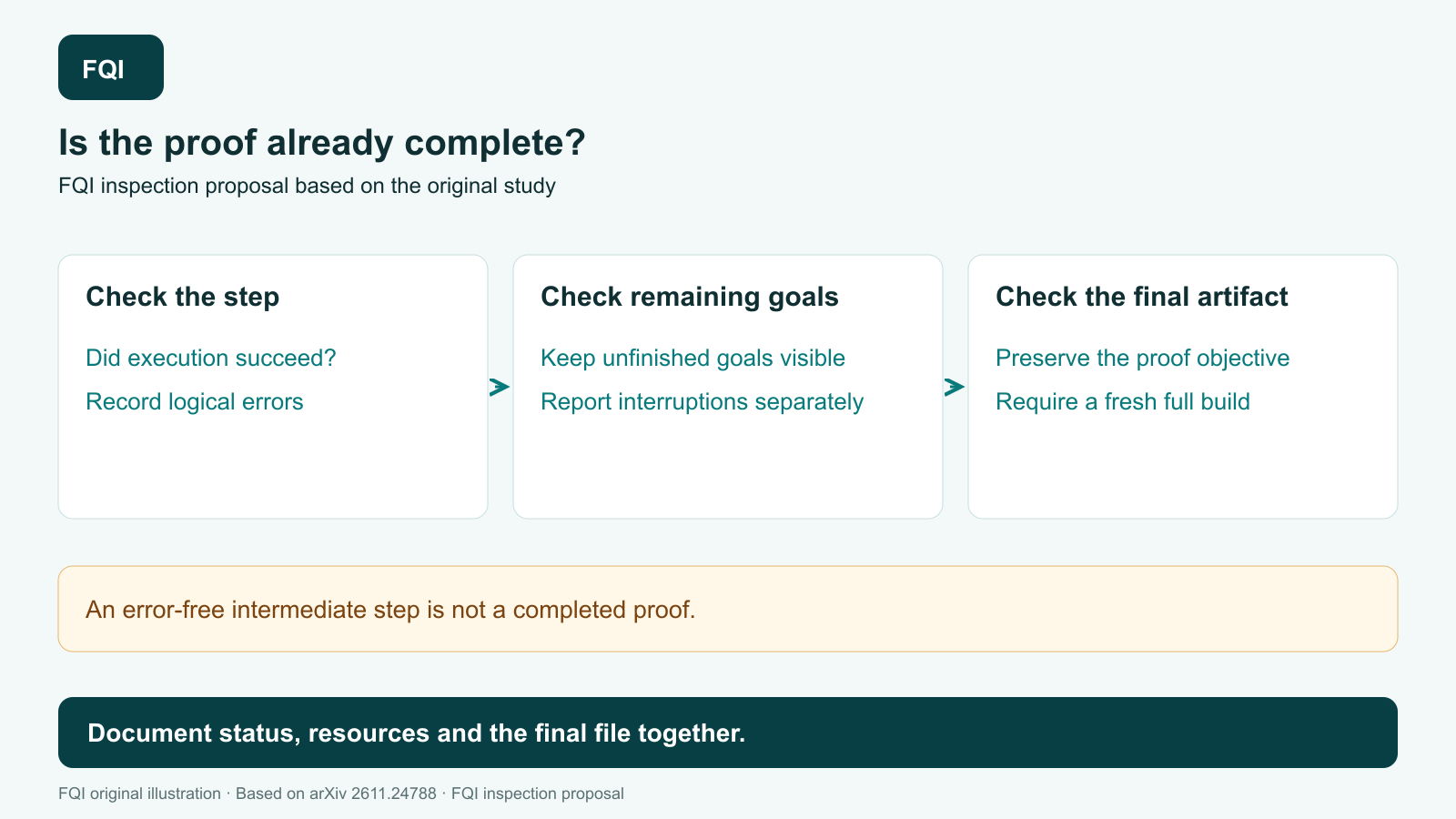
AI agents can construct formal proofs incrementally and ask a proof assistant to check each step. Isabelle Pool Server studies how a verification service can reliably support several such agents. Throughput is only part of the quality question. A reply must distinguish a failed step, remaining proof goals and a fresh check of the complete file. These separate states are necessary for a defensible approval decision; a successful request alone is not a completed proof.
FQI takeaway
- Separate successful execution, reported errors and complete proof closure.
- Set explicit time and resource budgets for each request.
- Use a full build from scratch as the final check.
The principle at a glance
A formal proof assistant checks deductions against fixed logical rules. An AI agent can call it through an interface, try intermediate steps and restore earlier states. A successful call does not necessarily mean the originally requested theorem has been fully proved.
The proposed service manages prepared Isabelle sessions. A client temporarily holds exclusive access to a session, and abandoned sessions can be reclaimed. Memory-aware admission and request time budgets constrain resource use. The AI connection is reliable verification of machine-generated proof steps and concurrent proof search.
Deep dive
The work describes interfaces for individual steps, larger proof blocks and complete-file verification. Checkpoints allow branching and backtracking. A fresh complete build remains the final reference. This separates rapid interactive feedback from verification of the final artifact as a whole.
In one comparison, interactive verdict flags agree with complete-build results on all 890 examined checks. This is evidence for the documented corpus and software version, not proof that every possible interface state is correct. The paper also measures throughput and behaviour under memory pressure. Prepared-session throughput and session startup cost must be interpreted separately.
An FQI verification record for agent-generated proofs should capture the requested proposition, file version, imported foundations, return status, open goals and final build result. A timeout must remain visible as an undecided attempt. It should not silently become either a refutation or a successful proof in the reported success rate.
Restoration and concurrency also need counterchecks. A deliberately failing attempt should not contaminate a later correct attempt through leftover state. Two clients must not accidentally share a session. These are proposed qualification tests derived from the architecture, not experiments performed for this article.
Resources belong in the same record. Refusing a new session because memory is exhausted is different from finding a logical proof error. Otherwise, a model comparison partly measures the load on the verification host. Fixed budgets and explicit failure categories make repeated evaluations more comparable.
The final artifact must still correspond to the requirement being approved. Even a complete build can verify the wrong statement if an agent weakened or replaced the original proposition. Preserve that proposition and compare it with the final file alongside the technical status. A proof service supports assurance; it does not decide whether the chosen requirement is appropriate.
Limitations and risks
Measurements are tied to particular versions, hardware and comparison commits. Architectural limits include fixed imports per session, no full multi-file project view and a shared central runtime component. The paper states that the service has no built-in authentication and is intended for a trusted network or an authenticating proxy. Formal verification establishes only the encoded proposition, not its substantive suitability. FQI has not independently reproduced the results.
FQI conclusion
A proof-checking service is itself an instrument that needs qualification. Its status and resource errors must be clear enough that an AI agent cannot turn them into premature success claims. The useful transfer is the separation of interactive assistance from the final fresh build. An error-free intermediate step remains intermediate. Only documented completion of the unchanged proof objective on the final file can support the corresponding claim in an approval record.
Sources & transparency
Source 1. Author manuscript accessed on 20 November 2026; methods, experimental setup, results and limitations reviewed. Findings and FQI proposals are distinguished above. AI-assisted editorial draft, checked by Codex; no independent replication.
Codex assisted with drafting and checked the claims against the cited original sources. Johann Fischer authorized publication on 2026-11-20.