
Executive summary
Artificial intelligence (AI) supports the tasks described here.
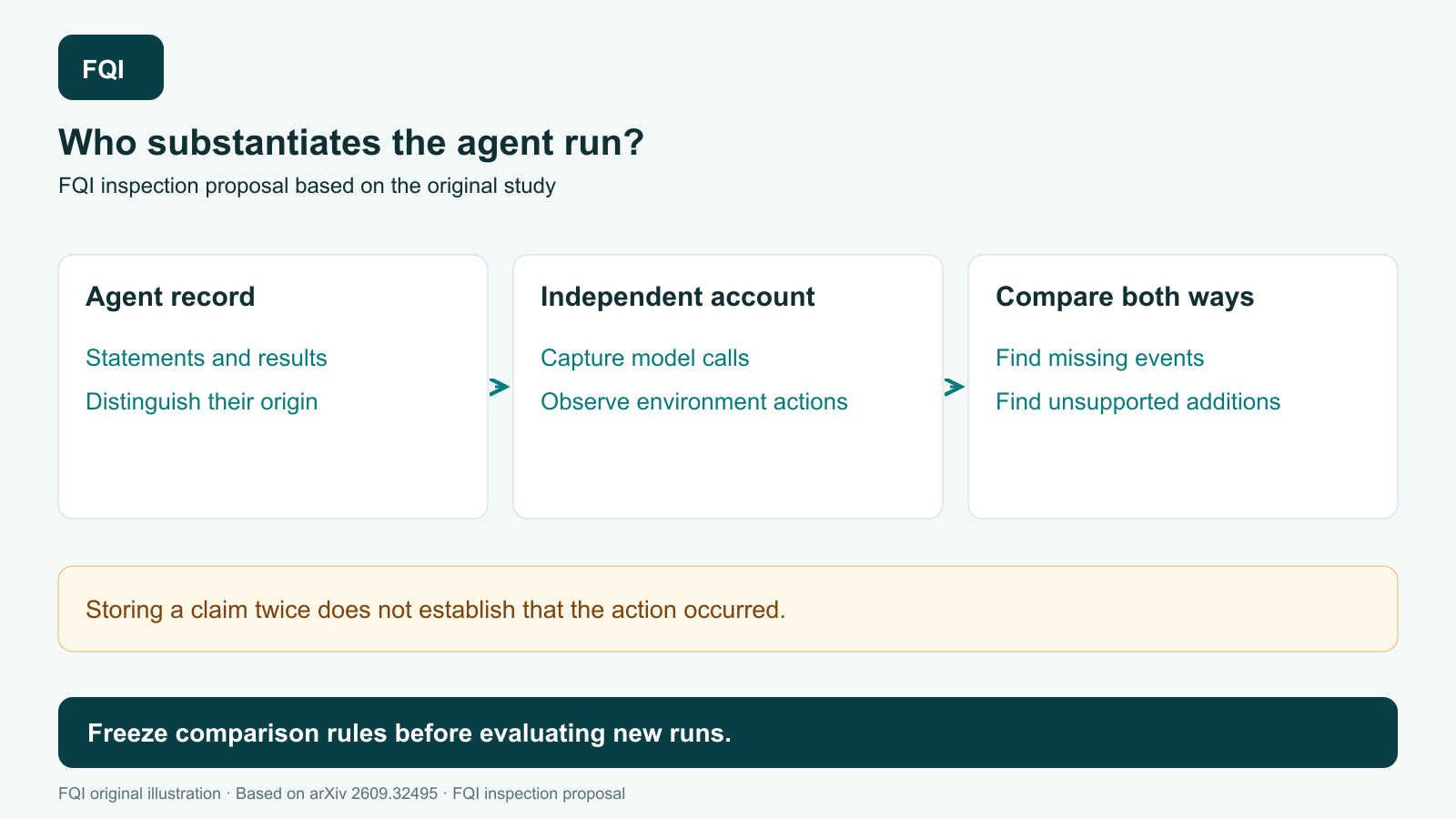
A well-formatted agent record can be incomplete or false. Hearsay examines how reliably people and language models can audit an AI agent from such records. Its central distinction matters: protection against later alteration does not establish that the record was accurate when written. Quality audits therefore need a concrete additional control. Important model calls and environmental actions should have a second account outside the component whose behaviour is being examined.
FQI takeaway
- Distinguish agent narration, filed tool output and independently observed execution.
- Compare the two accounts in both directions.
- Freeze legitimate exceptions before evaluating new runs.
The principle at a glance
An agent’s runtime controller determines which model replies and tool actions appear in its record. The same controller may omit outputs or add statements of its own. A chain of cryptographic hashes can protect the written record against certain later changes, but cannot establish its original completeness.
Hearsay therefore introduces a second writer at two boundaries: between controller and model, and between controller and execution environment. This account is outside the examined controller’s control. It provides the technical basis for comparison rather than merely asking another language model to read more carefully.
Deep dive
The study examines five agent controllers on 14 tasks with several driving models. Readers reconstruct actions, identify the fault and detect record changes. The evaluation also tracks who authored each cited piece of evidence. A reader might correctly infer a fault from the final code without substantiating the claimed sequence of actions.
The independent account enables two mechanical comparisons. One finds events recorded outside the controller but missing from its record. The reverse comparison finds record content without a corresponding entry in the independent account. Both directions are necessary because omissions and unsupported additions are different failure classes.
A particularly informative additional experiment fixes the comparison rules and exceptions before generating new runs. The authors report detecting 64 changes among 66 manipulated comparison cases. This result should not be combined indiscriminately with earlier trials in which parts of the exception list were refined after inspection. The order of rule development and evaluation affects what a false-alarm estimate demonstrates.
An FQI audit trial would execute a representative workflow from a fixed task state, preserve both accounts separately, and introduce controlled omissions and invented success statements into copies used for testing. Each reviewer receives only the record being assessed. The comparison rules must already be frozen before that trial begins.
An externally recorded model statement still demonstrates only that the model emitted those words. If it claims that a test passed, the test process and result need their own evidence. Copying an unsupported assertion into a second storage system does not transform it into independent confirmation.
For each audit finding, preserve the disputed statement, its source, the corresponding observed action and the rule that identified the disagreement. This makes the finding reviewable without relying on a summary written by the same agent. It also helps distinguish a genuine omission from information that the record format legitimately represents elsewhere.
Limitations and risks
The approach trusts the operator of the independent account and assumes the monitored boundaries cannot be bypassed. Format-specific parsing rules and exemptions may leave gaps. The experiments cover selected software tasks, not arbitrary organizational agent workflows. A complete record proves neither the quality of a change nor the safety of executed code; those require separate checks. FQI has not independently reproduced the experiments.
FQI conclusion
The evidential strength of an agent record depends on provenance. Who wrote a statement, and what independent observation supports it? Hearsay adds a question that precedes familiar concerns about record detail: did the runtime controller record the execution truthfully in the first place? An independent account with predetermined comparisons makes that gap testable. It still needs an explicit trust boundary and must not be presented as an all-purpose quality certificate.
Sources & transparency
Source 1. Author manuscript accessed on 20 November 2026; methods, experimental setup, results and limitations reviewed. Findings and FQI proposals are distinguished above. AI-assisted editorial draft, checked by Codex; no independent replication.
Codex assisted with drafting and checked the claims against the cited original sources. Johann Fischer authorized publication on 2026-11-20.