
Executive summary
Artificial intelligence (AI) supports the tasks described here.
When a language model grades responses against a point-based rubric, the structure of the rubric affects the result. A study of three medical benchmarks splits bundled requirements and regrades the same responses. Scores sometimes shift substantially although the responses remain unchanged. For FQI this is a measurement qualification issue: before using a total score, decide whether requirements must all be satisfied together, are genuine alternatives, or should receive partial credit.
FQI takeaway
- Identify joint mandatory requirements and genuine alternatives explicitly.
- Compare original and split criteria on identical responses.
- Separate score shifts, rankings and substantive correctness.
The principle at a glance
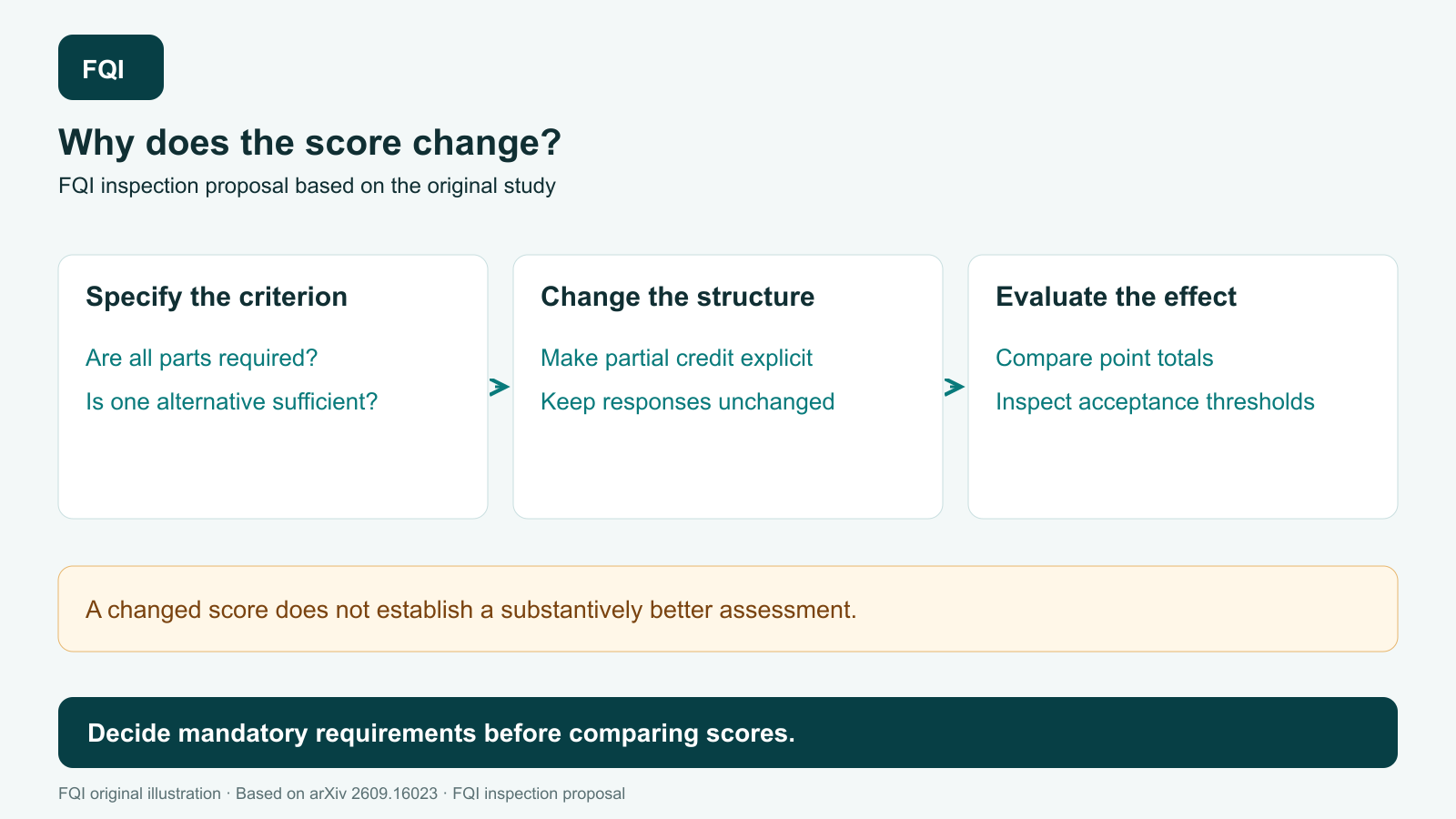
A grading rubric assigns points to requirements. A bundled criterion may require all its components, or accept any one of them. Splitting it into equally weighted individual criteria changes the opportunity to earn partial credit.
For positive points, splitting a conjunctive requirement can reward partially correct answers more generously. Splitting an alternative can reduce an answer’s formerly full credit. Penalties can reverse the direction. More detailed criteria therefore do not automatically constitute better measurement.
Deep dive
The authors apply a failure taxonomy to HealthBench Professional, LiveMedBench and MentalHealthBench. Language models flag issues including bundled and poorly aligned criteria. The study then experimentally changes bundling: one criterion containing independent components becomes equally weighted child criteria. Responses and grading model remain fixed for the paired comparison.
The authors report shifts of up to 15.9 percentage points on affected conversations. Across six answering models and two common grading models, these shifts do not change the ranking. A changing score therefore does not automatically imply a different model selection or improved measurement of answer quality.
Detection of questionable criteria is itself uncertain. Different language-model judges flag substantially different proportions. The paper does not treat those rates as human-established prevalence estimates. An automated rubric audit produces candidates for expert review, not unquestionable findings.
An FQI transfer is a controlled comparison for inspection reports or proposed corrective actions. Select responses with an existing expert assessment, freeze their text and change only the scoring structure. Then document which partial credits arise and whether any response crosses the operational acceptance threshold. The link to the actual decision matters more than an abstract change in average score.
Experts must decide in advance which bundles are intentional. A mandatory safety requirement must not accidentally become compensable through points earned elsewhere. This is an FQI inference about evaluation design, not clinical guidance from the benchmark tasks.
Preserve the old and new criterion wording, weights, grader configuration and per-response differences. If a score rises, the review should identify whether newly available partial credit explains it. If the ranking stays fixed, still inspect threshold crossings. Stable model order and stable individual acceptance decisions are different properties of the measuring instrument.
Limitations and risks
Only bundling is tested through a targeted causal intervention. Other flagged rubric weaknesses are described but not subjected to the same experiment. Comprehensive human reference judgments are missing for deciding which scoring rule better represents substantive quality. Some graders also differ from official leaderboard configurations. The study supports paired comparisons under fixed conditions, not interchangeable official scores. FQI has not independently reproduced the results.
FQI conclusion
A point-based rubric should be versioned as a measurement specification. Splitting a criterion is a substantive change whenever it affects partial credit, penalties or approvals. The study offers a direct test: evaluate identical responses before and after restructuring. Expert decisions about mandatory conditions and alternatives must come first. A stable model ranking does not make a shifted operational threshold irrelevant; both effects deserve separate evidence in the change record.
Sources & transparency
Source 1. Author manuscript accessed on 20 November 2026; methods, experimental setup, results and limitations reviewed. Findings and FQI proposals are distinguished above. AI-assisted editorial draft, checked by Codex; no independent replication.
Codex assisted with drafting and checked the claims against the cited original sources. Johann Fischer authorized publication on 2026-11-20.