
Executive summary
An image model using artificial intelligence (AI) may perform worse at a new site while retaining useful features. CalibCause investigates this possibility in retinal-image grading. A small labeled target-site sample adjusts only the boundaries between grades. For quality management, this suggests a bounded diagnostic experiment: before rebuilding an entire model, examine separately whether features, decision boundaries or probabilities no longer fit the site. The research does not provide clinical deployment approval or establish industrial transfer performance.
FQI takeaway
- Assess transfer on sites entirely withheld from model training.
- Evaluate local class-boundary adjustment separately from retraining.
- Report accuracy, probability calibration and deferred cases separately.
The principle at a glance
A classifier extracts image information and assigns a grade. Decision boundaries determine when similar model outputs become different grades. Changes in acquisition or grading practice may make those boundaries unsuitable even if the features remain informative.
The paper combines specialized image models, a gating mechanism and a smaller distilled model. Its name is not evidence of causality. What matters is the controlled comparison and the additional benefit the combined architecture actually demonstrates.
Deep dive
The authors use more than 51,000 images from three research datasets treated as acquisition environments. Besides a pooled split, they hold out one complete environment at a time. A simpler image network trained under comparable conditions serves as a reference.
The more complex architecture is not consistently superior across environments. Average agreement with grading labels is close to the simple baseline. An additional training mechanism intended to suppress site differences does not improve held-out accuracy. Architecture alone therefore does not establish site invariance.
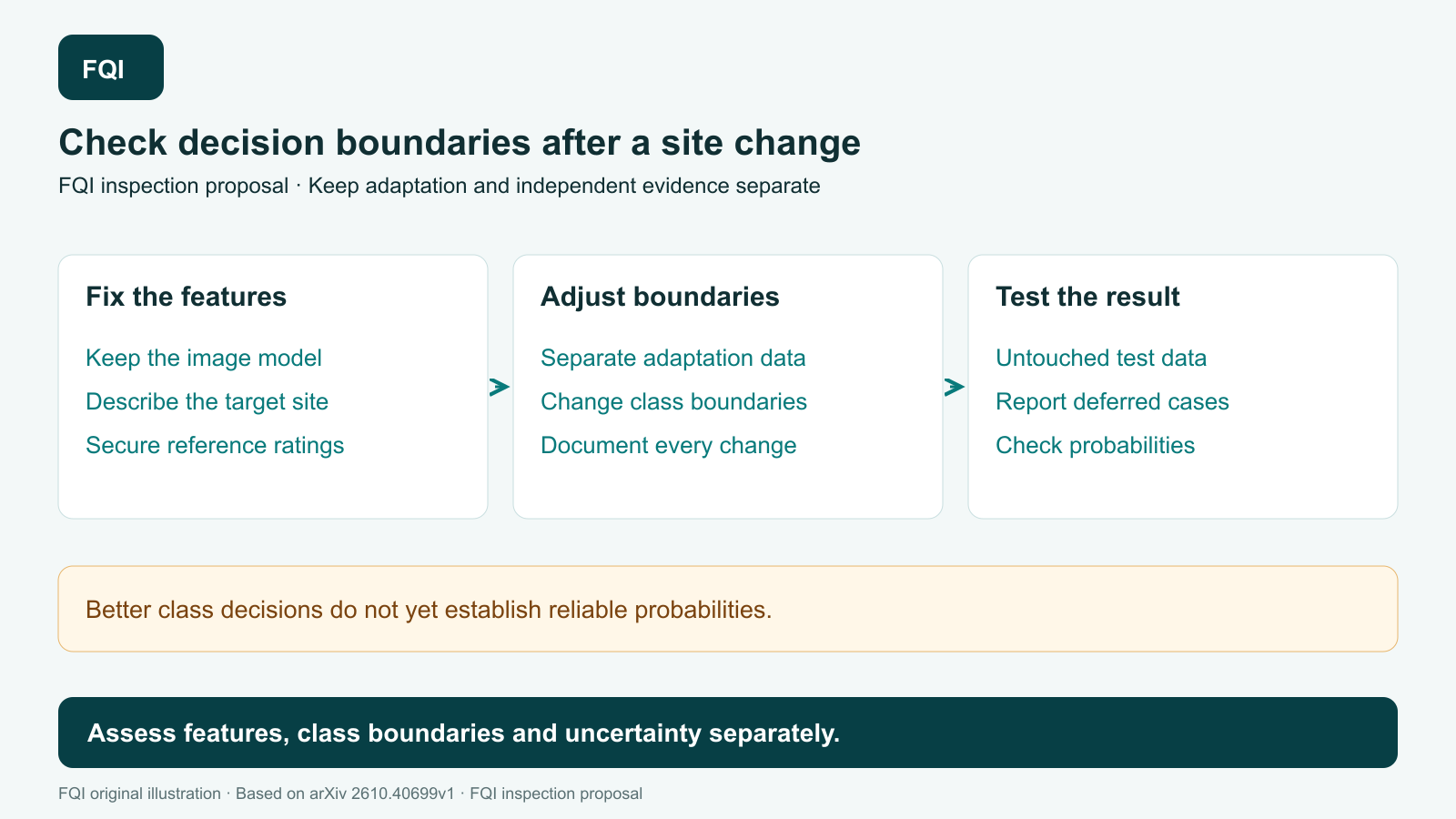
The diagnostic experiment refits four ordered grade boundaries using 200 labeled images from the target site’s validation split. Final test images remain separate. Repeated draws assess sensitivity to the selected sample. For one held-out environment, the adjustment helps several variants more than the plain baseline. This supports a partly correctable decision shift without fully explaining the site effect.
Probabilities are also calibrated after training. Calibration parameters are fitted on validation data and applied unchanged to test data. A separate analysis asks how accuracy among retained images changes when uncertain cases are deferred. For a compact variant, the authors report improved accuracy after deferring one fifth of images. The gain concerns retained cases; the deferred cases still require handling.
FQI translates the separation into an industrial inspection pilot. First, test a new site without adaptation. Then evaluate distinct variants: boundary adjustment alone, probability calibration alone and, where justified, more extensive model adaptation. Keep a common independent test set untouched. This sequence is an editorial proposal, not a manufacturing experiment in the paper.
Each variant should disclose how much target-site data was used and how much expert labeling it required. For deferred cases, track review time, technical decisions and error consequences. Better accuracy in the automated portion becomes useful only when the remaining manual process is also controlled.
Comparisons should additionally preserve the original unadapted results. Otherwise, the final score cannot show whether improvement came from changed boundaries, changed probabilities or a different population of retained cases. Local adaptation is a separate service with its own evidence and cost, not a free property of transfer.
Limitations and risks
Public research collections are not a consecutive screening population. Only part of the comparison was repeated with a second training seed. Certain pooled evaluations lack a directly comparable plain baseline. Local boundary refitting requires labeled target-site images and is not a data-free transfer method. Visual explanations were not validated against lesion annotations as reliable causal indicators. Operational and medical suitability require separate evidence.
FQI conclusion
Treat site transfer as a set of testable components. Reduced classification performance can have different causes requiring different actions. CalibCause illustrates a limited boundary-refitting diagnostic and shows why architectural complexity cannot replace transfer evidence. FQI recommends separate adaptation experiments, one common independent test set and full disclosure of local labeling effort. Subsequent clinical or industrial acceptance must additionally address the intended workflow, error consequences and deployment population.
Sources & transparency
Primary source: CalibCause: A Quality-Gated, Interpretable and Calibrated Deep Learning Framework for Diabetic Retinopathy Grading; versioned full text reviewed. Relevant methods, results and limitations were reviewed on 2 November 2026. Scientific preprint; FQI has not independently reproduced the findings. Operational inspection plans and examples are FQI interpretations, not additional experiments reported by the authors.
Artificial intelligence assisted preparation. Johann Fischer explicitly approved this article package for publication on 2026-11-02.