
Executive summary
An artificial intelligence (AI) agent remembers parts of conversations and retrieves them for later answers. A security filter intended to catch poisoned memories also processes legitimate information. A controlled study examined that second part of the decision in five long conversations. For 14.9 percent of questions a read-time filter withheld at least one entry it assessed. The experiment could estimate the average effect on answer accuracy only within fairly wide bounds.
FQI takeaway
- Replay benign traffic in a separate trial with and without protection.
- Review withheld information independently of the eventual answer.
- Report extra model processing and uncertainty in the measured quality difference.
The principle at a glance
The experiment used 150 turns from each of five conversations in the LoCoMo dataset and asked 255 questions per run. The researchers held the backbone model configuration, memory system and answer instructions fixed and repeated each condition three times. They compared measures applied when writing memories with a further assessment of retrieved entries at read time. A change on the write path can affect every later memory state. A read-time intervention initially changes the information available for one answer.
Deep dive
Two measures, sanitization and provenance checking, never fired on this material. Model-based anomaly detection blocked nine of 2,250 turns. The read-time filter dropped 2.2 percent of the memories it assessed. The denominator matters. Losing one entry can affect a question even when nearly all entries pass through the filter.
A blinded audit found a content-based justification for only two of 50 sampled drops. Yet the estimated accuracy change for this filter was plus 0.6 percentage points, with a 95 percent interval ranging from minus 2.6 to plus 3.8 points. An operation with narrow tolerances cannot infer equivalence from that result. The workload differed too. Read-time filtering increased the number of text units processed, by three percent. Combining all four measures increased it by 4.5 percent.
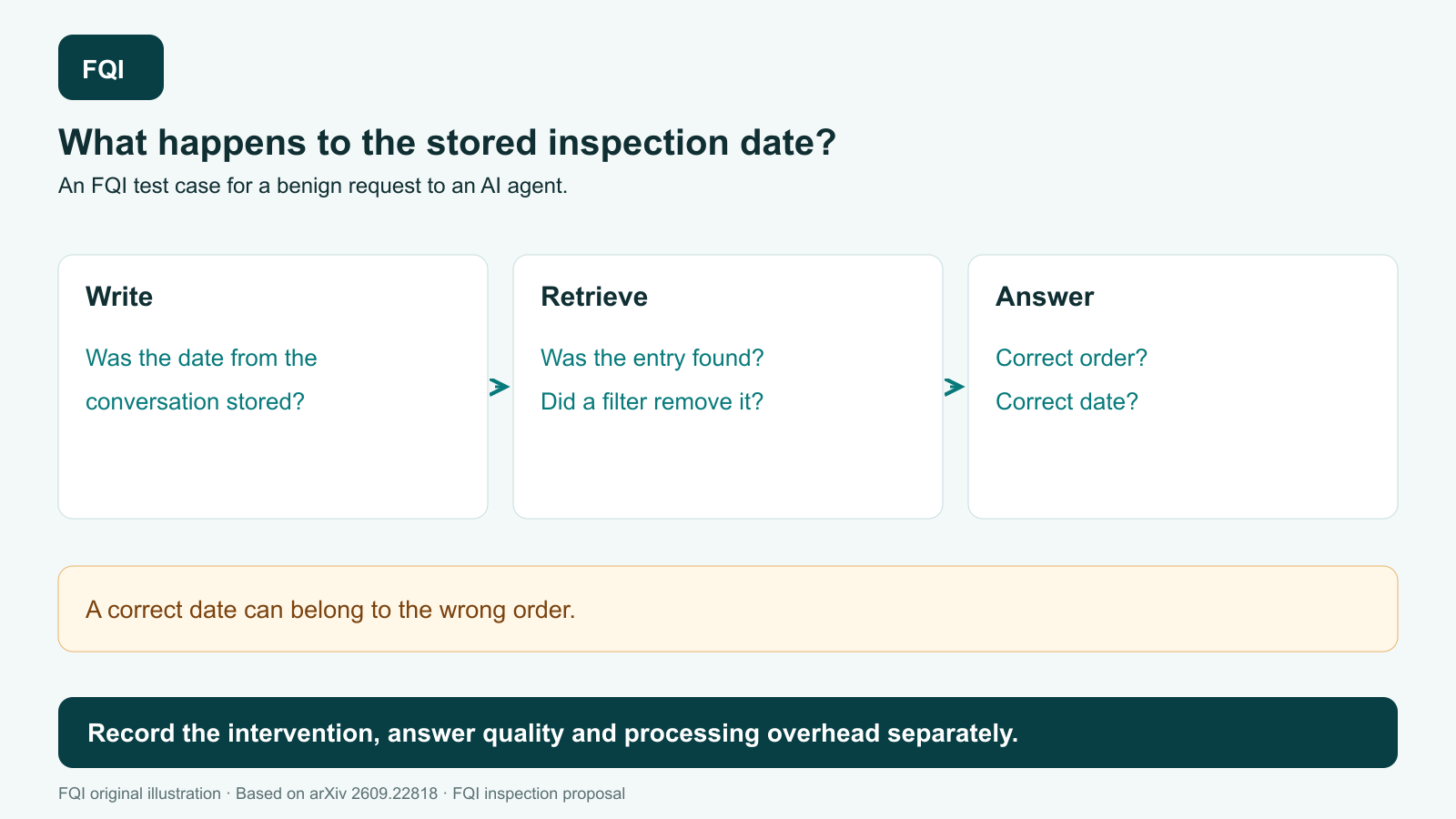
FQI proposes test questions linked to specific, necessary memories. One example is a previously agreed change to an inspection date. Record whether the date was stored, found during retrieval and passed to the answer stage. These observations locate a missing piece of evidence within the processing chain.
Specify in advance what makes two answers equivalent. A response can give the right date for the wrong order. A check looking only for a matching date would conceal the loss of context. Review a sample linking answer, necessary memory and order. The team can then distinguish a benign intervention from a fault that its scoring rule overlooked.
Limitations and risks
Five truncated conversations represent a limited range of benign traffic. An earlier experiment changed the model between conditions. The corrected comparison illustrates the importance of keeping the model basis fixed. Even the hosted model used for the corrected trial lacked a permanently pinned version. Resistance to attacks needs a separate experiment with adversarial inputs.
FQI conclusion
A memory protection decision needs evidence about both attack resistance and its cost for legitimate tasks. Samples of withheld entries and the extra processing load help explain the operational price even when average answer accuracy initially appears stable. Report the bounds alongside the average so a reviewer can compare them with an actual tolerance.
Sources & transparency
The methods, figures and limitations come from the authors’ publicly accessible paper. The proposed workplace test and simplified example are FQI interpretations. Study record. Original study.
Guidance from the National Institute of Standards and Technology (NIST) offers a framework for planning evaluation in the intended context of use. The numerical results in this brief come from the study. NIST evaluation guidance.
Artificial intelligence assisted preparation. Johann Fischer approved this article package for publication on 2026-11-06.