
Executive summary
A neural network can return different results for identical inputs when stored model values are corrupted. LEAN attempts to reduce the sensitivity of critical weights during training. Its central testing lesson extends to artificial intelligence (AI) quality assurance: a lower mathematical sensitivity score is insufficient.
Tests must establish whether actual changes to stored bits cause less output damage. Error correction, numerical format and protection assumptions remain separate parts of that evidence. The paper supplies bounded experiments rather than a general hardware guarantee.
FQI takeaway
- Measure actual impact: Check an improved sensitivity score through controlled changes to stored values.
- Expose protection assumptions: Document training, correction and the assumed error distribution separately.
- Retest the operating format: A more compact model may need different protection from its source version.
The principle at a glance
Model weights are learned numbers used by a neural network to process inputs. A bit error changes one position in their binary storage. Its impact depends on both the affected weight and the numerical representation.
LEAN adds two training influences: restricting large value ranges and reducing the sensitivity of particularly critical weights. The authors distinguish improvement in a mathematical indicator from improvement in the observed effects of altered bits.
Terms explained
- Model weight: A learned numerical value within a neural network.
- Bit error: A change in one stored binary position from zero to one or vice versa.
- Quantisation: Representing numbers with fewer possible levels to save storage.
- Error correction: A separate mechanism restoring some corrupted values under specified conditions.
Deep dive
The paper examines image models on CIFAR and ImageNet, plus three small language models. Its sensitivity measure combines the local effect of a weight change on model loss with the step size caused by a bit flip in the particular numerical format.
A partial training variant mainly reduces the first factor. In controlled experiments, the sensitivity indicator falls without a corresponding reduction in actual bit-flip damage. This is the central quality warning: optimising a proxy can inadequately represent the target behaviour. The combined training modification provides a stronger link to measured impact in the tested configurations.
For ResNet-18 on CIFAR-10 with additional selective error correction, the authors report stable results through 300 deliberately induced bit errors across all three training runs. At 500 errors, only two of the three runs remain stable. LEAN also fails under the examined attacks without correction. Effectiveness therefore does not belong to the training method alone.
Another boundary concerns protection simulation. Flips affecting protected positions are treated as corrected. The full correction code is not simulated; the setup assumes that too many errors do not accumulate within one codeword before correction. A hardware implementation must independently establish this assumption.
Storage reduction and robustness are also separate objectives. A more compressed model needs different protection. Some reported storage sizes count weight payloads without all mapping information.
Energy savings are analytical estimates of weight transfer rather than whole-hardware measurements. They cannot directly establish lower operational costs.
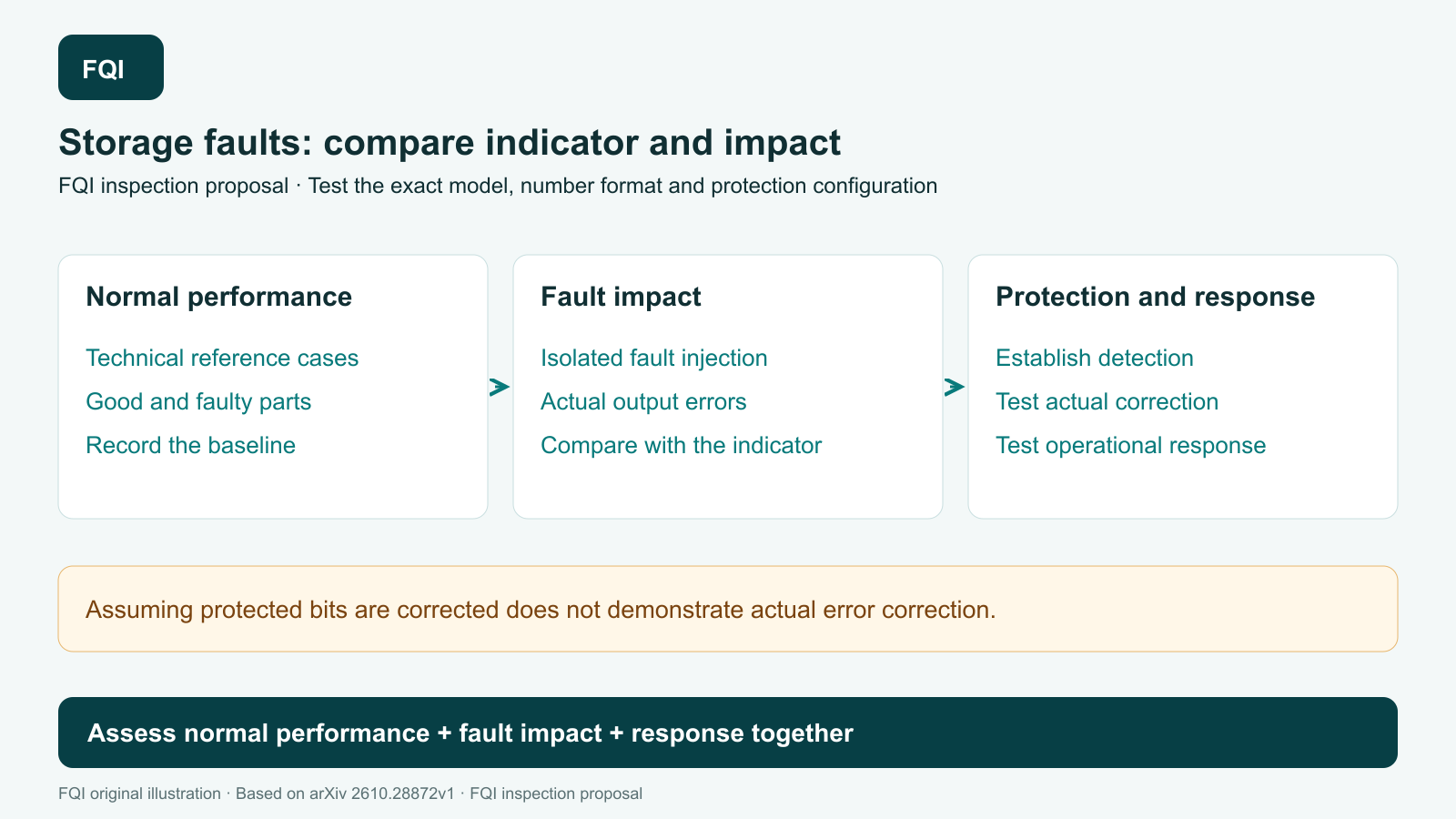
The FQI proposal is a three-stage qualification. First test normal task performance for the exact operating configuration. Next induce controlled storage errors in an isolated evaluation environment and measure their effects on outputs.
Finally establish detection, correction and operational response separately. For visual inspection, missed faulty parts and false rejections matter more directly than an aggregate image-classification score.
Evidence should bind those stages to the numerical format, model version and correction configuration actually tested. A favourable sensitivity curve from one version cannot establish the behaviour of a differently compressed deployment. The proposed record keeps assumptions visible alongside observed results.
Limitations and risks
Many findings use single training runs. According to the authors, a targeted ImageNet attack test overlaps with fine-tuning images and favours LEAN; those results are not used here as independent superiority evidence. Small-language-model experiments show mixed outcomes and cannot be transferred to large current systems.
Errors are software-induced, and no physical memory hardware is qualified. The FQI test pattern needs local technical references and a justified fault model. The voluntary National Institute of Standards and Technology (NIST) framework supports documented reliability and resilience assessment, without confirming any particular LEAN protection effect.
FQI conclusion
The useful question is whether a change reduces the actual error in the intended system. An improved sensitivity curve, smaller model file and assumed correction each answer only part of it. Quality owners should test normal performance, fault impact and response separately before assessing them together.
LEAN offers experimental leads with explicit limits. Any later release must remain bound to the numerical format, correction mechanism and operating conditions actually demonstrated. Proxy improvement can guide investigation, while observed effects determine the practical assurance claim.
Sources & transparency
- Rahaman and Bhunia: LEAN: Loss-Engineered Modulation of the Model Weight-Sensitivity Distribution for Efficient, Error-Tolerant Neural Networks, version 1, sections II–V including limitations.
- NIST: AI RMF Core, Measure 2.5 and 2.7.
Editorial note: Research preprint without peer review; no independent reproduction or hardware testing here. The operational assessment process is FQI interpretation. AI-assisted article, approved for publication by Johann Fischer on 2026-10-22.