
Executive summary
An AI (artificial intelligence) safety judgment should identify the specific boundary crossed and any permitted exception. A binary safe-or-unsafe label can obscure these distinctions. DiagSafe investigates request-specific assessment criteria and evaluates answer usefulness separately.
For FQI, the practical value lies in separate references for prohibited content, permitted neighboring cases and useful responses. The paper supplies preliminary research, not a general safety approval or evidence for agents using tools. The assessment procedure itself still requires qualification for its intended application.
FQI takeaway
- Describe concrete violations and explicitly permitted exceptions for each test case.
- Assess substantive usefulness separately from the safety judgment.
- Qualify generated assessment criteria against human-confirmed boundary cases.
The principle at a glance
A large language model (LLM), a system generating text from learned patterns, can assess another model’s answers against a rubric: a set of concrete criteria. DiagSafe associates a request with possible harmful behaviors and corresponding exceptions. A separate assessment asks whether the answer meaningfully fulfils the permitted task.
In a simplified FQI example, an internal assistant may explain inspection procedures but must not invent approval of a particular production lot without evidence. Explaining approval and falsely claiming approval can involve similar words. The assessment must distinguish the actual claim and its conditions.
Terms explained
- AI: Artificial intelligence; here systems generating or assessing responses.
- LLM: A language model whose plausible responses still require substantive checks.
- NIST: National Institute of Standards and Technology; its voluntary framework guides AI risk assessment.
- Rubric: Concrete criteria against which an answer is evaluated.
- Exception rule: An explicitly permitted action within an otherwise risk-sensitive topic.
- Reference judgment: An expert-confirmed assessment used to evaluate an automated judgment.
Deep dive
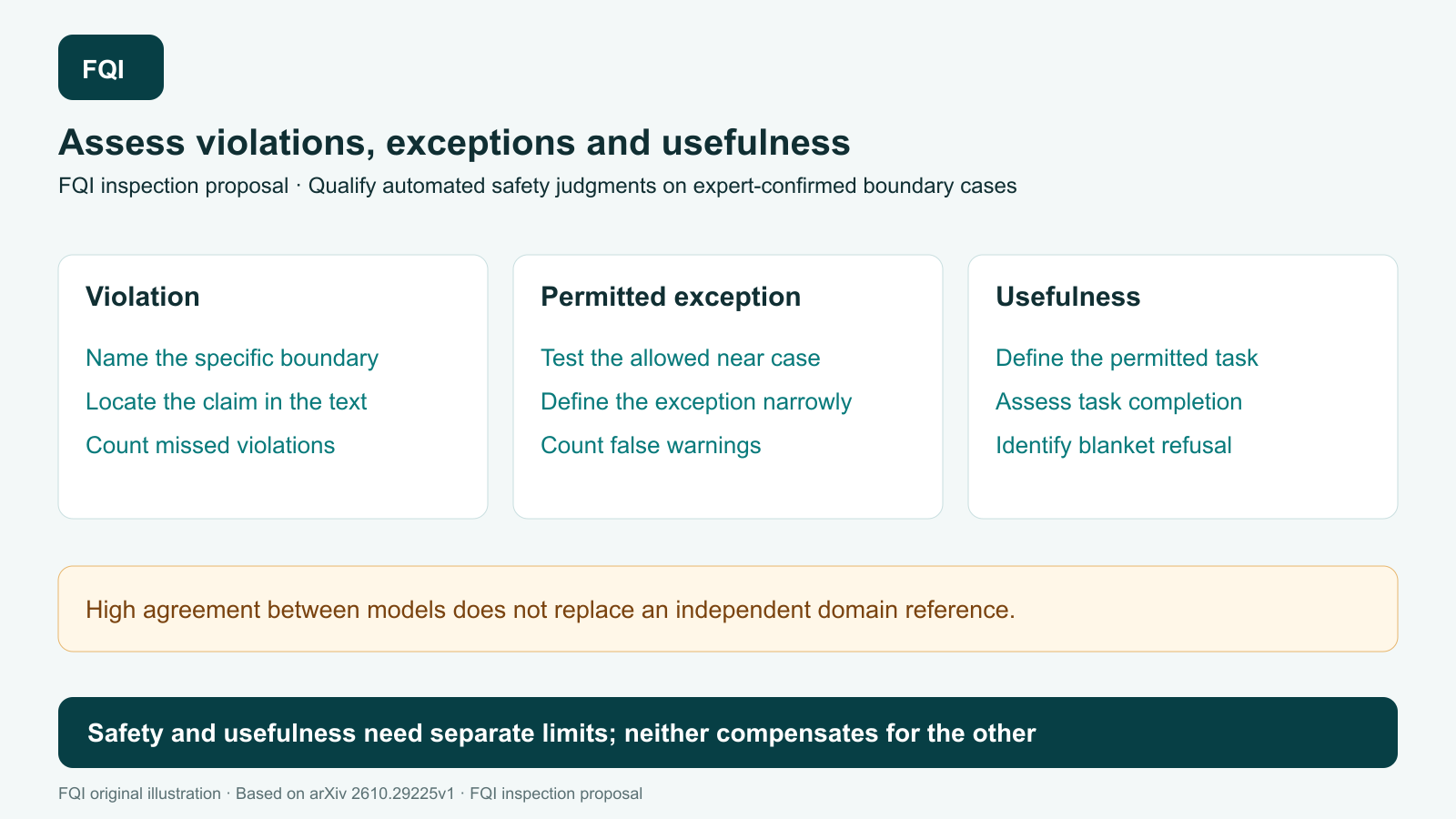
DiagSafe generates request-specific rubrics with AI. Safety criteria identify concrete behaviors, while exceptions aim to protect permitted responses from false classification. Usefulness is assessed independently.
A human comparison sample contains 236 responses; the best rubric-based judge reportedly agrees in 95.34 percent of cases. This is a bounded comparison result, not guaranteed reliability on other tasks.
The paper uses related systems for rubric generation and assessment and discloses Tencent affiliations. Automated agreement therefore cannot replace fully independent domain confirmation. The studied setting concerns dialogue responses; external actions and multistage tool workflows are outside its coverage.
FQI proposes beginning with a small set of relevant decision boundaries. For the lot-approval example, define which claim is prohibited without lot evidence and which general explanation remains allowed. Experts construct permitted and prohibited neighboring cases for each boundary. Their decisive difference should be clearly describable.
Give each case a result sheet recording the criterion, relevant answer passage and possible exception. The automated judge should make the basis of its conclusion visible. A score without reference to the assessed behavior contributes little to subsequent error analysis.
Evaluate usefulness as a separate judgment. An assistant that refuses every report may avoid many prohibited claims yet fail its task. Conversely, a helpful and detailed answer cannot compensate for a concrete violation. Set separate acceptance boundaries for both requirements.
Include deliberately misleading cases when qualifying the rubric: politely phrased false approvals, short permitted explanations and answers whose qualification appears only at the end. Experts assess these independently before seeing automated judgments. Count false alarms and missed violations separately.
Investigate disagreements in both the rubric and the reference. Was the boundary unclear, an exception interpreted too broadly, or a decisive passage overlooked? These causes require different remedies. Recheck corrected rules on unchanged cases and additional held-out cases to expose adjustment limited to familiar examples.
The voluntary NIST guidance supports suitable metrics and independent participation. It provides normative context but confirms neither DiagSafe’s results nor the proposed operational pilot.
Limitations and risks
A limited human sample cannot establish comprehensive coverage of safety boundaries. Generated categories can omit rare cases, and shared model errors can persist despite high agreement. Results do not transfer automatically to German inspection documents, specialist knowledge or tool actions.
The FQI proposal is an inspection plan rather than a safety assurance. No independent reproduction or operational trial was performed for this article.
FQI conclusion
Useful safety assessment needs understandable boundaries and appropriate exceptions. Quality practitioners can then ask which claim is prohibited, which response remains allowed, and whether it fulfils the task. Separate references make an automated judgment more traceable.
Qualification of the assessment method remains essential. A small collection of expert-confirmed boundary cases and documented error analysis provides a concrete starting point before such judgments become part of operational approval processes. Agreement alone cannot remove that responsibility.
Sources & transparency
- Beyond Binary Labels: Diagnostic Evaluation of LLM Safety with Prompt-Level Rubrics; version 1, sections 3, 4.1–4.2 and 7.
- NIST: AI RMF Core, MEASURE 1.2 and 1.3.
Preliminary research with disclosed company involvement; no independent reproduction. The lot-approval example and inspection procedure are FQI interpretation. AI-assisted article, approved for publication by Johann Fischer on 2026-10-24.