
Executive summary
When artificial intelligence (AI) is trained against new attacks, protection against earlier variants can deteriorate. DACE studies this alongside another problem: an attacking language model can narrow its search to a few successful strategies. The method combines structured attack diversity with an updated pool of earlier counterchecks. For quality management, the central decision is to retest each protection version against historical failure cases. Reported improvements do not establish complete safety, especially for attacks spread across several conversational turns.
FQI takeaway
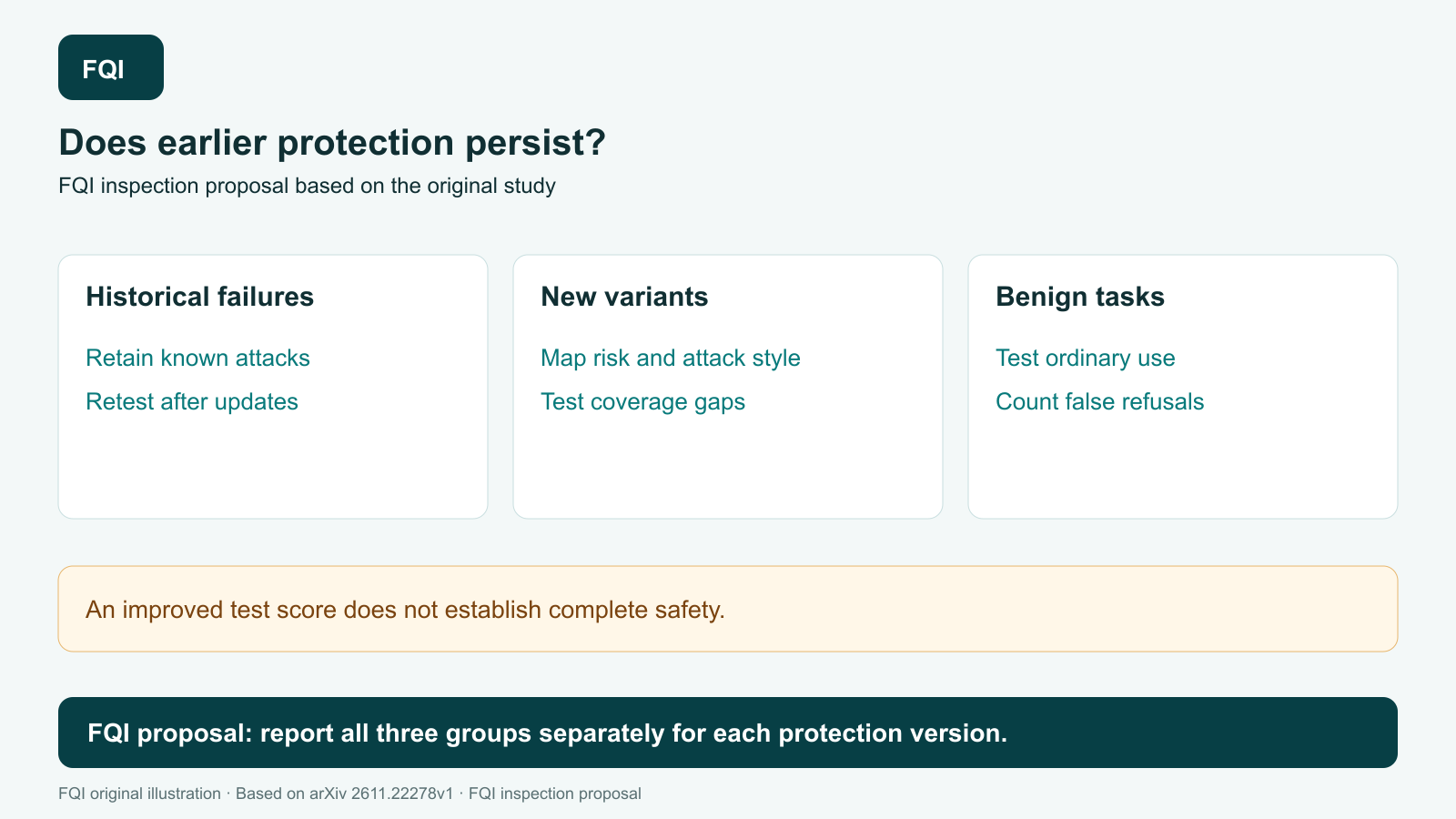
- Rerun previously successful counterchecks after every protection update.
- Organize new variants by risk and attack style rather than counting distinct texts.
- Measure harmful compliance and false refusal of benign requests separately.
The principle at a glance
DACE trains an attacker and a defender together. The attacker rewrites test requests; the defender should reject harmful requests while continuing to answer benign ones. If training only follows the newest attacks, older weaknesses may disappear from its working set.
The method therefore retains counterchecks and updates estimates of their threat. Older observations decay in weight and can be refreshed through new evaluations. The intended result is neither a static archive nor a collection containing only recent cases.
Deep dive
The attacker operates in a strategy space defined by risk category and attack style. Its reward reflects whether a variant expands coverage. On the defender side, a probabilistic selection process chooses retained attacks for replay. These estimates account for stochastic responses and changes to the defender.
Experiments use several Qwen and Llama models. They examine harmful and benign requests, general capabilities and attacks outside the training distribution. An automated safety judge supplies much of the assessment; another model judge is used for additional attack evaluations.
The authors also cross-evaluate attackers and defenders from different training rounds. This reveals whether a later defender still resists earlier attackers. The temporal comparison is particularly relevant to quality management: strong performance against the current opponent could otherwise conceal regression on historical failures.
The multi-turn evaluation shows a substantial remaining limitation. In the X-Teaming test with Qwen2.5-7B-Instruct, the reported attack success rate falls from 94.9 to 79.1 percent. That is an improvement within this test, but the absolute rate remains high. Training coverage designed primarily around individual requests must not be represented as a guarantee for longer conversations.
FQI recommends reporting three groups separately for each protection version: known failure cases, newly discovered variants and benign control requests. A better overall result is insufficient if an important historical failure returns or legitimate work is blocked more often. The failure classes that prevent acceptance should be defined before the run.
Assessment effort also belongs in the report. Testing more variants can discover more failures without demonstrating a fundamentally stronger attacker. Retain model versions, repetition counts and judgment rules with each result. This operational documentation is FQI interpretation, not a process improvement already demonstrated by DACE.
The distinction between regression and new coverage should remain visible when selecting future tests. A retained case can be valuable because it exposes a previously repaired defect, even if it no longer appears novel. Conversely, repeating only familiar cases can leave new strategy classes unexplored.
Limitations and risks
The study covers particular models, test sets and model judges. Different judges or attack environments may change the results. Some baseline values come from an earlier publication rather than fresh runs of every method in one execution environment.
A defined strategy space is finite. New attacks may fall outside its categories. The improvement on multi-turn attacks also does not demonstrate comprehensive coverage of that setting. DACE is a research approach to stronger evaluation and training, not a safety certification.
FQI conclusion
The practical contribution is continuity across protection versions. Historical failures must remain visible after a successful update. FQI recommends a distinct acceptance check against earlier attacks, combined with new variants and benign tasks. This makes improvement more traceable while exposing regression and excessive refusal. Whether the resulting protection is sufficient still requires appropriate operational requirements and independent technical judgment.
Sources & transparency
- DACE: Diversity-Driven Adversarial Co-Evolution for Robust LLM Safety Alignment
- DACE: Diversity-Driven Adversarial Co-Evolution for Robust LLM Safety Alignment
Codex assisted with drafting and checked the claims against the cited original study. Results were not independently reproduced. Operational recommendations and simplified examples are FQI interpretations.
On 2026-11-21, Johann Fischer authorized editorial approval following source and quality review by Codex. Approval relies on that review; individual human reading is not claimed.