
Executive summary
A failed artificial intelligence (AI) safety test contains more information than its final input. The search history shows how many variations were needed and which cases still fail after protection changes. MACE uses this information when jointly training an attacking and a defending language model. For quality management, the useful lesson is to preserve the provenance of test examples. Results must not be equated with operational safety approval: the comparison score combines different properties, and equal attempt counts do not mean equal computational effort.
FQI takeaway
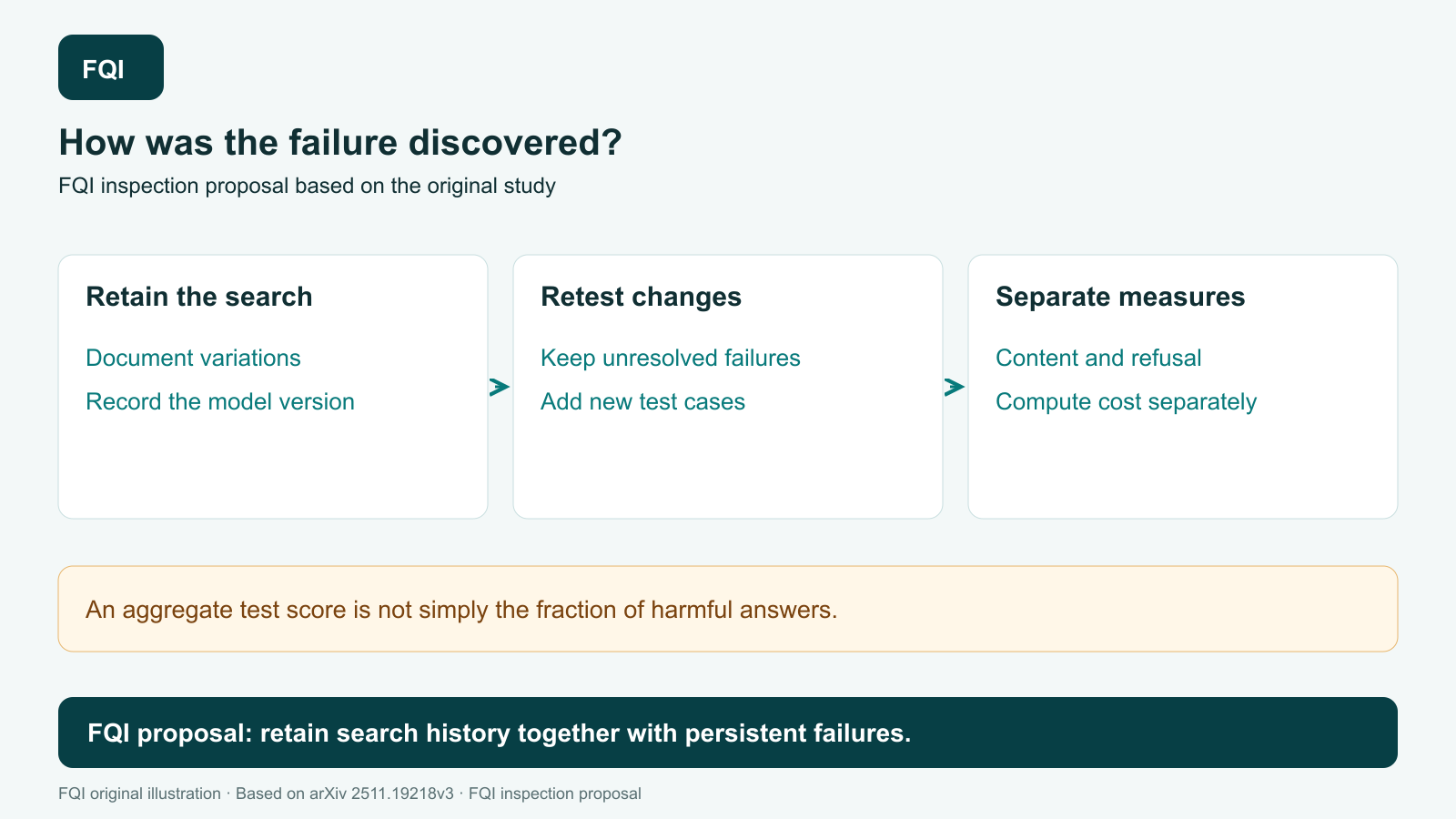
- Retain search history: Store the variation path, system version and search budget with test cases.
- Retest earlier failures: Carry cases that still fail after changes into the next assessment.
- Separate measurements: Assess harmful content, missing refusal phrases and computational cost individually.
The principle at a glance
MACE combines guided tree search with learning language models. The search explores successive variations of an input. Subsequent learning uses both observed success frequency and search-path depth, preserving information about how an example was found.
A second component connects training rounds. Newly generated counterchecks are supplemented by tests against the preceding defender and earlier counterchecks that still succeed. Artificial intelligence (AI) generates test variations, evaluates responses and learns protective behaviour. These roles should remain distinguishable in the inspection record.
Terms explained
- Tree search: Structured exploration of several possible continuations of a search path.
- Countercheck: A targeted test of whether a system respects a specified behavioural boundary.
- Training round: A sequence of new test examples followed by adjustment of the participating models.
Deep dive
The authors argue that many approaches collect only completed attack inputs. MACE also transfers search-process metadata into the weighting of learning examples. Rare successes on longer paths receive a different weight from frequent successes after few steps. This difficulty estimate remains a heuristic, a useful approximation rather than a calibrated measure of risk.
For defence, Table 4 compares twelve combinations of four model backbones and three attack families. The mean comparison score is 8.8, against 11.9 for SafeDecoding, the strongest baseline on average. The score combines two equally weighted components: absence of standard refusal phrases and a model-based assessment of harmful response content. Thus, 8.8 does not mean that exactly 8.8 percent of responses were harmful according to an independent human assessment.
The work separates the model supplying training rewards from the model used for final evaluation. This reduces direct reuse of the same judge but does not eliminate all evaluation dependencies. In an additional stress test, the final learned attacker still obtains a comparison score of 17.5 against the final learned defender. That experiment is not a matched comparison of every competing protection method.
Cost claims also need a defined denominator. The comparison caps method-native attempts, but an individual attempt can contain different numbers of auxiliary model calls. Fewer attempts therefore do not establish a general speed or cost advantage. The authors explicitly identify comparisons under equal computational budgets as further work.
A harmless FQI example could involve a document assistant that should detect inconsistent version references. For each test variation, the team would store the original task, the modification step, expected behaviour and tested model version. An incorrectly selected document would then be recorded together with the path that produced the failure, rather than as an isolated input.
After a correction, the team would repeat both historical failure cases and newly generated variations. A continuing failure would remain open; a single pass would not justify general reassurance. Ordinary allowed requests would also be tested so that stronger protection did not silently prevent useful answers. This is an FQI application of the principle, not an operational process validated in the study.
Limitations and risks
The results come from public benchmarks and selected model families. Search steps are successive input variations, with each candidate evaluated independently. They do not establish protection against attacks in a continuous multi-turn conversation carrying state between messages.
The aggregate score can obscure differences between linguistic refusal and actual response content. Broader human assessments and independent safety judges remain necessary. Search-path depth represents neither harm severity nor operational occurrence probability. Specific bypass instructions from the paper are not reproduced in this review.
FQI conclusion
An inspection archive becomes more useful when it retains a failure’s search history. MACE provides a research approach that uses this information for learning and repeated counterchecking. The practical documentation decision is to preserve variation paths, reference models and unresolved cases together. Evaluation must nevertheless rely on separate, interpretable measurements. An improved aggregate score is a comparison within an experimental setup, not a general statement that the system can be used safely.
Sources & transparency
- From Strategy Search to Policy Learning: MCTS-Guided Adversarial Co-Evolution for LLM Safety Alignment
- From Strategy Search to Policy Learning: MCTS-Guided Adversarial Co-Evolution for LLM Safety Alignment
Codex assisted with drafting and checked the claims against the cited original study. Results were not independently reproduced. Operational recommendations and simplified examples are FQI interpretations.
Codex assisted with drafting and checked the claims against the cited original sources. Johann Fischer authorized publication on 2026-11-22 following review by Codex. Individual human reading is not claimed.