
Executive summary
Many differently worded test questions can examine the same weakness while leaving other risks untouched. Quality-Diversity Red-Teaming, or QDRT, organises tests of large language models along two axes: risk category and request style. Its method achieves broader coverage of this predefined space in the reported comparisons.
For quality management, the practical lesson is to define test diversity technically and measure relevant combinations. A well-populated matrix is useful evidence organisation; it does not establish complete safety of an artificial intelligence (AI) system.
FQI takeaway
- Define meaningful diversity: Establish risks and relevant request variations before generating tests.
- Expose gaps: Record evidence, outcomes and remaining uncertainty for each combination.
- Cross-check assessment models: Alternative automatic categorisation supplements control but does not replace a technical reference.
The principle at a glance
Red-teaming means targeted counterchecks intended to reveal system weaknesses. The authors argue that differences in wording or mathematical text representations do not reliably establish different test intentions.
QDRT therefore combines the risk being tested with the type of request used. Each combination forms a cell in the test plan. Several generating models work on different regions. A structured archive retains informative examples for each region, rather than accumulating one undifferentiated collection.
Terms explained
- Behaviour space: A predefined set of technically distinguished risk-and-request combinations.
- Coverage: The share of those combinations represented by examples.
- Assessment model: Another model that judges examples or responses against specified categories.
Deep dive
The evaluated taxonomy contains 14 risk categories and eleven request styles, producing 154 possible combinations. The authors train specialised generators and adjust their responsibilities to observed strengths. An archive arranged by combination aims to prevent common or easily generated examples from displacing rarer test areas.
Comparisons use the same numbers of model evaluations and training steps, with results reported over five random seeds. The main evaluation measures represented cells and an aggregate of automatic risk assessments. That aggregate combines countercheck quality and coverage; it is not a probability of real-world harm.
On the extended dataset, QDRT achieves 96 to 98 percent coverage across three target models. The GFlowNets comparator reaches 74 to 80 percent. These figures apply to the chosen categories and automatic assignments. They establish neither that every conceivable attack was examined nor that the target models became safe.
A supplementary evaluation assigns generated examples to request styles using a different model. The advantage persists. However, the original risk scores are held fixed.
This cross-check therefore examines style assignment rather than independently validating the entire safety assessment. Systematic sensitivity to alternative taxonomies also remains future work.
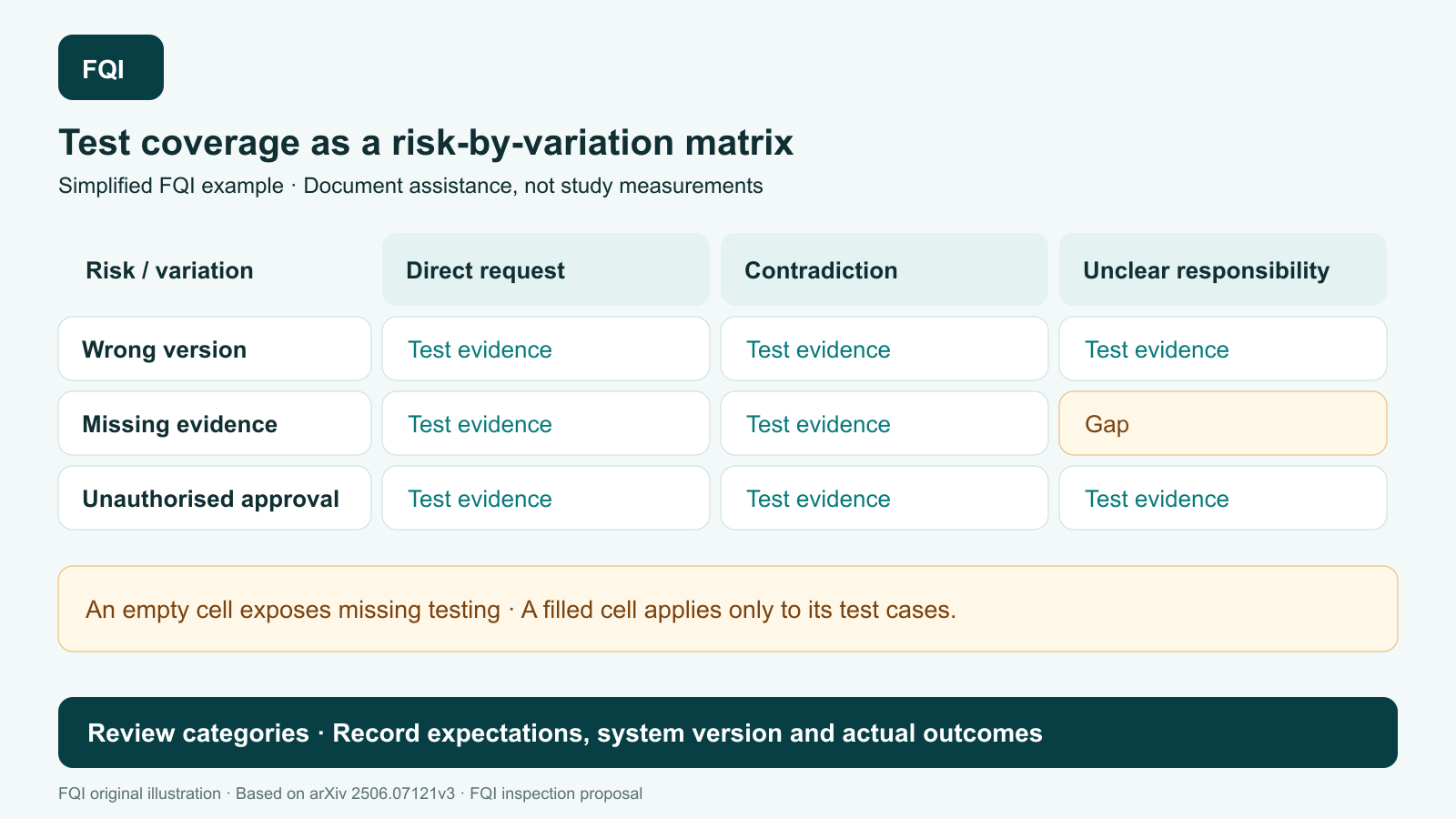
An operational FQI pilot can use the organisational principle without reproducing dangerous test content. As an explicitly simplified example, a document assistant could be checked for wrong document versions, missing evidence and unauthorised approval. The other axis could distinguish direct requests, contradictory information and ambiguous responsibilities. Experts define the expected permitted behaviour for every combination.
A filled cell should contain more than a test sentence. It needs a checkable expectation, the system version and the observed result. Empty cells expose missing evidence.
Passing cells apply to the actual examples tested. Rewording many examples within one cell increases the count but does not close a different risk gap.
The matrix also needs a named owner who can challenge its categories. A category omitted from the plan remains invisible to its coverage percentage. Reviewing operational incidents and changed requirements is therefore part of the FQI proposal for maintaining the plan, rather than a result demonstrated by QDRT.
Limitations and risks
The taxonomy determines which differences become visible. A poor taxonomy can deliver high coverage while overlooking operational risks. Automatic assessment models can repeat the same judgement error across many examples. The alternate style check does not fully remove that possibility.
Authors include universities and an industry-related research institute. The paper supplies a research comparison, not independent operational product acceptance. National Institute of Standards and Technology (NIST) supports context-specific evaluation of assessment effectiveness; it does not validate QDRT or its figures. Concrete circumvention instructions are not reproduced here.
FQI conclusion
A test library becomes useful through meaningful coverage as well as its size. QDRT provides a research basis for describing risks and variations separately, then examining their combinations. Quality practitioners can turn this into a testable matrix with visible categories, reference judgements and gaps.
Coverage must always be assessed alongside the suitability of the categories and reliability of the assessment method. The matrix organises evidence and directs further testing. A safety release still requires context-specific assurance beyond represented cells in a research taxonomy.
Sources & transparency
- Wang et al.: Quality-Diversity Red-Teaming, version 3, sections 3–4.
- NIST: AI RMF Core, particularly Measure 2.13.
Editorial note: Updated version of an earlier research preprint. Findings were not independently reproduced. The benign document matrix is FQI’s own example. AI-assisted article, approved for publication by Johann Fischer on 2026-10-22.