
Executive summary
Some language models reuse computational blocks and can answer after different numbers of recurrent passes. Safety evidence for one depth does not automatically cover the others. A study of recurrent language models also finds that disturbances developed against one depth can be particularly effective at another. Quality assessment therefore needs a concrete test matrix: every permitted output depth requires its own evidence and counterchecks developed at other depths. A strong overall average is insufficient.
FQI takeaway
- Treat every operationally permitted depth as a separate assessment state.
- Test all combinations of disturbance-development depth and output depth.
- Assess safety improvements alongside legitimate responses and general capability.
The principle at a glance
Recurrent computation means that a model repeats parts of its processing. Further passes can change the answer even though the underlying parameters are shared. Depth here refers to the number of these repeated processing steps.
The source investigates whether safety training remains effective across these states. Its SafeBridge method combines depth-specific adjustments with coordination between states. The editorial question is already relevant before such training: which state is being accepted, and against which counterchecks?
Deep dive
The authors evaluate Ouro models with 1.4 and 2.6 billion parameters. Several training approaches are compared across four safety benchmark collections. Three methods generate adversarial test inputs, meaning deliberately challenging requests. Each input is developed against one of four recurrent depths and evaluated at all four output depths.
This produces 48 attack sets per model size and 192 assessment conditions per checkpoint. The matrix diagonal represents matching development and output depths. Other cells reveal cross-depth transfer. Those cells are invisible to an assessment restricted to the final pass.
The results do not support a simple rule that more computation always means greater safety. In one evaluated configuration, an intermediate depth is particularly vulnerable. SafeBridge reduces observed attack success in the studied comparisons. The paper also checks excessive refusal of harmless requests and preservation of general capabilities.
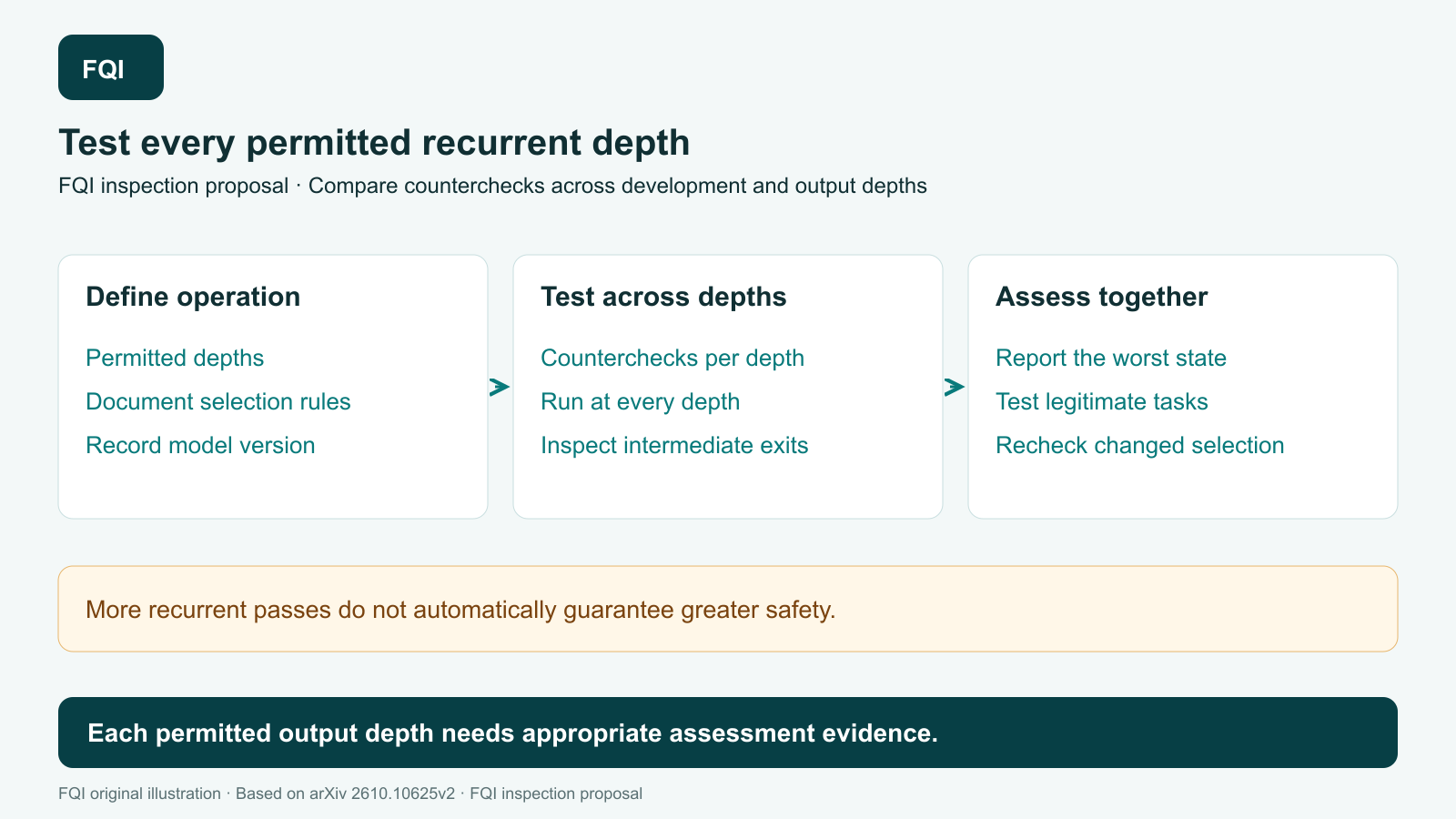
FQI derives an acceptance procedure for each operational state. Teams should first document which depths the application may use and what controls switching between them. Each state receives the same technically reviewed test collection. Counterchecks developed against other states are then added. Report results for each combination and for the worst permitted state.
Another control concerns selecting from several disturbances. The source also counts success when any variant developed against different depths succeeds. This distinguishes a single countercheck from a collection of available counterchecks. Both views can be useful, but their denominators and interpretation should remain separate.
A later change to depth selection requires renewed assessment. Unchanged model weights do not establish that a new operating configuration is already covered. The release record should therefore bind the permitted depths and selection policy to the tested checkpoint. Otherwise a deployment can expose an untested state without replacing the nominal model.
Limitations and risks
The study concerns two sizes of one model family and specific testing and training methods. Automated classification of harmful responses is itself a measurement method with limitations. Low attack-success rates on these collections are not a general safety guarantee.
Comparisons between depths must also preserve the practical purpose. A system that frequently refuses legitimate tasks may no longer perform its intended function. Safety and usability therefore require separate results that are considered together rather than collapsed into a single favorable average.
FQI conclusion
Acceptance should cover exactly the computational states used by the application. The distinct assessment object is the combination of disturbance-development depth and model-output depth. This exposes vulnerable intermediate states that final-pass testing can miss. FQI does not infer a recommendation for a particular training method. The defensible operational decision is to bind depth selection, counterchecks and legitimate task performance to a documented model version, with explicit evidence for every state allowed in use.
Sources & transparency
Primary source: Safe at One Loop, Risky at Another: Aligning Safety Across Recurrent Depths in Looped Language Models; versioned full text reviewed. Preliminary research; methods, relevant results and limitations were assessed. No independent reproduction.
Artificial intelligence (AI)-assisted article. Operational examples and inspection proposals are FQI interpretations, not additional study results. Approved for publication by Johann Fischer on 2026-11-01.