
Executive summary
Can a specialist language model interpret sensor readings better than an ordinary classifier given the same instructions? A smart-home study tests this question with eleven workflow configurations. Extra general-purpose models sometimes reduce performance. Specialised roles help under certain conditions, particularly with a smaller final classifier. The practical decision is whether the gain survives a comparison in which both alternatives have access to the same activity knowledge.
FQI takeaway
- Compare specialist models with direct access to the same knowledge.
- Reserve an independent time period for the final assessment.
- Check event timing and usability as well as the activity labels.
The principle at a glance
A motion sensor produces an observation at a particular time. A process analyst wants an event such as washing dishes, with a meaningful beginning and end. The authors convert observations to descriptions, combine context and use language models to assign activities. Several models can contribute to a decision. Their additional calls are justified only if they improve the result needed by the analyst.
Deep dive
The CASAS Aruba data come from one resident in one home. The study varies the description of the current observations, the use of prior context, the roles of auxiliary models and the final model. Most comparisons over a day and a half were repeated. The longer assessment covering a week ran once.
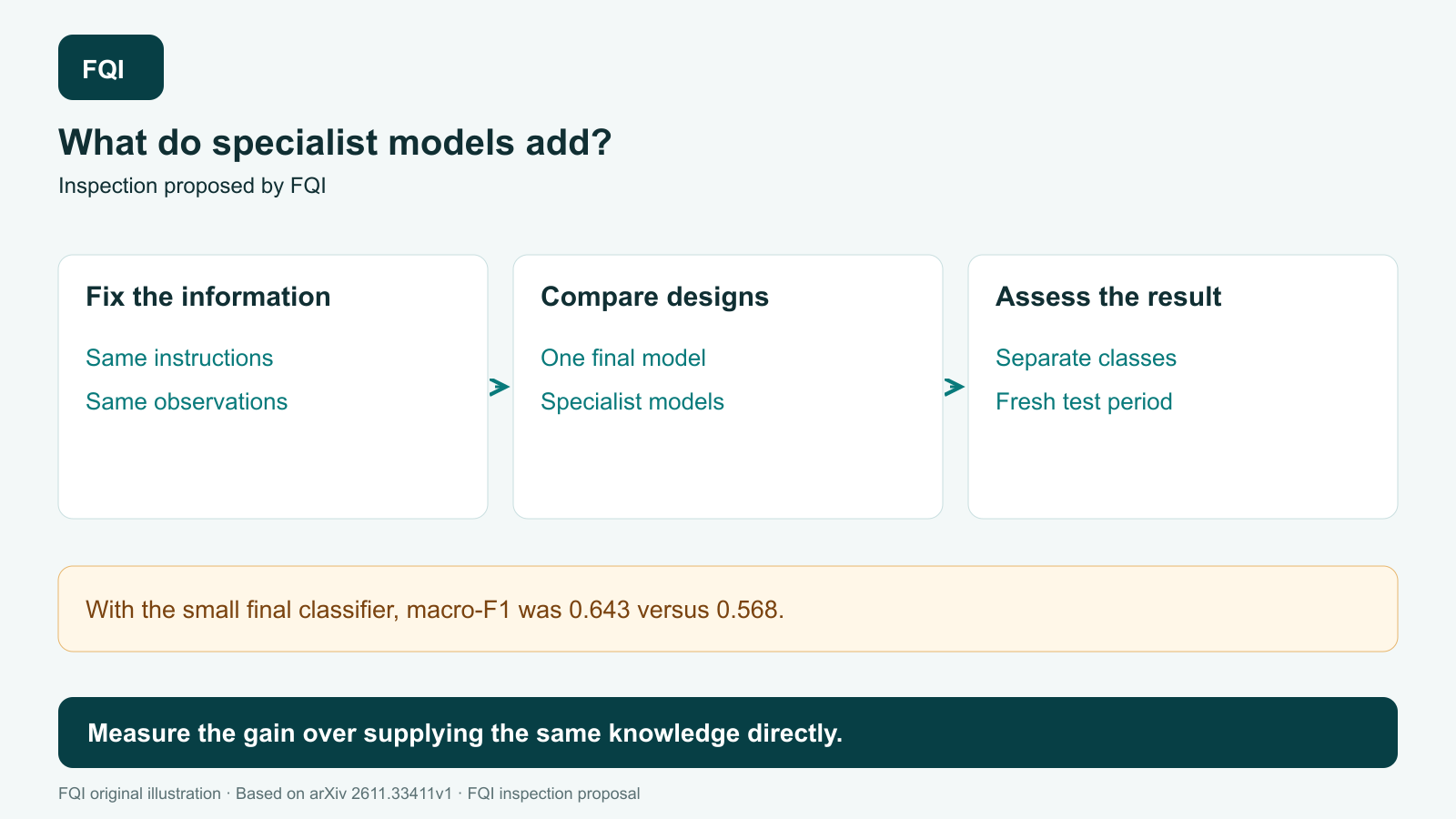
The comparison with direct instructions is particularly informative. When the larger model makes the final decision, specialisation and direct access to the activity knowledge produce relatively similar results. With the smaller final classifier, the specialist configuration achieves macro-F1 of 0.643 against 0.568 for direct knowledge. Macro-F1 gives each activity class equal weight when combining measures of the accuracy and completeness of its detections.
In the week-long assessment the selected configuration achieved macro-F1 of 0.567 and frequency-weighted F1 of 0.680. Frequent activities contribute more to the latter number. Neither measure directly establishes the accuracy of the sequence of events in an entire day.
For a simplified shop-floor example, imagine identifying machine setup, idle time and a brief inspection from a sensor stream. Give one model the rules for all three states. Give the competing system the same rules divided among specialists. Keep the time windows and the reference events fixed. Examine short inspections separately. A single label for a window containing a transition can be incorrect for process analysis even if it captures the activity occupying most of the window.
Limitations and risks
The week includes the shorter comparison period and a development excerpt. It cannot serve as an independent final test. The specialists were designed after observing recurring errors. The study establishes no transfer to other residents or industrial machinery. The authors also identify evaluation of the resulting event logs in a downstream process analysis as future work.
FQI conclusion
Separate two decisions when considering a more expensive design. First establish whether specialisation adds value beyond its instructions. Then establish whether the activity labels support the intended operational use. The different F1 results and overlapping test periods in this study show why those decisions require class-level reporting, independent test data and an explicit definition of a usable event.
Sources & transparency
Collaborative Language Models for Semantic IoT Data Processing: Validation through Zero-Shot Human Activity Recognition · arXiv v1
Author preprint v1. FQI checked the cited sections of the original study. Workplace examples and inspection proposals are FQI interpretations. The experiments were not independently replicated.
Codex drafted the texts and checked them against the original study. Johann Fischer authorized publication on that basis on 28 November 2026.