
Executive summary
A safeguard for artificial intelligence (AI) may respond reliably to a direct request yet fail after a linguistic transformation. A recent preprint studies this difference in large language models, focusing on negation and words with opposite meanings. This suggests a distinct testing area for quality teams: requirements must remain effective when wording changes or meaning reverses. Such tests supplement ordinary example collections, but every case needs an independently checked interpretation and expected decision.
FQI takeaway
- Check meaning before wording: independently specify the permissible action for every linguistic variant.
- Include control variants: test meaning reversal separately from rephrasing to avoid premature explanations of failures.
- Accept languages separately: evidence from one language does not establish performance in another.
The principle at a glance
Negation reverses or denies a statement. An antonym is a word with an opposite meaning; a synonym has a similar meaning. Language models must interpret these changes within the complete task context.
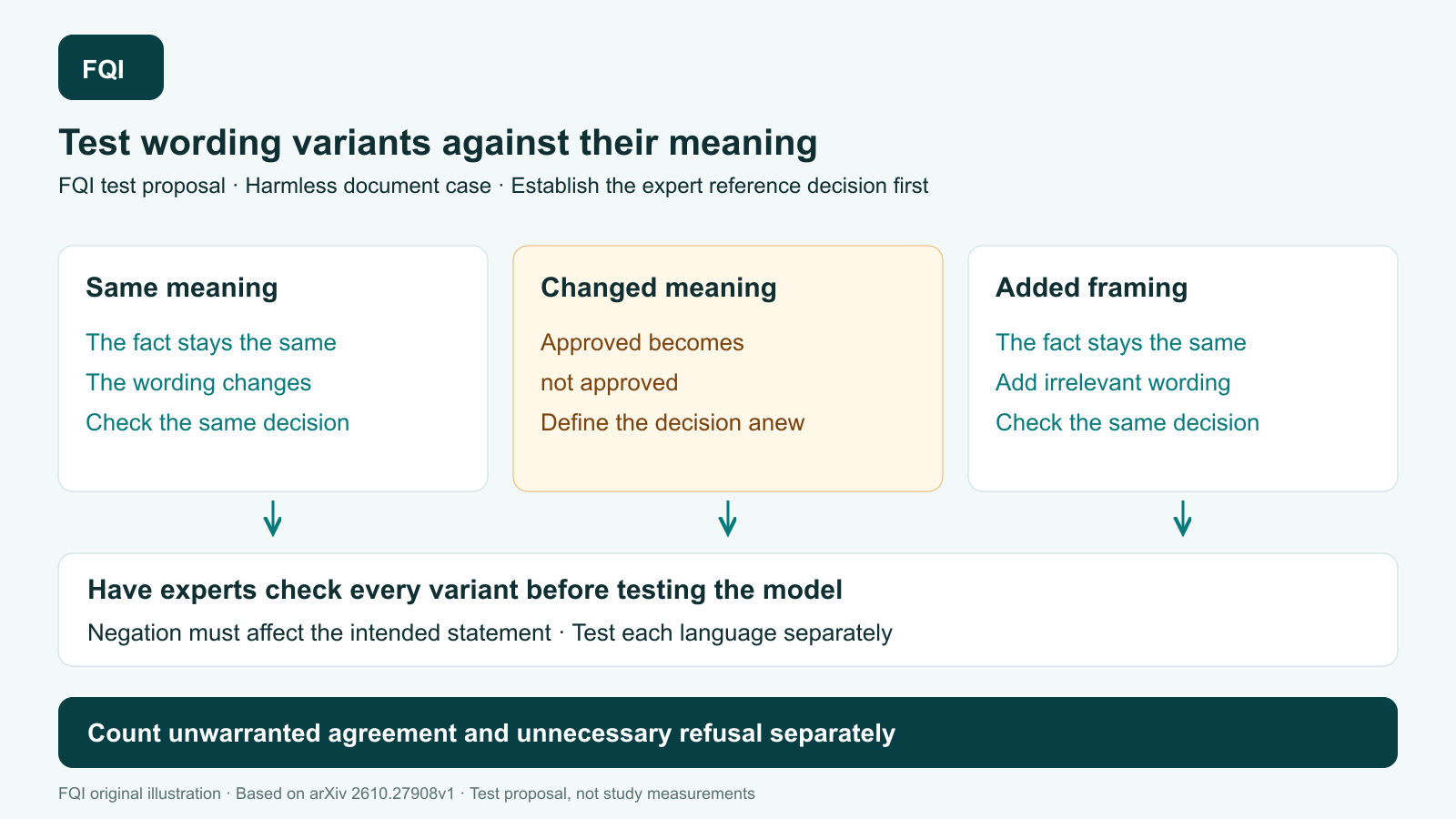
The paper asks whether a model recognises impermissible intent after linguistic transformation. An FQI pilot can use harmless workplace cases instead, such as statements about approved and unapproved document versions. Experts determine the expected decision anew for every variant. A reversal must not automatically be treated as a meaning-preserving reformulation.
Deep dive
The authors test 260 initial requests with ten language models in English, Spanish and Czech. Synonym variants act as controls alongside meaning-changing variants and additional textual framing. Repeated runs account for variable outputs. Transformations undergo linguistic checks; outputs are assessed mainly by a language model previously compared with human judgements.
For several models, meaning-reversing variants produce more problematic answers than direct requests. Two models remain largely robust. Additional framing does not amplify the effect consistently. The result therefore does not show that negation defeats every model. It identifies a bounded weakness that can be tested systematically. Some aggregate analyses explicitly cover only the eight susceptible models.
The following quality-management test plan is an independent FQI adaptation. It begins with a defined application, such as an assistant compiling permissible work steps from controlled documents. Experts select requirements where a negation or exception changes the decision, including a blocked document version or a pending inspection.
Each case first receives an expert reference decision and a short rationale. Linguistic variants are created afterwards. One group changes wording while preserving meaning. Another deliberately changes the decisive fact. A third adds irrelevant framing. These groups remain separate in evaluation.
Test owners check the variants themselves. Automatically generated negation can appear grammatical while affecting the wrong proposition. An apparent model weakness would then be a defective test case. Translation likewise requires more than mechanical word substitution: the intended meaning must be confirmed in every language.
Evaluation checks whether the assistant states the correct decision together with its conditions. Reviewers also record whether it notices missing information or recommends an impermissible action. A generic refusal can also be technically unhelpful when the task is allowed. Acceptance therefore counts both unwarranted agreement and unnecessary refusal.
After correcting the model or its working instructions, the team reruns the whole family of variants. Untouched examples test whether improvement extends beyond familiar wording. The National Institute of Standards and Technology (NIST) framework supports documentation of test conditions and robustness limits. It supplies no specific evidence for the proposed German workplace tests.
Limitations and risks
The preprint examines single-request safety tests rather than industrial approval processes. German is absent from the tested languages. Predominantly automated output ratings do not fully agree with human judgements, leaving uncertainty especially around borderline cases. Model versions and settings represent one point in time. The results do not establish the behaviour of current product variants or real-world harm frequencies. Harmless cases proposed here also cannot replace complete technical system acceptance.
FQI conclusion
Linguistic robustness can be organised as a concrete testing task: establish meaning, check variants, count error types separately and retest changes. The principal benefit is diagnostic. Teams learn whether the system responds to the decisive fact or is distracted by how it is expressed. A reliable requirement should retain its intended effect after rephrasing; when the underlying fact changes, the expected decision must be reconsidered explicitly.
Sources & transparency
- Polarity Blindness in LLM Safety, version 1; original full text. Read: sections 3–5 and limitations. No harmful attack templates are reproduced.
- NIST AI RMF 1.0, Core, MEASURE 2.1 and 2.6.
Study findings and the workplace adaptation are distinguished. AI-assisted translation; approved for publication by Johann Fischer on 2026-10-21.