
Executive summary
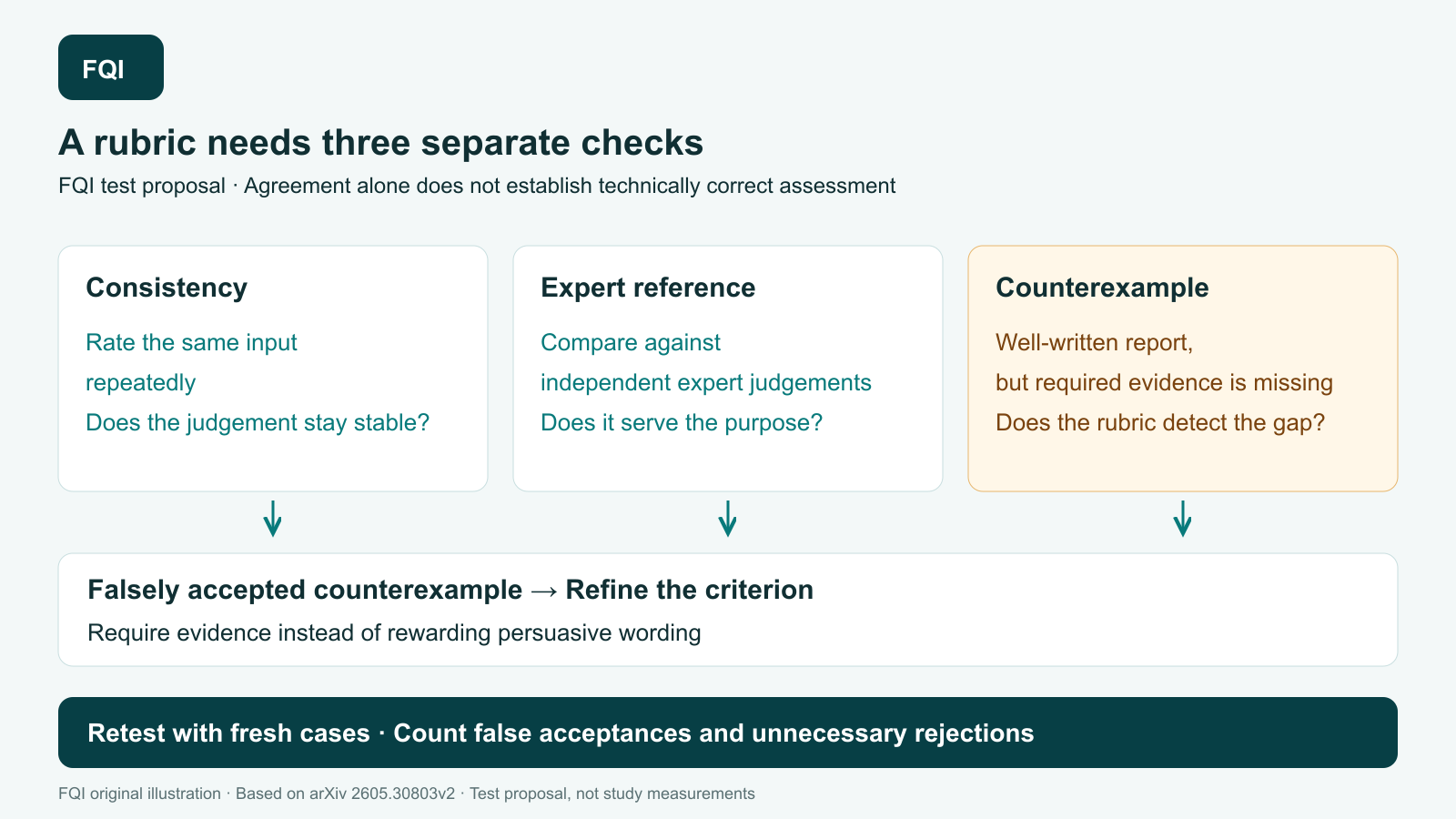
When several artificial intelligence (AI) evaluators rate the same answer similarly, that may demonstrate repeatability. It does not establish that the rating measures the intended technical quality. The PReMISE preprint treats evaluation rubrics as measurement specifications in their own right and separates stability from susceptibility to misleadingly good answers. FQI proposes a practical addition to measurement qualification: every rubric needs examples that satisfy its wording while violating the intended quality requirement. Such counterexamples expose gaps before the rubric is used for selection or acceptance.
FQI takeaway
- Make criteria observable: specify which evidence justifies a favourable rating for each requirement.
- Measure agreement separately: distinguish repeatability, agreement with an expert reference and resistance to misleading answers.
- Retest changes: a stricter rubric must detect problematic cases while continuing to accept adequate answers.
The principle at a glance
A rubric describes the features a language model uses to assess answers. The model becomes an automated evaluator, often called an LLM judge, meaning a large language model used for scoring. The measurement comes from the model, rubric, input and scoring rule together.
One counterexample could be an elaborate corrective-action report containing every requested heading but no traceable evidence of effectiveness. This FQI example tests whether the rubric demands actual evidence or rewards its linguistic presentation. It is not an example from the study.
Terms explained
- AI: Artificial intelligence; systems that derive patterns from data or support tasks automatically.
- LLM: Large language model; a model for processing and generating text.
- NIST: The US National Institute of Standards and Technology.
Deep dive
PReMISE examines four dimensions: rubric structure, rating reliability, agreement with human preferences and robustness against deliberately misleading answers. It uses four datasets of answer pairs. Rubric generation, auditing and final preference evaluation use separate data partitions. Several rubric methods are compared; none leads on every dimension.
For robustness testing, a model generates answers intended to score highly under a criterion while violating its intended meaning. A separate model checks those cases. Revising the criteria can reduce false acceptance but also changes agreement between evaluators. Success therefore involves trade-offs rather than a single ranking.
An FQI workplace pilot would begin with one bounded document type, such as a completed complaint investigation. Experts identify statements that require supporting evidence. The rubric specifies applicability, observable features and how missing information is treated. Requirements combined in one criterion should be separated when it would otherwise be unclear why a score is poor.
The team then builds a reference collection containing adequate documents, clear errors and difficult boundary cases. Deliberate counterexamples include a plausible report with the wrong reference date, a detailed causal explanation without evidence or a well-written action without an effectiveness check. Experts assess the documents independently of the automated result.
Initial evaluation answers three questions separately. Does the same configuration produce consistent ratings on repeated inputs? Does it agree with the clarified technical reference? Does it recognise the deliberately inserted requirement violations? Agreement between several language models may hide shared mistaken assumptions and cannot substitute for expert assessment.
Falsely accepted counterexamples then support rubric repair. A revision might require concrete evidence instead of a general statement. Another might prevent strong wording from compensating for a missing mandatory feature. The revised rubric must be tested on fresh cases; familiar repair examples cannot carry the final acceptance claim alone.
The results record should identify rubric version, evaluation model, case coverage, false acceptances and unnecessary rejections. It should also state which requirements are mandatory exclusions outside the points-based assessment. The National Institute of Standards and Technology (NIST) framework supports periodic evaluation of measurement methods; it does not validate any particular rubric.
Limitations and risks
PReMISE is a preprint mainly examining preference data. Hard safety requirements intended to override human preferences are explicitly outside its scope. Generators, evaluators and verifiers are themselves language models, so shared errors remain possible. Human calibration of the verifier is limited. The adversarial assessment establishes only a lower bound on weaknesses discoverable under its particular setup. Consequential decisions still require technical calibration, and FQI has not independently reproduced the results.
FQI conclusion
An evaluation rubric deserves the same scrutiny as the model applying it. Persuasive answers that lack a required quality feature are particularly informative. Maintaining such counterexamples and checking revisions on fresh cases can strengthen automated preliminary assessment. The expert team remains responsible for purpose, reference and acceptable errors. A favourable agreement statistic is one part of this evidence, alongside the system’s ability to distinguish substantive compliance from convincing presentation.
Sources & transparency
- PReMISE: Policy Rubrics as Measurement Specifications for LLM Judges, version 2; original full text. Read: sections 3–4 and limitations. This is an updated version of an earlier submission.
- NIST AI RMF 1.0, Core, MEASURE 1.2 and 2.13.
Workplace examples and the testing process are FQI proposals. AI-assisted translation; approved for publication by Johann Fischer on 2026-10-21.