
Executive summary
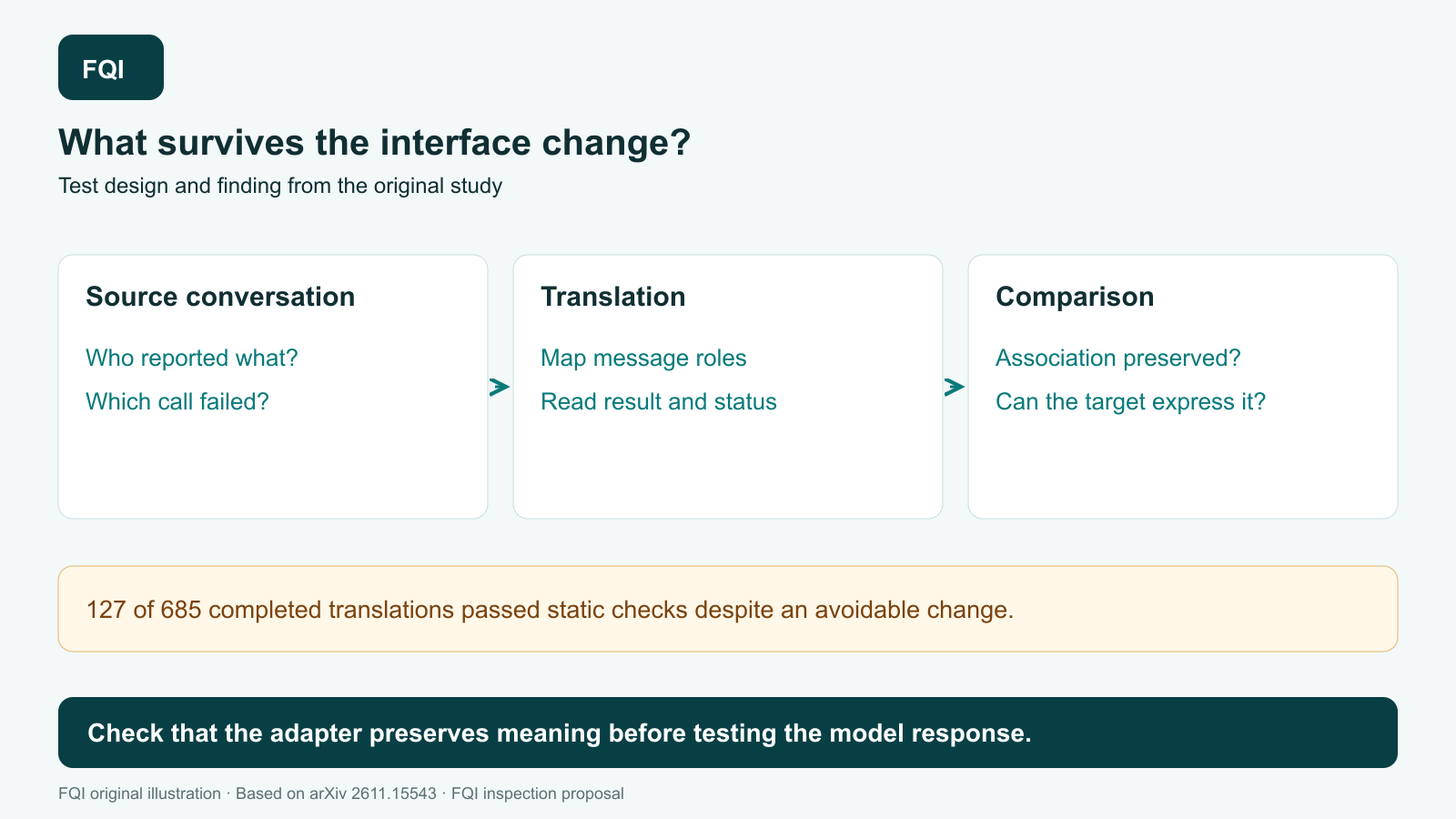
A message can reach a new model without carrying the same meaning. A tool error might lose its connection to the request that failed. Xin Liu and colleagues examine a part of this problem that teams can test before asking the destination model a question. They translate saved conversations and check whether the resulting messages preserve information required by explicit rules. In the main synthetic experiment, 127 of 685 completed translations passed static checks for the destination format yet introduced at least one avoidable change.
FQI takeaway
- Save representative conversations from the process being migrated.
- Record which roles, tool results and error states must survive the translation.
- Compare the converted request with the original before interpreting any change in the model’s answer.
The principle at a glance
Providers can represent the same event in different ways. A tool reply, for instance, can carry an identifier linking it to a particular request. Keeping the text but losing that link can change which operation appears to have succeeded. The researchers map both representations into a common form. Rules then distinguish legitimate differences in spelling or structure from changes to the information supplied to the model.
Deep dive
The authors first ask whether their checking procedure detects changes with known outcomes. On held-out cases it detects 95 of 125 planted faults and raises two false alarms on 100 permitted changes. Both counts matter for acceptance. A detector that flags every difference will find many planted faults while sending harmless transformations for unnecessary investigation. In the main experiment, synthetic requests pass through six configurations from five translator codebases. A completed translation under one configuration is the unit counted. One defect can affect several of these units. The result therefore describes neither the number of distinct software bugs nor their frequency in customer traffic.
Limitations and risks
Consider a simplified complaint search. One tool finds the complaint record, while another cannot open the inspection report. The quality team can retain a redacted source conversation and its converted counterpart and check each result against the call that produced it. If the destination can express an error and the adapter drops it, the adapter needs attention. If the destination cannot represent the state, the team needs a documented fallback for that workflow. The study tests explicit rules. A conversation can satisfy every implemented rule and still produce a factually wrong answer.
FQI conclusion
Run the same stored conversations after an adapter or provider update. Keep an example of an allowed transformation alongside every critical failure case. This gives the person investigating a regression a concrete field, association or status to inspect. A separate answer-quality test can then investigate any remaining changes in model behaviour.
Sources & transparency
The figures and comparisons come from the authors’ arXiv preprint. The workplace example and proposed acceptance decisions are FQI interpretations. Testing Conversation Preservation Across LLM APIs: A Rule-Based Oracle for Detecting Silent Information Loss · Version history
Codex assisted with drafting and checked the claims against the cited original sources. Johann Fischer authorized publication on 2026-11-14.