
Executive summary
A neural network may tolerate changes in its inputs, yet the practical meaning of that claim depends on which changes the proof covers. Adrian Wurm studies several formal definitions of robustness. Changing the way distance is measured changes the inputs included in the guarantee. A quality engineer assessing an inspection system using artificial intelligence (AI) needs to check whether the mathematical input region includes the combinations of measurement errors that can occur in the process.
FQI takeaway
- Specify whether the output class must stay the same or a numerical output may change only by a limited amount.
- Use a concrete boundary case to check which combinations of input errors the specification admits.
- Record the verified property together with the network version, reference input and distance measure.
The principle at a glance
A classifier can give a numerical score to each of two classes, such as “acceptable” and “requires inspection”. Suppose the system reports the class with the higher score. A test can require the same class to win whenever the input readings vary within a specified range. Another test can require the output numbers themselves to change by at most a stated amount. When two scores are close, a small change may reverse their order. When they start far apart, even substantial changes can leave the winning class unchanged.
The way the output is used determines which property matters. If the winning class alone triggers a second inspection, a class change has an immediate consequence. If a downstream process adjusts its sampling frequency using the numerical score, a change in that score can alter the process while the reported class stays the same.
Deep dive
Wurm defines robustness around a given reference input. The claim applies to every input within a given distance of that reference. Specifying the permitted size of the change is only half of the job. The team must also decide how the deviations of individual inputs combine to determine the distance.
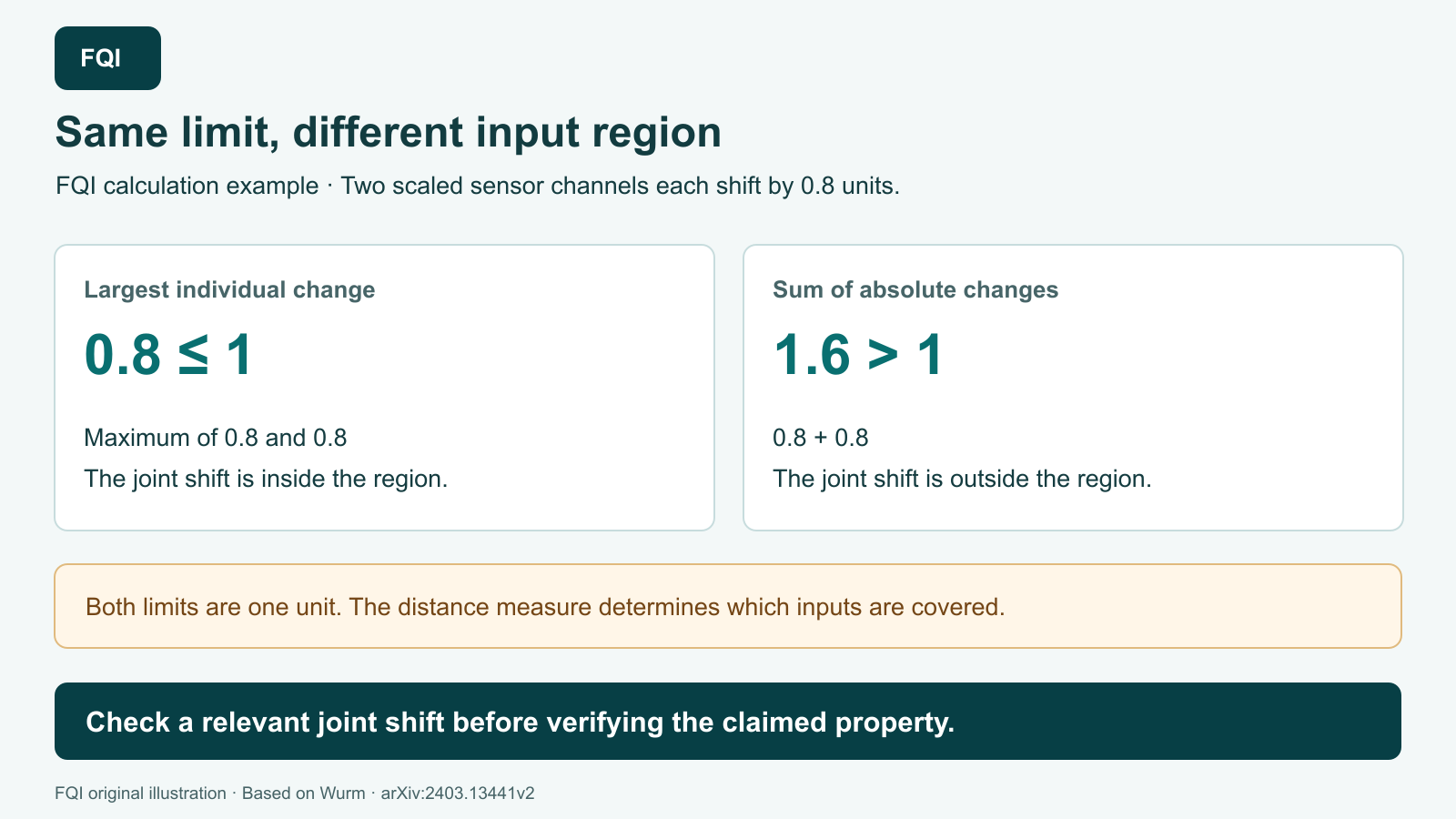
In a simplified FQI example, two measurement channels on a common scale both shift by 0.8 units. Suppose the maximum permitted distance is one unit. If distance means the largest individual change, the two shifts are inside the region. If distance means the sum of their absolute sizes, the distance is 1.6 and they fall outside. A guarantee for the second region leaves this joint shift open. An inspection report that lists a tolerance of one unit without naming the distance rule hides that difference.
The paper examines how these choices affect the computational complexity of verification. For networks with certain piecewise linear activation functions, the regions defined by the sum and the maximum of the absolute deviations can be expressed with linear constraints. This helps characterise several verification problems mathematically. The analysis supplies no fixed running time for checking an industrial network. Ease of calculation also offers little justification for choosing a region that misses an observed fault.
A team could start with a real process observation. Suppose a temperature change affects both sensor channels together. The team writes down one observed pair of deviations and checks by hand whether it meets the proposed input constraints. If the pair falls outside, the specification needs another look. Spending more time verifying the original specification would leave that particular operating condition unexamined.
Limitations and risks
The analysis concerns mathematical models under stated assumptions, including rational network weights and biases. It provides no measurements of sensor drift or of verification time on production equipment. A local proof around one reference reading also leaves other parts of the operating range open. Evidence from the process is needed to decide which disturbances can occur together.
FQI conclusion
A robustness report should identify the region of input values and the promised behaviour at the output. Trying one relevant pair of sensor deviations can reveal a gap between a valid mathematical guarantee and the decision an inspector wants to make.
Sources & transparency
Adrian Wurm defines the input and output properties in Definitions 2 and 3 and examines complexity in Section 3. FQI devised the two-channel example to illustrate the definitions.
Codex assisted with drafting and checked the claims against the cited original work. Johann Fischer authorized publication on 2026-11-11.