
Executive summary
A verifier’s acceptance leaves an important question open when code is generated by artificial intelligence (AI). Did the obligation actually reference a condition in the agreed specification? In one HumanEval experiment, a study of formally verified code reports 99.1% verifier acceptance but only 1.9% with the tested binding to an externally defined condition. Before a software team counts a formal certificate as evidence for a requirement, it should inspect the obligation that was actually checked.
FQI takeaway
- For each accepted proof, identify the specification condition it references.
- Record missing bindings as a distinct gap in the evidence.
- Test the bound specification with counterexamples justified by the intended use.
The principle at a glance
A postcondition describes a property that must hold after a function executes. A verifier can establish whether the code satisfies the conditions it receives. When a system generates both code and proof, a new interface matters. An external requirement may exist even though the checked postcondition bypasses it. The verifier can do its job correctly while leaving the team’s main question unresolved.
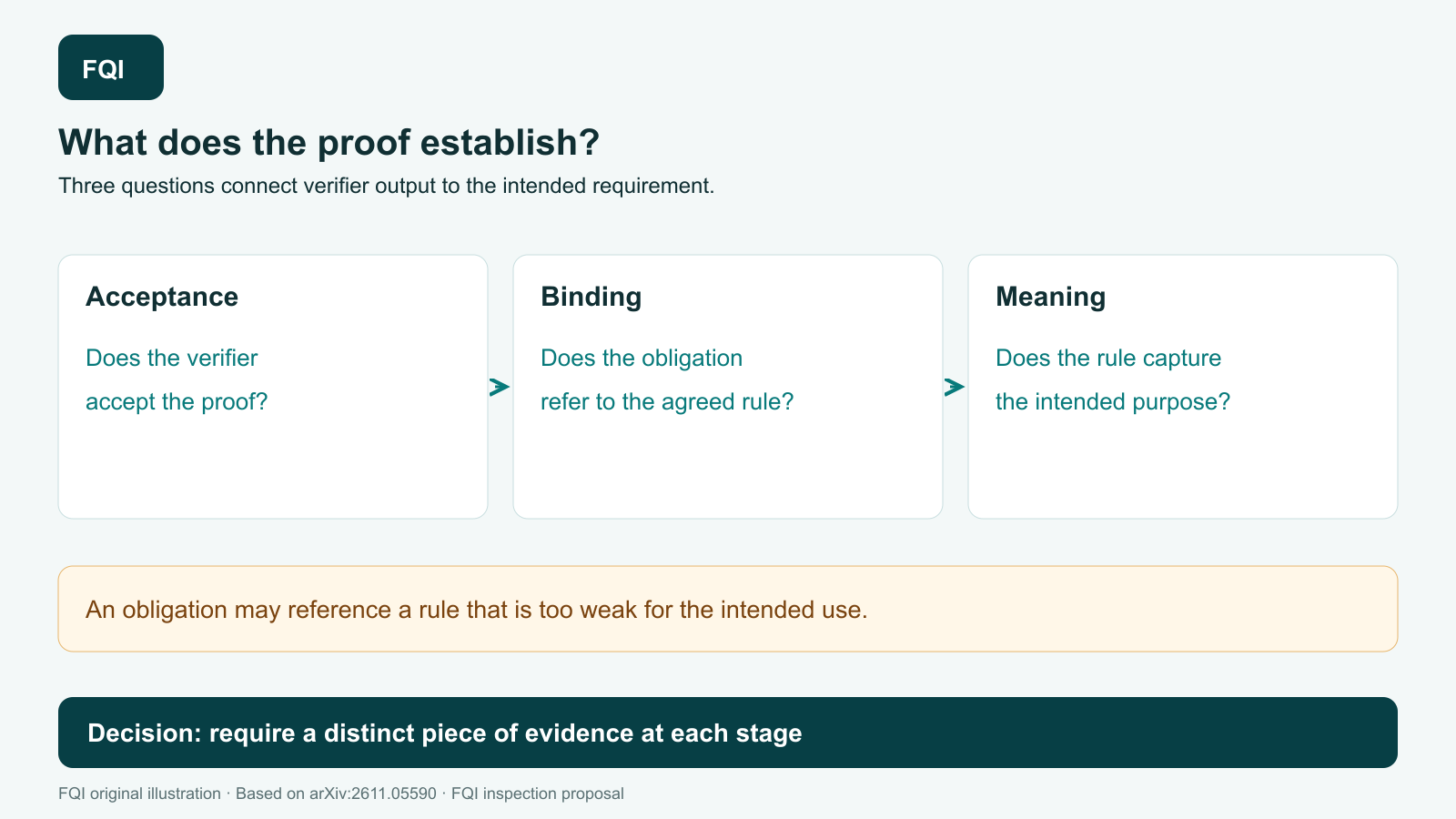
The researchers distinguish three stages. First comes verifier acceptance. Next they ask whether the proof obligation refers to the external specification. Finally, they assess whether the specification captures the purpose expressed in ordinary language. Each stage calls for a different piece of evidence.
Deep dive
For the middle stage, the study examines the structure of generated expressions in the Dafny verification system. Counting postconditions is insufficient. What matters here is a reference to a predicate or function from the supplied specification. In the reproduced generation pipeline, this fraction remains small across three collections of Python tasks. That remains true even where more solutions contain a postcondition of any kind.
A simplified inspection-software example illustrates the decision. A function must count measurements within a specified interval. A postcondition might say only that the result is at least zero. A program that always returns zero would satisfy this weak condition. The first acceptance record should therefore show where the formal obligation invokes the agreed counting rule. Next, a domain test uses a value exactly on the interval boundary. That test asks whether the formal counting rule uses the same boundary convention as the department that requested it.
FQI proposes keeping both records against the agreed version of the requirement. If a rule changes name or version, the team must still be able to resolve the reference. This can reveal a refactoring in which the specification remains in the project but disappears from the obligation that the verifier actually checks.
Limitations and risks
The structural test assumes a pipeline with distinguishable specification and implementation artifacts. Other systems may represent obligations differently. A reference alone cannot establish that the condition is strong enough or that its meaning is correct for the application. The percentages in the study apply to the particular models, tasks and experimental arrangements that the researchers examined.
FQI conclusion
Before accepting generated code, a team should be able to trace a successful verifier run to the agreed condition. That link gives the domain reviewer a concrete rule to examine. If the link is missing, the report should identify which requirement coverage remains open. This prevents a high rate of technical acceptance from silently becoming a metric for complete fulfillment of customer requirements.
Sources & transparency
Three-stage audit, experiments in sections 4–6 and limitations in section 9.
- Verified but Vacuous: Three Failure Surfaces of LLM-Driven Verified Code Generation
- Original full text
- NIST AI RMF Playbook, MEASURE 2.1
Operational examples and inspection proposals are FQI interpretations. The source study has not been independently replicated by FQI.
Artificial intelligence assisted preparation. Johann Fischer approved this article package for publication on 2026-11-06.