
Executive summary
An agent using artificial intelligence (AI) can correctly name the affected function and likely software flaw yet fail to produce an input that triggers it. A study of local language models reveals this gap on ten known vulnerabilities. It suggests a precise acceptance question for software quality teams. Can another person use the saved input on the specified build to observe the same failure? Until then, the analysis remains a reasoned hypothesis that may already help developers investigate.
FQI takeaway
- Record fault localization and an executable reproduction case as separate outcomes.
- Preserve the input file, software build and observed failure signature together.
- Compare models under identical time budgets and break results down by task difficulty.
The principle at a glance
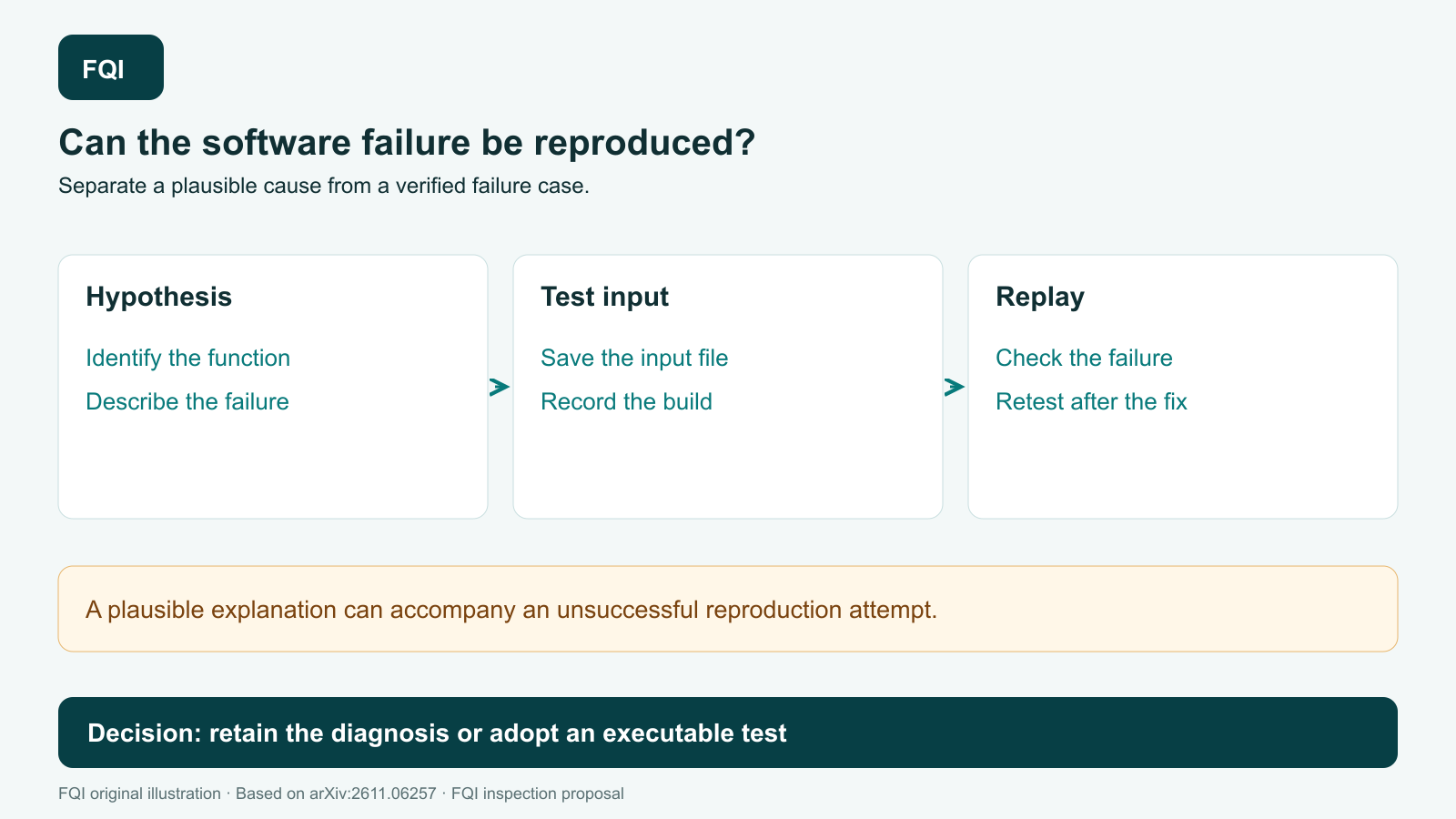
In vulnerability reproduction, the agent receives information about a known weakness. It can inspect source code and try candidate inputs. The behavior of the affected program version determines the outcome. Even a nearly correct file may fail an early format check and never reach the suspect branch. A reviewer reading only the written explanation could easily miss the difference.
The researchers test twelve configurations of locally run language models. Each configuration makes three attempts on each of ten tasks, for a total of 360 runs. A common agent environment and time limit allow the results to be compared on the same tasks. When time expires, the agent loses the opportunity to try another input.
Deep dive
Six of the ten tasks belong to the easier group. Even the smallest configuration solves most of them. Differences emerge mainly on the remaining tasks. In many unsuccessful runs, the agent still names the correct function and identifies a plausible flaw. The hurdle is often turning the idea into a working sequence of input bytes. Counting convincing explanations would hide this gap in an acceptance report.
A quality team could structure its defect report in three parts. First, state the suspected location and the behavior expected to go wrong. Then preserve the agent’s test case in the controlled test environment. Finally, record the observed effect, such as a specific crash signature on the affected build. This keeps the diagnosis available even when the last step remains open.
For regression testing, FQI proposes an additional check. Replay the case on the corrected build and record whether the original failure signature disappears. A different crash or a change of startup configuration needs its own interpretation. The saved case loses value if a later reviewer cannot establish which build and operating conditions produced the result.
Limitations and risks
The ten tasks form a small selection from CyberGym. The experiment covers specific model families and one execution environment. Observed runtimes do not establish a general ranking of local models. A faster model can attempt more inputs within the same time limit. Time to the first confirmed finding and the number of confirmed findings therefore answer different operational questions.
FQI conclusion
A useful report shows how far the evidence reaches. Correctly locating a fault can save a developer time. Adding a repeatable regression test also requires a reproducible input, a known build and a clear criterion for success. Counting those contributions separately helps teams use an assistant where it already helps with diagnosis and identify cases that still need a person to develop the test.
Sources & transparency
Experimental setup, comparison of tasks and conclusions.
Operational examples and inspection proposals are FQI interpretations. The source study has not been independently replicated by FQI.
Artificial intelligence assisted preparation. Johann Fischer approved this article package for publication on 2026-11-06.