
Executive summary
A coding agent using artificial intelligence (AI) changes how a tolerance is calculated. While the boundary test is running, it starts editing the export and the inspection report. If the test fails, the team has to work out which later changes relied on a faulty assumption. Writing for the Lean Enterprise Institute, Remo H. Jansen proposes limiting the amount of work that can accumulate before verification. His proposal describes a way to organise work. Its effect on rework in a particular team would need to be measured.
FQI takeaway
- Before editing, state which property must hold and which test will demonstrate it.
- Before starting a dependent change, check whether its prerequisite has passed. If the result is still pending, wait.
- When work resumes, record the software version and the result together. Later edits may require the same test again.
The principle at a glance
A coding agent is an AI system that can edit code and use tools to carry out an assignment. One task can therefore lead to several connected changes before anyone has checked the first one. Counting open tickets gives little indication of how much remains to be verified. Even a small change to a unit of measurement can affect every report that uses the value.
Jansen draws on two principles from the Toyota Production System. Work stops when an abnormality is detected. New work is released in line with the capacity of the next step. Applied to an agent, this raises two questions. Has a check failed? Is a result still pending while the agent is asking to make a change that depends on it? In the latter case, too, there is a reason to pause.
Deep dive
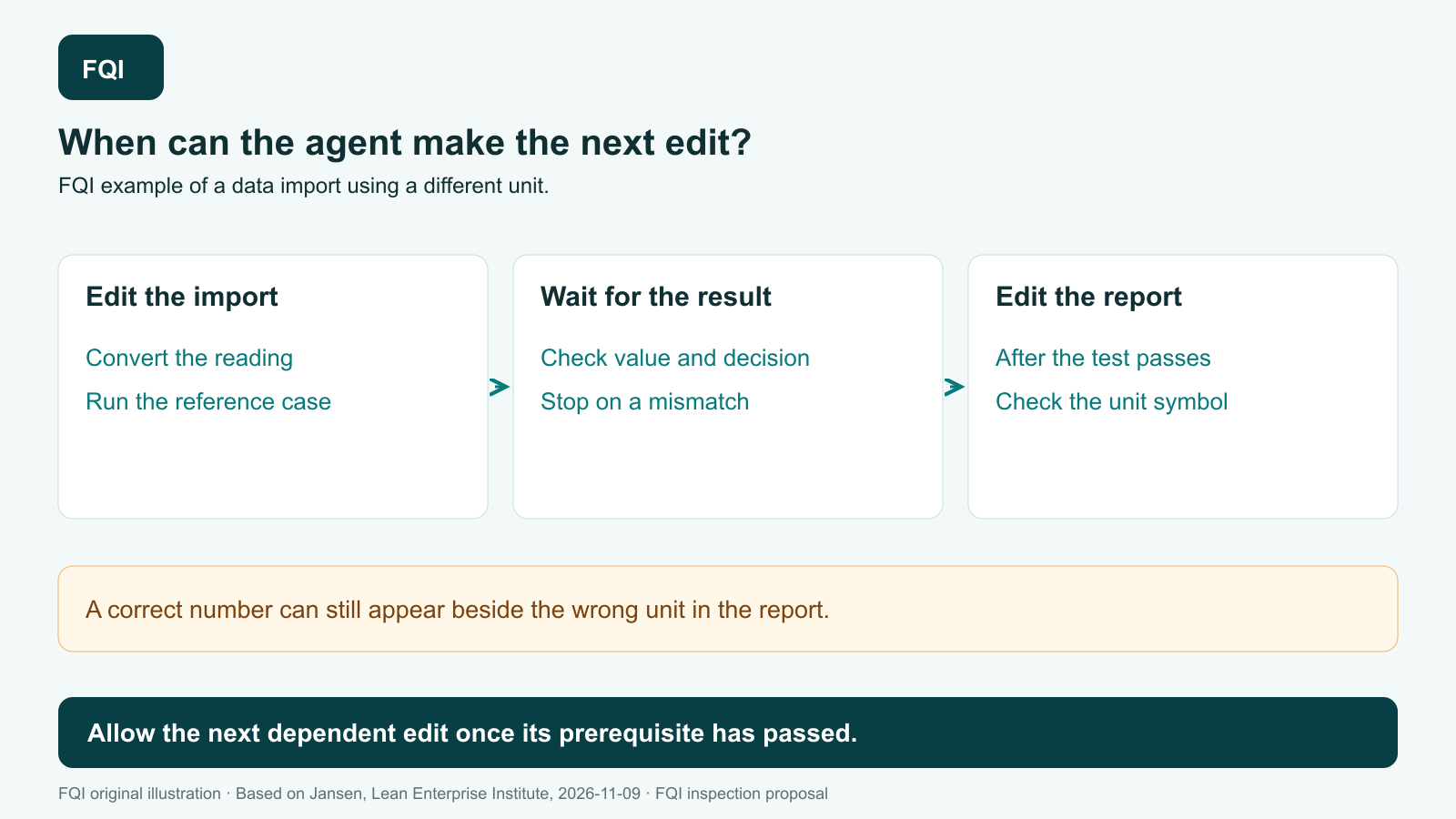
Consider a simplified example devised by FQI. A team adds a new data import to an inspection program. Its existing interface supplies dimensions in millimetres, while the new one supplies micrometres. Before the agent edits the import, a team member selects a reference case at the tolerance boundary. After conversion, both inputs should produce the same dimension and the same inspection decision. The team now has a testable expectation.
The reference case runs after the import changes. The report edit waits for the result. If the comparison fails, the team examines the unit, the rounding rule and the treatment of the boundary in the recorded version. If the comparison passes, the agent can update the report. This requires a separate check because the report can display the wrong unit symbol even when the calculation is correct.
In a pilot, a team could record the time between each edit and its test result, and count the subsequent edits that needed rework after a failure. It could compare similar import tasks completed with and without the waiting rule. If short tests consistently produce long waits, the team could investigate how the checks are scheduled. Repeated corrections to later edits would warrant a closer look at dependencies between steps.
Limitations and risks
A technical control can enforce a defined test result. GitHub documents required status checks before changes can be merged. A merge rule acts later than the pause in this example. To hold the agent’s next write operation, its execution environment must control that operation. A passing test establishes only what it actually checks. A mistaken reference unit could survive a complete run of passing tests.
FQI conclusion
Start with one dependency that already causes measurable rework. Define what must hold at that point and who may resume work after a failure. Whether to keep the rule depends on the results for comparable tasks and on whether the test captures the relevant fault.
Sources & transparency
Jansen’s article for the Lean Enterprise Institute provides the proposal. Toyota describes the two production principles. GitHub documents the controls available before merging. The measurement example and proposed pilot are FQI interpretations. No operational measurements for that inspection process are available here.
Artificial intelligence assisted preparation. Johann Fischer approved this article package for publication on 2026-11-10.