
Executive summary
Artificial intelligence (AI) supports the tasks described here.
A robot’s success rate is meaningful only if the rule measuring success represents the task correctly. SimAudit uses artificial intelligence (AI) to compare instructions with the checking code of simulated manipulation tasks. The authors find both incomplete outcomes that receive credit and valid solutions that are rejected. Quality teams should therefore qualify the success rule itself: it must reject partial completion and accept legitimate alternative solutions. Passing a reference demonstration does not establish both properties.
FQI takeaway
- Test incomplete executions separately from valid alternative solutions.
- Capture the actual physical state when the checker issues its verdict.
- Re-evaluate archived executions after changing the checking rule.
The principle at a glance
A success checker translates an instruction into executable conditions. Those conditions can be too weak: lifting a bottle is accepted although the instruction also requires shaking it. They can also be too restrictive: two bottles are correctly picked up, but the checker additionally demands a particular location.
SimAudit first asks a language model to describe the instruction’s requirements and the code’s conditions separately. It then proposes targeted disagreements. Executing the proposed scenario and reviewing its rendered views turns a suspicion into a supported finding. AI supports the audit of the evaluator, not merely the robot policy being evaluated.
Deep dive
The authors examine 142 tasks from three simulation benchmarks. Of 568 proposed states, 183 produce the predicted checker verdict. Visual review and deduplication leave 61 distinct defects across 49 tasks: 40 phantom successes and 21 silent failures. These stages matter. Correctly predicting what a program returns is not sufficient to establish that its verdict is wrong.
The pipeline runs the original checker without modifying it. A separate visual reviewer receives the task instruction, multiple views and the recorded verdict, but not the probe code. Cases that exist only through unrealistic object placement are excluded. The evidence must show a reachable state and a visible discrepancy between instruction and verdict.
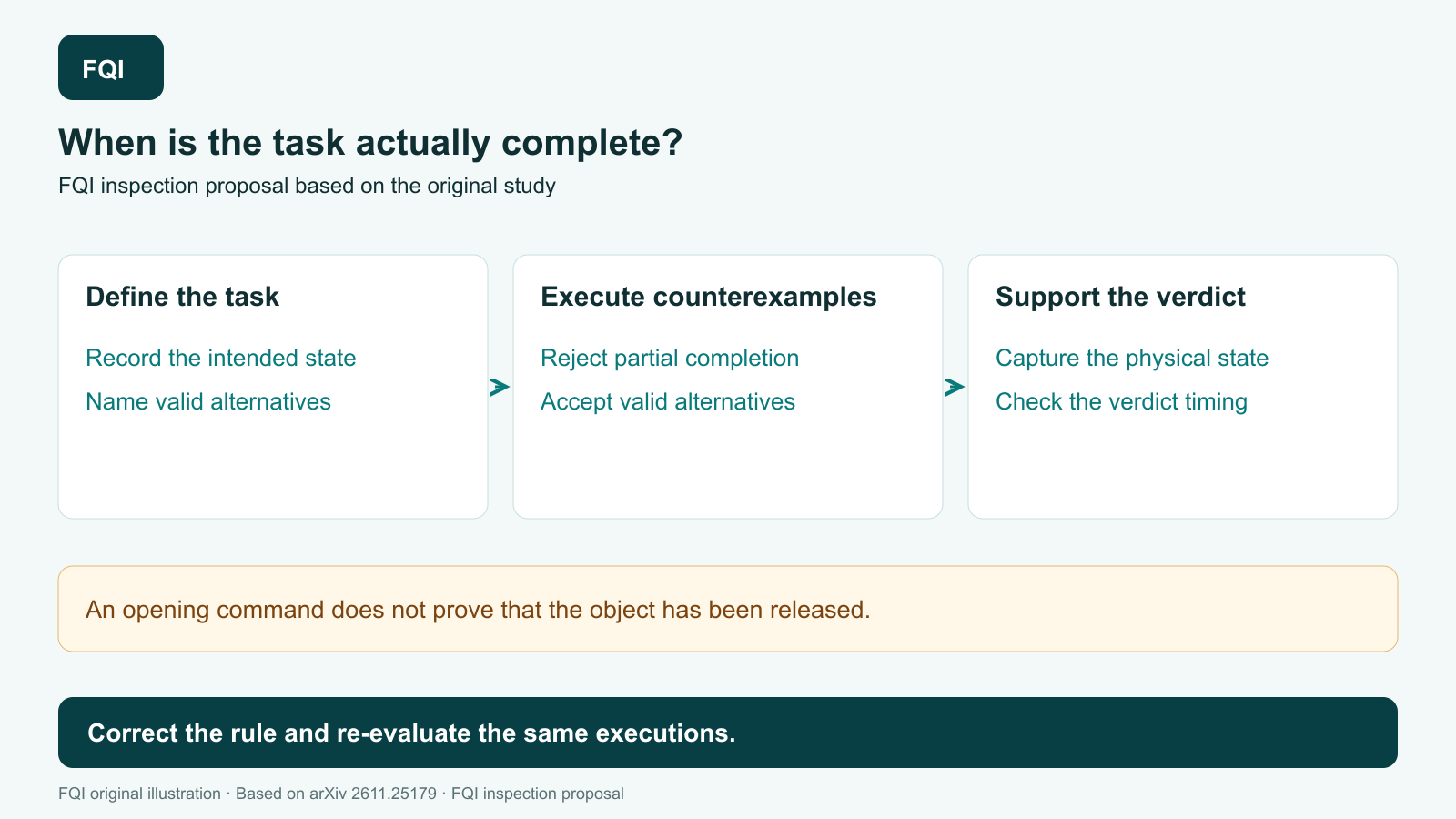
An FQI transfer is to document four items for each acceptance requirement: intended outcome, measured quantity, logical condition and final evaluation time. A command to open a gripper does not demonstrate that the object has already been released. A briefly upright stack does not demonstrate stable placement. These are transferred failure categories, not measured production findings.
The timing of the verdict deserves its own test. A task can appear complete for an instant while an object is still falling or a stack is beginning to collapse. The checker must evaluate the intended physical condition at the point when credit becomes final. Its input should not silently substitute a command or proxy for that condition.
After correcting a rule, replay the same archived executions and record verdict changes in both directions. Some previously accepted cases should now fail; some previously rejected alternatives may correctly pass. This distinguishes a change in measurement from a change in robot capability. The repaired rule, the old rule and the evidence for each change should remain identifiable.
Limitations and risks
The study concerns simulation and does not estimate the prevalence of these defects in physical production robots. The separate visual reviewer can also be wrong; unclear views require expert review. Some repaired conditions must persist for one second in the study. That is an experimental choice, not a universal industrial holding time. FQI has not independently reproduced the experiments.
FQI conclusion
A success rule is a measurement instrument. Its qualification should include a plausible partial execution and a legitimate alternative in addition to the reference demonstration. SimAudit’s contribution is the use of executed, visually supported counterexamples against unchanged checking code. For change control, qualify the rule first and compare old and new results under an explicit version. The reported defect count supports conclusions about the studied tasks, not a universal defect rate.
Sources & transparency
Source 1. Author manuscript accessed on 20 November 2026; methods, experimental setup, results and limitations reviewed. Findings and FQI proposals are distinguished above. AI-assisted editorial draft, checked by Codex; no independent replication.
Codex assisted with drafting and checked the claims against the cited original sources. Johann Fischer authorized publication on 2026-11-20.