
Executive summary
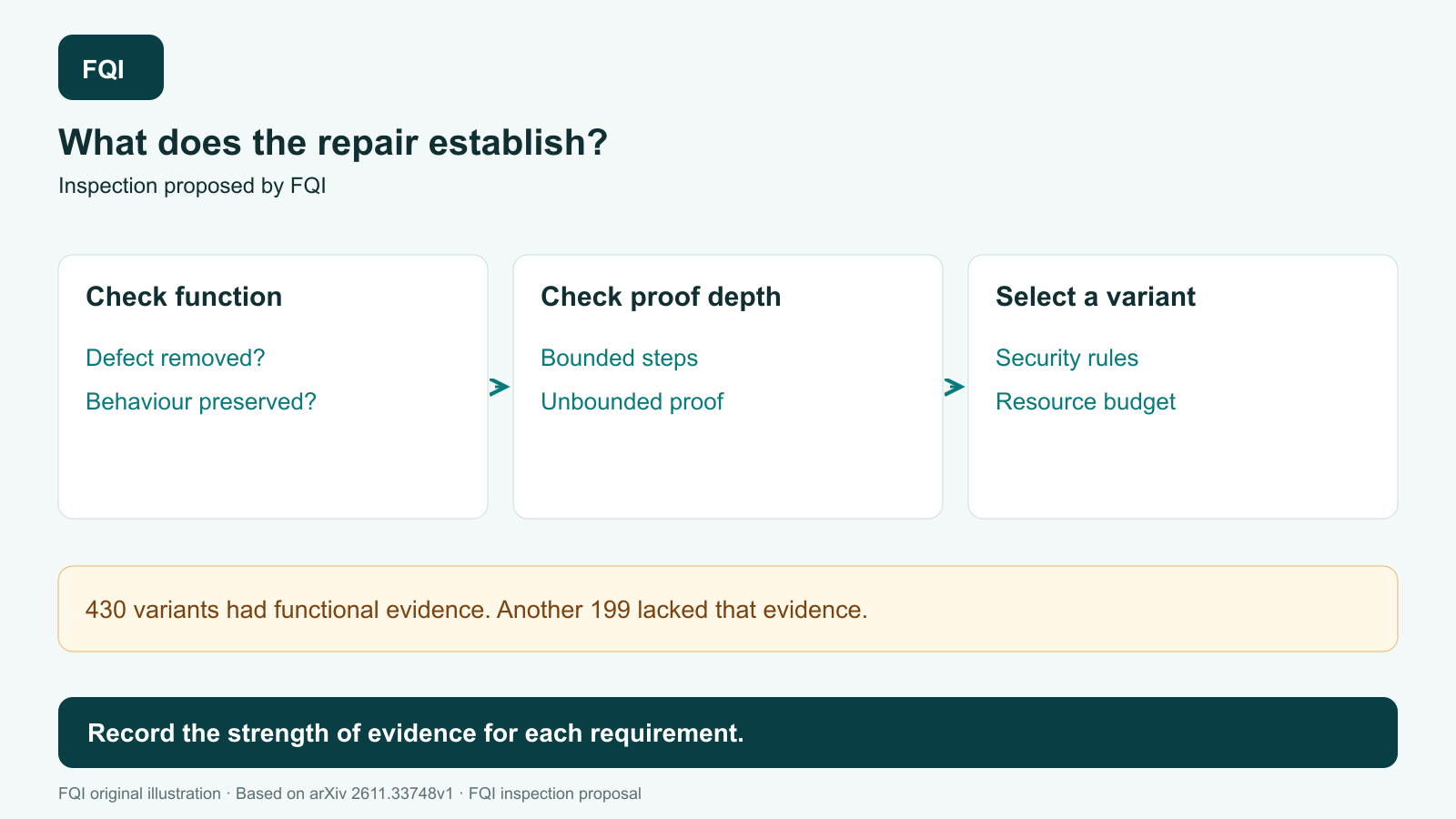
A change to a digital circuit description can pass simulation while leaving its behaviour under other conditions unverified. REFORGE examines repairs proposed by language models and records separate evidence for function, preservation of other behaviour, security checks and implementation resources. The distinction matters when a team counts successful repairs. Of 629 selected variants in this study, 430 had checked functional evidence. Another 199 had evidence from a configured security check only.
FQI takeaway
- Record function, preservation, security and resource use separately.
- Keep the proof depth and any missing result with the verdict.
- Check equivalence before counting files as independent alternatives.
The principle at a glance
A register-transfer description specifies how data moves through the elements of a digital circuit. A language model can suggest an edit to this description. Different tools then answer different questions about the edit. Does it compile? Does the failing case pass? Can a formal check establish the required behaviour within a stated range? Does the resulting implementation meet the resource budget?
Deep dive
The study covers 288 runs across three suites and three model backends. On CirFix, 32 of 63 runs produced a checked repair with the basic instructions. Adding structural context raised the count to 45. Adding diagnosis raised it to 51. The guided runs used 47% more new tokens, the units of text handled by the model. Computing budgets differed, which limits causal interpretation of the gain.
Even the 430 functionally checked variants vary in the strength of their evidence. In 140 cases the repair verdict was unbounded. In 290 it was bounded to at most 20 steps. A bounded check can support a claim within its horizon. Behaviour beyond that horizon needs additional evidence if the requirement extends further. Power, performance and area measurements have their own reference and acceptance criteria.
Different files can also describe equivalent circuits. The authors checked 408 pairs within groups sharing implementation metrics and found every one of those pairs functionally equivalent. This finding applies to the selected pairs. It shows why filenames and source differences alone cannot establish diversity.
Consider a simplified acceptance record for a control circuit. The failing sequence now produces the expected output. A required security check could not run. Recording both outcomes allows a reviewer to retain the functional evidence while keeping the remaining requirement open. The eventual decision can then refer to a particular version, reference circuit, proof depth and budget.
Limitations and risks
The security analyses covered configured rules and known classes of weakness. Unchecked properties remain open. Repeated model calls consume resources, and a missing reference implementation can prevent an overhead estimate. This is an early author version of an accepted conference paper. FQI reviewed the reported results and did not independently rerun the hardware tools.
FQI conclusion
A useful repair report lets the next engineer find the boundary of each claim. The engineer can see whether a particular behaviour was simulated or formally checked, how far the proof extends and which resource estimates are complete. Keeping those records separate also makes it possible to compare two candidate repairs on the properties the intended application requires.
Sources & transparency
REFORGE: LLM-Assisted RTL Bug Repair with Structured Context and Verification Feedback · arXiv v1
Author preprint v1. FQI checked the cited sections of the original study. Workplace examples and inspection proposals are FQI interpretations. The experiments were not independently replicated.
Codex drafted the texts and checked them against the original study. Johann Fischer authorized publication on that basis on 28 November 2026.