
Executive summary
A repaired routine can run without raising an error and still return a different amount, type or status from the one its users require. A study of 73 migration tasks examines which incorrect repairs a release test accepts. Adding an input derived from a documented runtime change was particularly effective. Even then, one group of plausible wrong repairs remained difficult to detect.
FQI takeaway
- Specify an observable requirement for each changed interface.
- Derive an input from the release note that separates competing implementations.
- Report false acceptance separately for variants designed to be hard to distinguish.
The principle at a glance
The experiment covers 60 documented changes in CPython, Node.js and SQLite. An old routine must continue to meet a contract under the new runtime. A language model chooses from prepared program variants. The researchers execute the variants on the real runtimes and compare their outputs with withheld requirements. This allows them to measure how many wrong variants a visible test would accept even before considering which one a model might choose.
Deep dive
With typical inputs, the gate checking all visible assertions accepted an average of 41.0 percent of wrong variants across the repair space. Adding an edge input based on the release note reduced the fraction to 6.5 percent. On previously unseen task clusters it was 6.1 percent. A separate model asked to write three inputs without seeing the program achieved 7.0 percent. These figures describe a test’s ability to distinguish variants within the experimental space. They do not estimate the prevalence of faulty production software.
A later stage introduced 233 hard wrong programs constructed to mimic the legacy output on typical inputs. With the targeted edge input the overall false-acceptance rate was 5.8 percent, but 16.8 percent of the hard wrong programs passed. An aggregate can thus conceal a weakness in precisely the plausible outputs that a user would have difficulty recognizing as wrong.
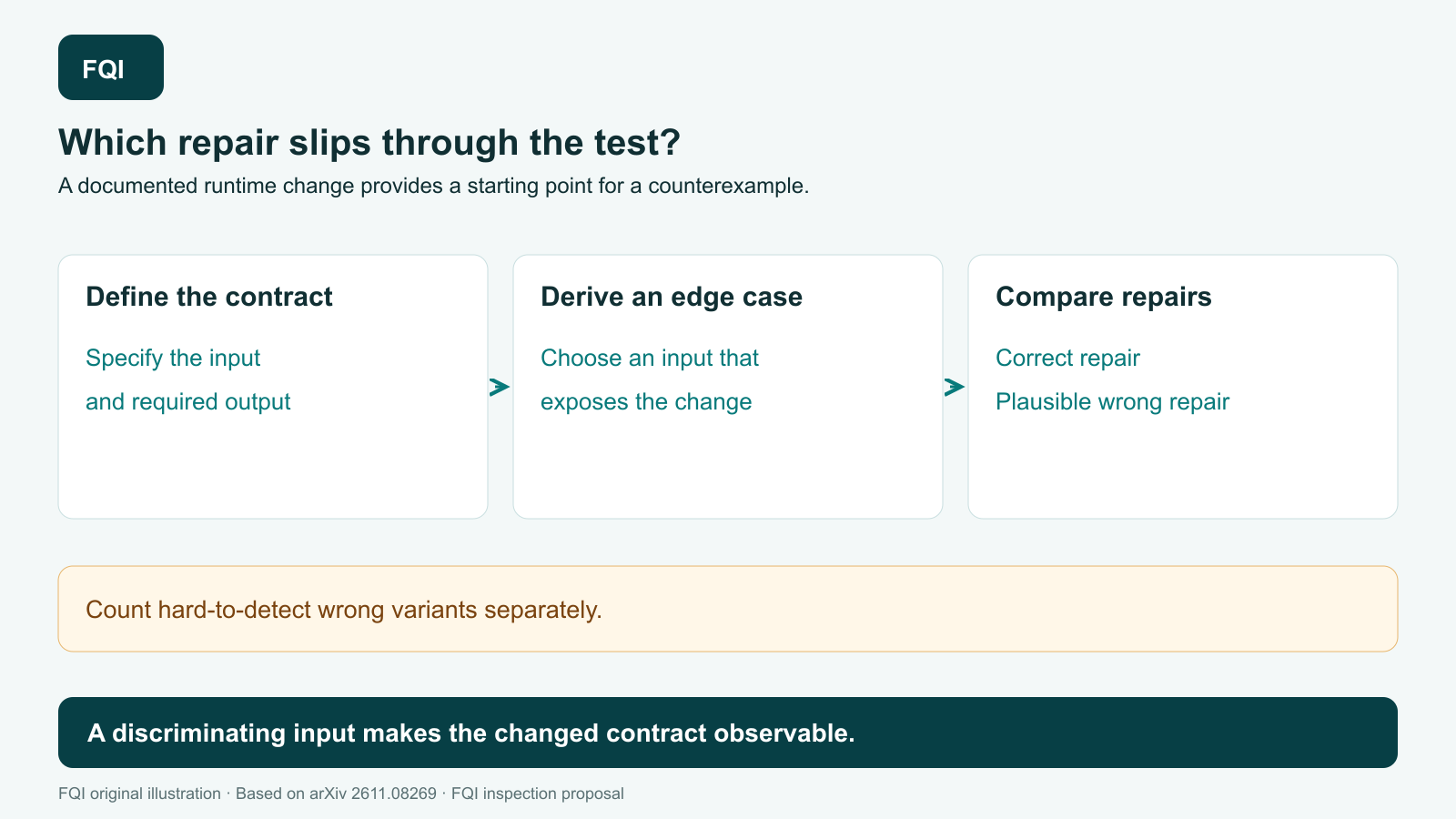
FQI proposes a small trial before releasing a migration. The interface owner takes one documented change, supplies an input and explains which outputs the old and new behaviours permit. The business owner separately specifies the required output. Run the test against a plausible wrong implementation as well as a correct one. If both pass, find another case that separates them.
For example, a status column might contain numbers after a migration. A single-record test can pass when a downstream routine accepts either text or a number. An input that requires grouping by the agreed status name exposes the difference. The business owner can specify the expected groups independently. The resulting test is tied to an observable business obligation under the new runtime.
Limitations and risks
The researchers executed prepared fragments, giving them control over the repair space. Large projects with dependencies, concurrent access and freely generated patches may have other failure modes. The additional test also needs a defensible expected result. If the migration deliberately changes an obligation, treating every legacy output as binding would reject some valid repairs.
FQI conclusion
Record the changed behaviour, discriminating input, required output and an incorrect implementation the test catches. This evidence is especially valuable where a plausible wrong value could pass unnoticed into downstream calculations. A green result then tells reviewers which part of the migration the test actually exercised.
Sources & transparency
The methods, figures and limitations come from the authors’ publicly accessible paper. The proposed workplace test and simplified example are FQI interpretations. Study record. Original study.
Guidance from the National Institute of Standards and Technology (NIST) offers a framework for planning evaluation in the intended context of use. The numerical results in this brief come from the study. NIST evaluation guidance.
Artificial intelligence assisted preparation. Johann Fischer approved this article package for publication on 2026-11-06.