
Executive summary
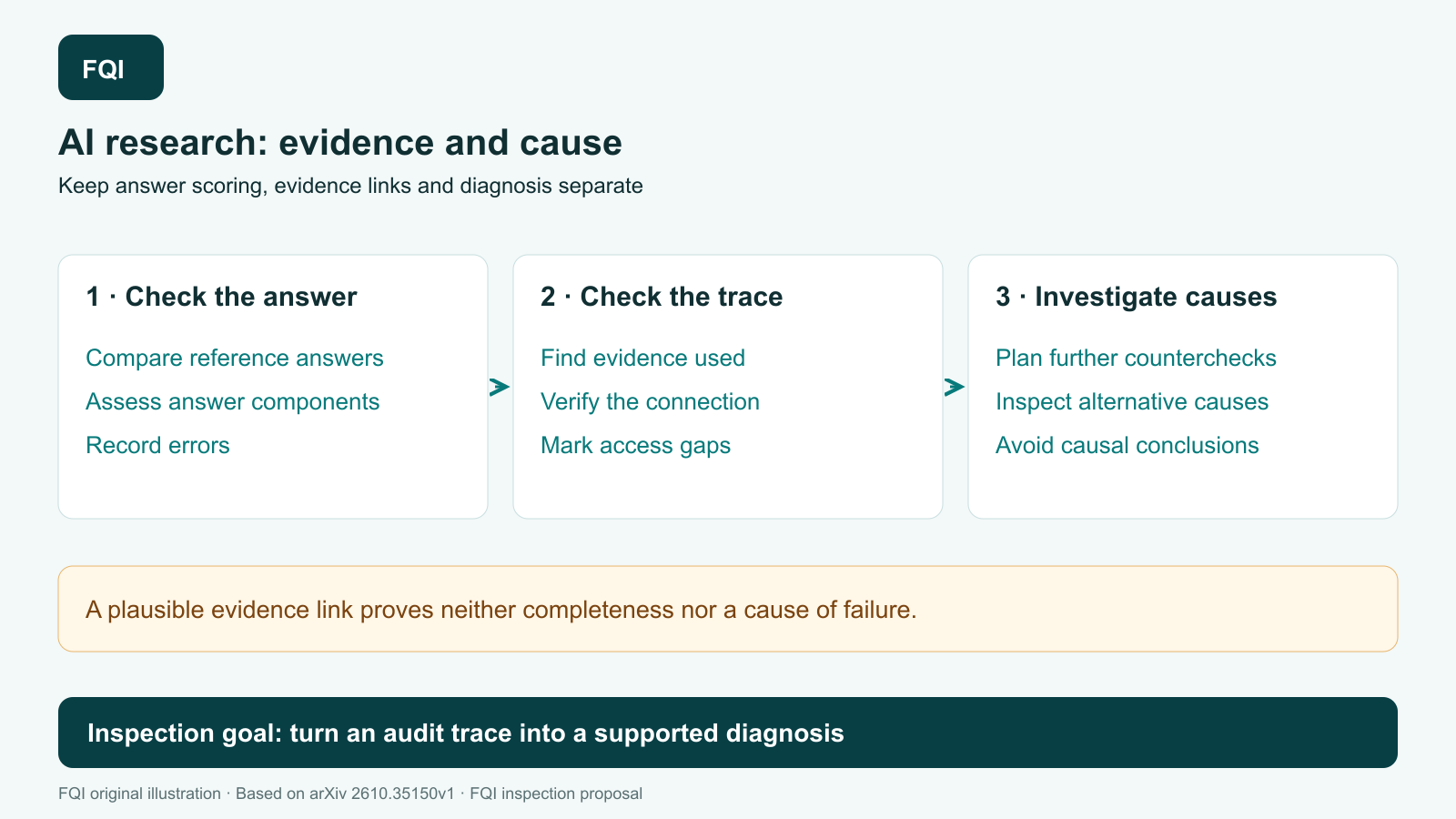
An incorrect artificial intelligence (AI) research answer can often be linked to particular points in its search history. That does not establish that the error originated there. LongSearchEval separates source-grounded answer verification from retrospective association with relevant trajectory steps. The research provides a basis for traceable research audits. For FQI, the key is to bound each piece of evidence: a verified association helps investigation, while a claim about causation needs additional support. Precise-looking diagnostic metrics should not silently acquire a stronger meaning.
FQI takeaway
- First check answer groups against the original pages actually cited.
- Label associated trajectory steps as investigation leads.
- Measure precision of returned links separately from completeness of error discovery.
The principle at a glance
A language-model research agent performs several search and reading steps. Its execution record contains tool calls, visible observations and the final response. LongSearchEval retains actual trajectories under a shared execution protocol.
The first evaluation stage divides the response into groups and checks their claims against the agent’s cited sources. The second looks retrospectively for related content in the trajectory. It already knows the final response and the first-stage judgments. Its links are therefore not independent observations of the moment an error began.
Deep dive
The study covers sixteen models and one hundred tasks, retaining 1,600 runs. Two model-based judges and arbitration produce the automated evaluation. Model identities are hidden during judging. A common protocol supports comparison within that experimental setting, without representing every real research environment.
Human validation examines 946 supplied answer groups from 200 responses. Agreement with automated group judgments is 94.50 percent. In a separate trajectory sample, reviewers check all 317 returned links; 311 exhibit the required concrete correspondence. A shared source or specific feature can establish such a relationship. Topic similarity alone is insufficient.
These results have different denominators. High precision among returned links does not establish that all relevant error locations were found. Nor does it show that the earliest linked round was the agent’s first erroneous commitment. Even a correct webpage observation can help explain a later answer discrepancy.
FQI proposes two-stage documentation. For each answer group, first record the inspected claim, supporting source and finding: correct, incorrect or unverifiable because of access failure. Then link trajectory steps with a concrete documented relationship. The explanation should identify the matching feature and state what the association does not establish.
As a simplified example, an agent researching a technical specification reads the correct table but later copies a value from the wrong row. That table is a useful investigation point. Whether the cause was context loss, a faulty summary or something else remains unresolved without further assessment. A diagnostic interface should preserve that uncertainty instead of assigning a definitive root cause automatically.
Limitations and risks
The stages depend on one another. An incorrect judgment about the final answer affects which trajectory links are retained. Human validation also inherits the supplied answer-group boundaries; it does not independently validate every possible way of decomposing the response.
Unavailable sources must be distinguished from fabricated or irrelevant citations. The paper makes that distinction, and an operational audit should too. Reported agreement does not replace validation on local source types or inspection of associations the method never returned. Results support investigation within the studied protocol rather than universal fault localization.
FQI conclusion
The paper supports a traceable audit with two separate questions: is the answer supported, and where can its development be investigated? FQI recommends preserving that distinction in reports and interfaces. A linked trajectory step is an inspectable lead, not a proven cause. Respecting that boundary allows automated assessment to direct human review without turning high correspondence precision into an unsupported claim of complete or causal diagnosis. Application-specific reference checks remain necessary before relying on those diagnostic outputs.
Sources & transparency
Primary source: LongSearchEval: Evaluating Long-Horizon Web Search Capabilities of Large Language Models via a Trajectory-Aware Agent Framework with Failure-Node Localization; versioned original. The public original was read on 29 October 2026. This is a research preprint; completed peer review is not assumed. The reported experiments were assessed editorially, not independently reproduced. Operational checks and examples are FQI interpretations, not demonstrated results of industrial deployment. AI-assisted article. Editorially approved by Johann Fischer on 2026-10-31.