
Executive summary
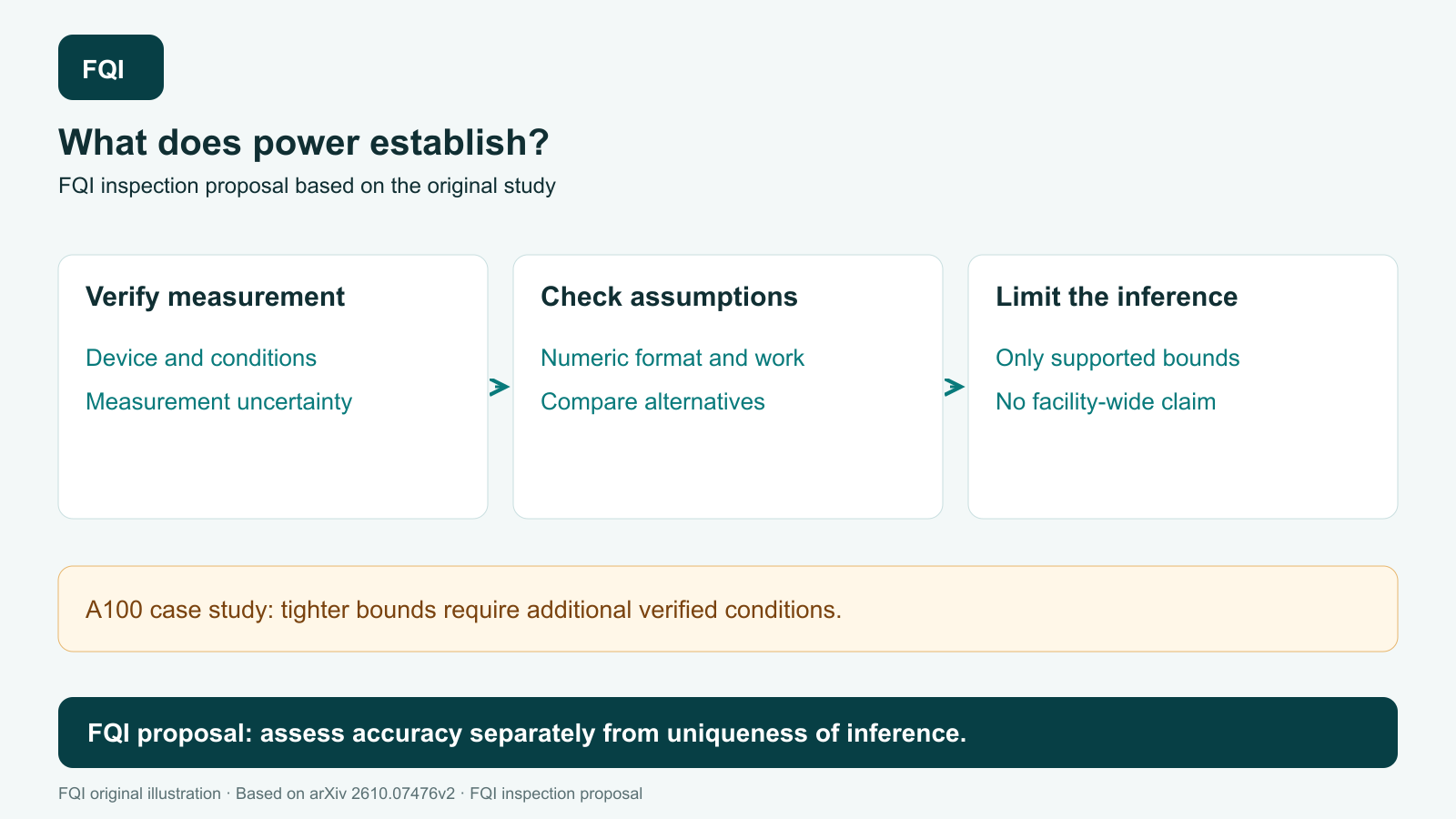
Can power measurements establish how much computation artificial intelligence (AI) systems actually performed? A study examines how much additional computation could remain compatible with an observed power trace. In its A100 case study, power alone constrains this ambiguity only weakly. Tighter claims require assumptions about hardware, numeric format and permitted workloads. For quality management, an accurate measurement is not automatically an unambiguous account of the activity being audited. The connection between the measured quantity and the claim needs explicit justification.
FQI takeaway
- Assess measurement accuracy separately from the uniqueness of the resulting inference.
- Bind tighter computation limits to verifiable operating assumptions.
- Do not transfer device-level findings directly to entire data centres.
The principle at a glance
The AI connection is the verification of computation budgets for AI governance. The paper does not propose a better prediction model. It investigates a possible technical audit channel: how much undeclared computation could still be consistent with the visible measurement?
Different computations have different energy costs per operation. Numeric formats, operand values and operating conditions affect that relationship. Equal energy consumption therefore does not necessarily imply the same number of comparable computational operations.
Deep dive
The authors combine a mathematical bound with measurements on NVIDIA A100 graphics processors. A controlled experiment varies numeric format, operand locality and operand distribution for a fixed matrix calculation. It measures how energy cost per counted operation changes under those conditions.
The paper distinguishes measured factors from assumptions. Clock frequency was not freely swept in the central experiment; the corresponding width is a physical estimate. Published peak capabilities are also not performance values measured in that same setup. These distinctions matter because a calculated bound depends on its inputs and assumptions.
The reported relaxed upper bound is 1.16 in units of declared machine capacity. A deliberately matched schedule demonstrates at least 0.41 such units of physical ambiguity. These numbers are not detection probabilities or direct percentages of an arbitrary data centre. They refer to the paper’s definitions and conditions.
Under substantially stronger restrictions, the case study obtains a bound of 0.059. Those restrictions include observed operating conditions, transferable re-execution of declared work and a constrained class of covert workloads. The smaller number cannot be promoted as the general accuracy of power-based auditing without its assumptions.
FQI recommends starting with the audit claim: which additional activity must be excluded? Then identify alternative schedules that could produce the same measurement. Independent information can narrow the inference only when it rules out relevant alternatives.
A simplified FQI example is checking an agreed AI computation budget on known hardware. The assessor records the measurement device, hardware version, allowed numeric formats and permitted workload class. A change to any of these conditions triggers reassessment. This is a derived inspection recommendation, not a contractual audit process validated by the study.
The assessment should also separate quantity from task identity. Even a defensible bound on total operations does not establish whether a particular training or inference task occurred. That is a different claim and may require a different observation channel or additional verified records.
Limitations and risks
The empirical evidence concerns specific hardware and selected workloads. Memory-bound programs, other devices and complete facilities may exhibit different relationships. An external supply-side meter is also different from the on-device counters used in the study.
Additional channels might provide further information, but the paper does not validate a complete multichannel system. Its tighter bound is a case study under explicit restrictions, not a universal bound on arbitrary useful computation. Facility-level transfer and retrofit measurement remain further work.
Specifically, the 0.059 bound assumes observed operating point and locality, transferable re-execution with the stated hardware gap, and one of the two measured transformer-block workloads or a separately justified class with the same energy-cost floor. It also assumes resident-workload overhead rather than cold-card overhead.
FQI conclusion
The paper makes an audit gap concrete: a quantity can be measured correctly while the desired conclusion remains ambiguous. FQI recommends placing an assumptions record beside the measurement result. Narrow bounds remain valid only while their conditions are supported. For AI computation budgets this offers a route to better evidence, but it does not establish general external monitoring of arbitrary data centres.
Sources & transparency
- Can Power Draw Constrain Covert Compute? Limits of Analogue Verification for AI Governance
- Can Power Draw Constrain Covert Compute? Limits of Analogue Verification for AI Governance
Codex assisted with drafting and checked the claims against the cited original study. Results were not independently reproduced. Operational recommendations and simplified examples are FQI interpretations.
On 2026-11-21, Johann Fischer authorized editorial approval following source and quality review by Codex. Approval relies on that review; individual human reading is not claimed.