
Executive summary
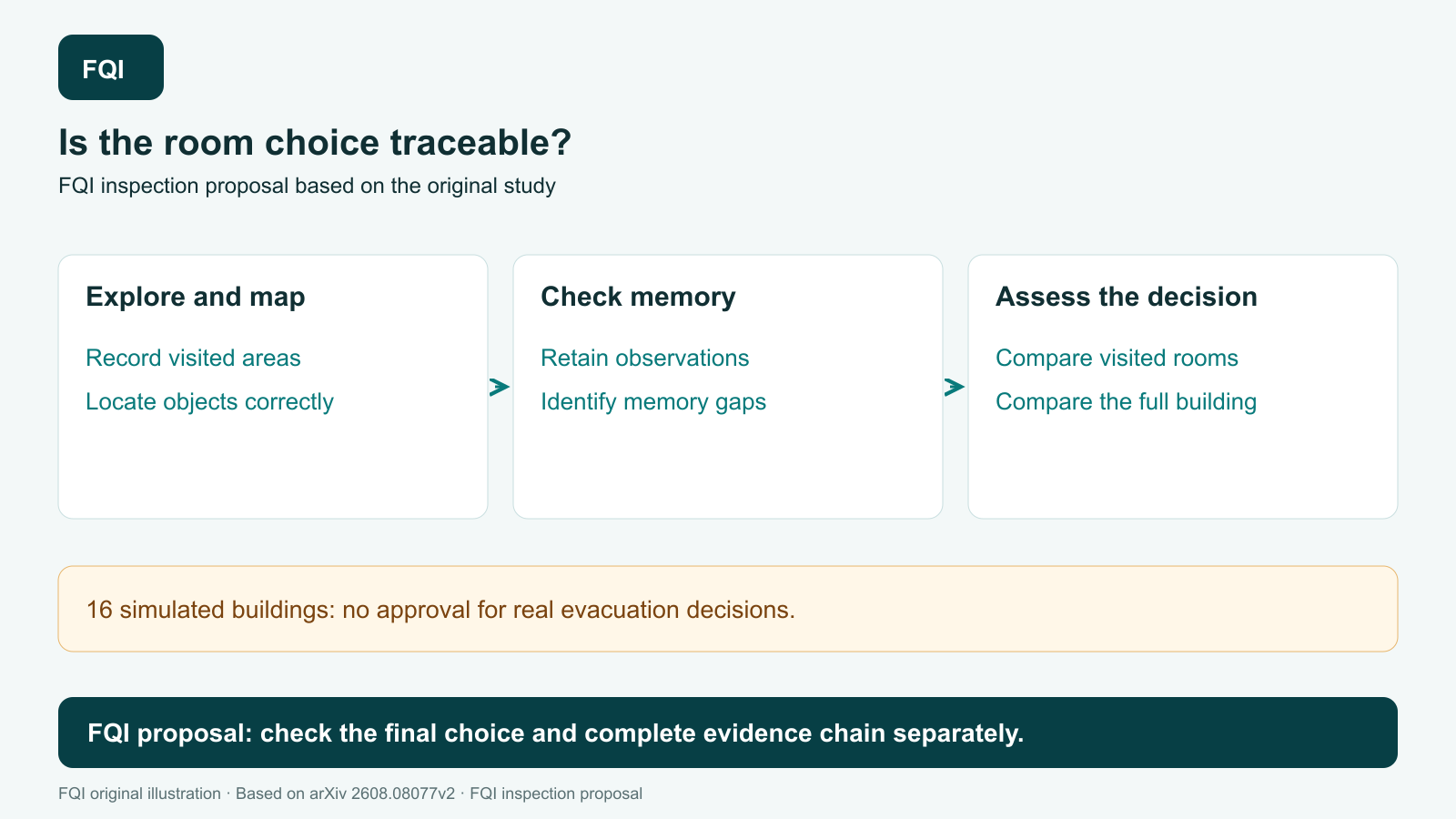
An artificial intelligence (AI) agent can select a plausible room despite incomplete exploration, incorrect mapping or forgotten observations. EMRD separates such decisions into four assessable stages: exploring, mapping, remembering and deciding. The study evaluates eleven vision-language models in 16 simulated buildings. For quality management, the final choice is insufficient on its own; its preceding evidence chain also needs to hold. The experiments do not support operational safety approval for real evacuations.
FQI takeaway
- Evaluate exploration, mapping, memory and final choice separately.
- Compare decisions against both visited rooms and the complete building.
- Vary the starting point, visibility and memory aid as distinct test conditions.
The principle at a glance
Vision-language models process images and verbal instructions. In the experiment they control an agent through discrete actions in unfamiliar buildings and eventually select a suitable gathering room. They must observe relevant objects, associate them with the correct location and use that information later.
EMRD exposes these intermediate stages through 18 stage-specific metrics. A failure to explore can therefore be distinguished from forgetting. This supports diagnosis even though the framework does not explain the model’s internal mechanisms.
Deep dive
The environment contains homes, offices, clinics and schools, with 80 rooms in total. The authors compare a track with an external notepad against a track that supplies the full interaction history. They also apply darkness, smoke and motion noise to stress different stages of processing.
Room choice is assessed using several unranked criteria, including hazards, passage, access and space. The evaluation distinguishes whether a better room existed among those entered or somewhere in the full building. This separates a decision based on incomplete exploration from a poor choice despite sufficient observations.
The stated justification is checked as well. Object claims are compared with available observations, while doorway and layout claims are checked against the building structure. Unverifiable claims are reported separately. A convincing explanation cannot simply substitute for missing observations.
The findings reveal different weaknesses along the chain. Darkness particularly affects correct mapping; dense smoke reduces what can be seen in the first place. An external memory aid does not automatically solve every problem and can accompany premature stopping. The starting location also influences which rooms become known to the agent.
For comparable inspection agents, FQI recommends a stage-level record. Document the areas visited, relevant cues actually visible, information retained and evidence supporting the final choice. A good final answer with an incomplete evidence chain should remain identifiable as a distinct outcome.
A simplified FQI example is a virtual walkthrough used to prepare an equipment inspection. The agent chooses an apparently suitable inspection area but never visits another relevant area. The report should expose that coverage gap rather than accepting the choice solely because it sounds plausible. The paper did not perform this industrial experiment.
The comparison against visited and all rooms also helps separate local decision quality from survey completeness. An agent may choose well among what it knows while still lacking the information needed for the full assignment. Those are different acceptance questions and should not be collapsed into one success score.
Limitations and risks
The buildings are simulated, actions are discrete and hazard rules are simplified. Real emergencies change during decision-making. People, blocked exits and evolving hazards require additional modelling. The study also does not establish why the observed failures arise internally.
Models run with particular processing budgets and configurations. Some settings differ for technical or cost reasons. Results therefore apply to the tested system versions rather than every possible use of the same model family. The gathering-room criteria are not a complete real-world safety assessment.
FQI conclusion
EMRD provides a useful structure for assessing multistage AI observations. FQI recommends reporting final success together with evidence completeness. This reveals whether an improvement affects perception, memory or only the final selection. Operational transfer still requires representative environments, hazards and human assessment roles. The simulated study supports more detailed test planning, not autonomous use in real emergencies.
Sources & transparency
- Explore, Map, Remember, Decide: A Benchmark for VLM Readiness in Safety-Critical Scenarios
- Explore, Map, Remember, Decide: A Benchmark for VLM Readiness in Safety-Critical Scenarios
Codex assisted with drafting and checked the claims against the cited original study. Results were not independently reproduced. Operational recommendations and simplified examples are FQI interpretations.
On 2026-11-21, Johann Fischer authorized editorial approval following source and quality review by Codex. Approval relies on that review; individual human reading is not claimed.