
Executive summary
Quantisation can change a language model, and the procedure used to measure the change can influence its apparent size. A study compares eight small models at three numerical precisions on matched items. It examines how answer scoring, question format and batch composition affect measured behaviour. For quality teams, the relevant decision is whether the observed difference survives a change of measurement method and remains visible on the individual cases that matter for use.
FQI takeaway
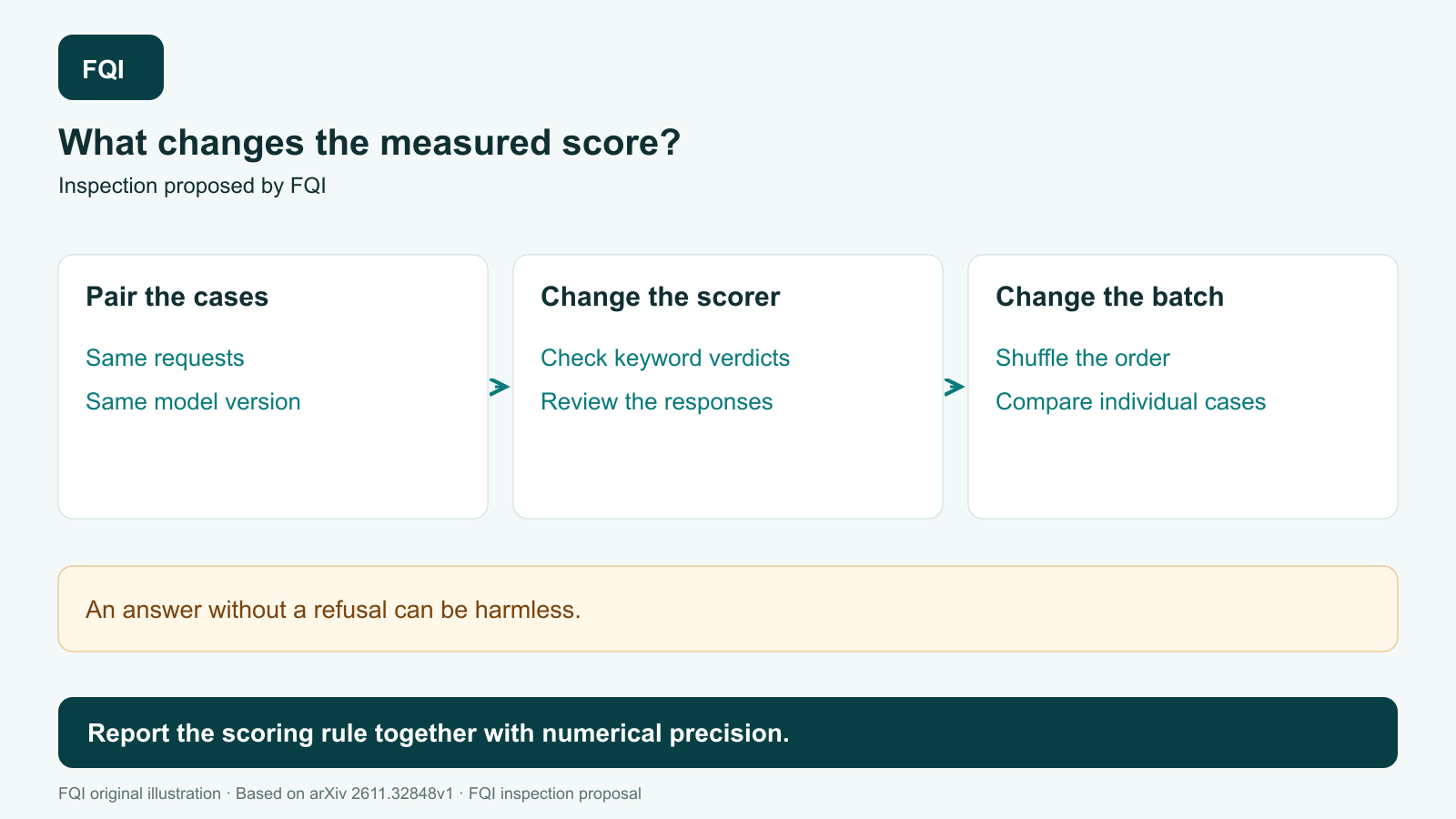
- Compare precision settings on identical questions with an independently checked scoring rule.
- Change batch composition and inspect individual outputs as well as averages.
- Distinguish a refusal, a harmless answer and actual harmful compliance.
The principle at a glance
Quantisation stores or computes some values using fewer numerical levels. The authors compared a 16-bit reference with two particular 8-bit and 4-bit configurations. A keyword detector can recognise a familiar refusal phrase, but an answer without that phrase might still be safe. If the frequency of such cases changes with precision, the detector can distort a paired estimate even when every version receives the same question.
Deep dive
The models had fewer than two billion parameters. The authors studied refusal detection, multiple-choice presentation, grouping of items into batches and interpretation of calibration changes. Two human annotators assessed a sample of 100 responses. Their adjudicated labels provided a reference for estimating how automatic verdicts related to the behaviour being measured.
With the 4-bit configuration, harmful compliance increased by an estimated 2.6 percentage points after human calibration. The corrected keyword detector recorded a drop of 4.7 percentage points in refusals. These quantities have different definitions. Some additional non-refusals were harmless, and some responses counted as non-refusals were still refusals in the human assessment. The choice of instrument therefore affected the estimated size of the change.
A separate experiment altered which questions shared a batch. With the tested 8-bit configuration, changing the order could change a response or the selected answer. In some comparisons, even padding the input changed answers. The tested NF4 configuration was invariant to batch composition in the reported checks. The implementation and the grouping of test inputs are consequently relevant parts of the measurement record.
For a local evaluation, FQI would save the original responses and the item identifiers. Apply an alternative scoring rule to the same outputs, then separately regenerate outputs after changing batch order. The first comparison tests the scoring procedure. The second checks whether the execution condition changes the response itself. Cases on which the verdict changes deserve a content review, even when the overall proportion barely moves.
Limitations and risks
The findings concern small models and specific quantisation configurations. The human reference was limited and agreement before adjudication was only fair. Responses in the main safety evaluation had a limited output length. Results about preferences among given answers have a narrower interpretation than results about freely generated text. A production test must identify the hardware, implementation and actual use conditions.
FQI conclusion
An earlier FQI brief examined how compression affects different behaviour domains. This study adds another source of variation within a domain, the measuring instrument. Keeping the question, raw response, automatic decision and reviewed decision together makes the effect inspectable. A team can then judge whether a regression belongs to the model, the execution settings or the way its outputs were scored.
Sources & transparency
Measurement Artifacts in Trustworthiness Evaluations of Quantized Small Language Models · arXiv v1
Author preprint v1. FQI checked the cited sections of the original study. Workplace examples and inspection proposals are FQI interpretations. The experiments were not independently replicated.
Codex drafted the texts and checked them against the original study. Johann Fischer authorized publication on that basis on 26 November 2026.