
Executive summary
An artificial intelligence (AI) evaluator can judge a conversation broadly or assess the criteria used by human experts. A study of three German conversation corpora finds advantages for the second approach when transferring to a held-out corpus. The quality-management decision therefore starts with the assessment instruction: do the requested features match the expert instrument? Observed rank agreement does not yet authorize binding grades, automatic acceptance or assessment of real consultations outside the studied setting.
FQI takeaway
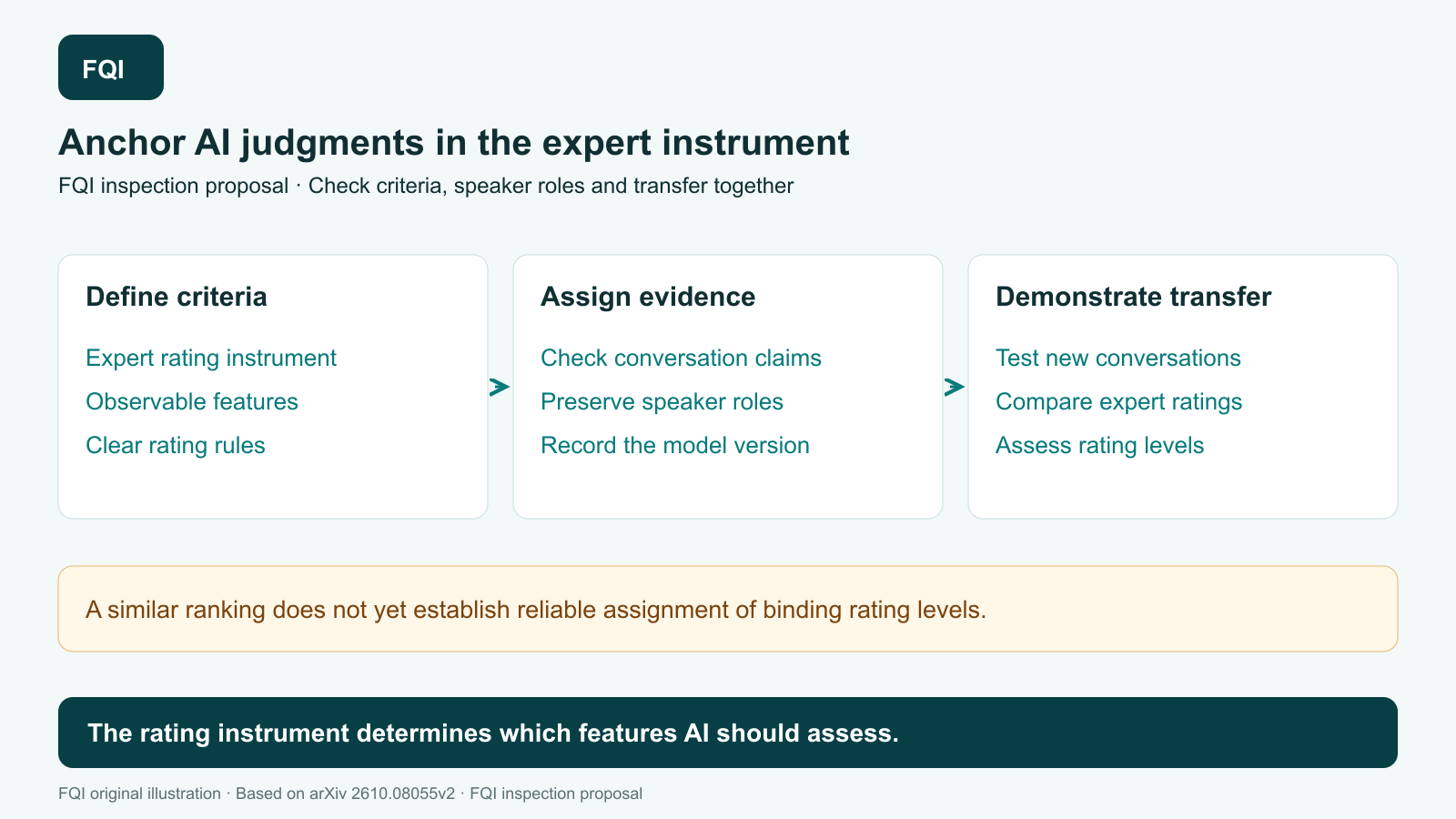
- Derive AI assessment questions from the expert instrument and version them.
- Test transfer to an application domain excluded from training.
- Assess speaker attribution and rank agreement separately from binding grades.
The principle at a glance
The language models act as feature extractors. They read transcripts and assess bounded properties such as structure or specific communication techniques. A separate statistical model relates these features to an expert’s overall impression.
Such a system can order conversations usefully without producing correct absolute scores. A feature may also help predict the overall impression without being validated as an individual feedback criterion. Both boundaries matter when choosing the eventual use.
Deep dive
Hallmen and André examine 195 simulated conversations from one university. Two corpora concern medical education and one parent–teacher conversations. Small locally executed language models extract criterion scores from transcripts. A compact additional feature block supplies further conversation information.
The main evaluation holds out one entire corpus and trains the prediction model on the other two. Selection of the evaluator ensemble takes place within the training corpora. The held-out domain therefore does not already determine the final ensemble. Results are compared with training inside that target corpus on the same evaluated sessions.
The authors report a transfer rank correlation of approximately 0.53 for the combined system. Language features alone perform almost as well. This is not the proportion of correctly graded conversations: rank correlation measures ordering, not accuracy at a pass threshold.
For the present quality question, the comparison of instructions is especially relevant. Features anchored in the experts’ actual assessment instruments outperform generic dialogue-quality questions. Repairing speaker attribution also materially improves one affected corpus. An apparent model weakness may therefore originate in preparation of the assessed material.
FQI proposes a bounded pilot for structured quality conversations. Define every criterion through observable evidence and specify whose statements are assessed. Compare generic and instrument-based instructions on the same held-out conversations. This directly tests the benefit of criterion anchoring instead of attributing a better overall result to an entirely changed configuration.
Record transcription errors and speaker-assignment errors separately. Expert sampling should establish whether the text represents the conversation adequately. Treat preprocessing changes as distinct experimental variants so their effects are not incorrectly credited to the language model.
If the initial purpose is merely to prioritize human review, evaluate that use separately. Binding grades, personnel decisions and automatic acceptance need additional evidence appropriate to their consequences. Predicting an expert’s overall impression also does not validate every extracted criterion as a useful individual recommendation.
The assessment report should therefore name its current permitted use. A ranking aid, a formative feedback system and an acceptance instrument are different products, even if they share the same model outputs. Moving between them requires a new comparison with suitable expert references.
Limitations and risks
Only three simulated German-language corpora from one institution were studied. Each conversation carries one expert rating, and human ratings are not perfectly consistent. Other languages, real counseling and different rating cultures remain untested. Some comparisons vary model family and task instruction wording together. Local execution limits external transfer of recordings but does not replace operational access and data-protection arrangements. Individual criterion validity also remains a separate research question.
FQI conclusion
An AI evaluator first needs a suitable technical measurement task. The study supports deriving features from the actual assessment instrument and testing transfer under controlled conditions. FQI additionally recommends treating speaker attribution as part of the measurement system. A useful first deployment may prioritize human review. Whether it can later provide reliable absolute grades or automated decisions requires separate reference data, explicit operating limits and evidence for that specific use.
Sources & transparency
Primary source: Instrument-Anchored LLM Judges Transfer Expert Counseling-Quality Ratings Across Three German Corpora; versioned full text reviewed. Relevant methods, results and limitations were reviewed on 2 November 2026. Scientific preprint; FQI has not independently reproduced the findings. Operational inspection plans and examples are FQI interpretations, not additional experiments reported by the authors.
Artificial intelligence assisted preparation. Johann Fischer explicitly approved this article package for publication on 2026-11-02.