
Executive summary
One language model carries out a task and another judges the execution. The verifier may see every step in a laboratory but only a compact tool-call summary in production. A study presents different views of the same frozen executions to the same verifier. Under certain macro and delegation conditions, about 31% of initially correct judgments are lost. Restoring the underlying evidence tests whether the trace view itself caused the change.
FQI takeaway
- Keep the original execution and its independently established reference judgment.
- Ask the same verifier to evaluate the view actually available in operation.
- Record wrong decisions, abstentions and recovery after evidence restoration separately.
The principle at a glance
A single visible tool call may cover several internal steps. Delegation and compacted histories also change what the verifier can see. A missing receipt might make a correctly completed action look unsupported. Conversely, a verifier might approve a result despite lacking the evidence needed to establish a prerequisite. Reliability therefore depends in part on the interface through which execution evidence reaches the verifier.
Deep dive
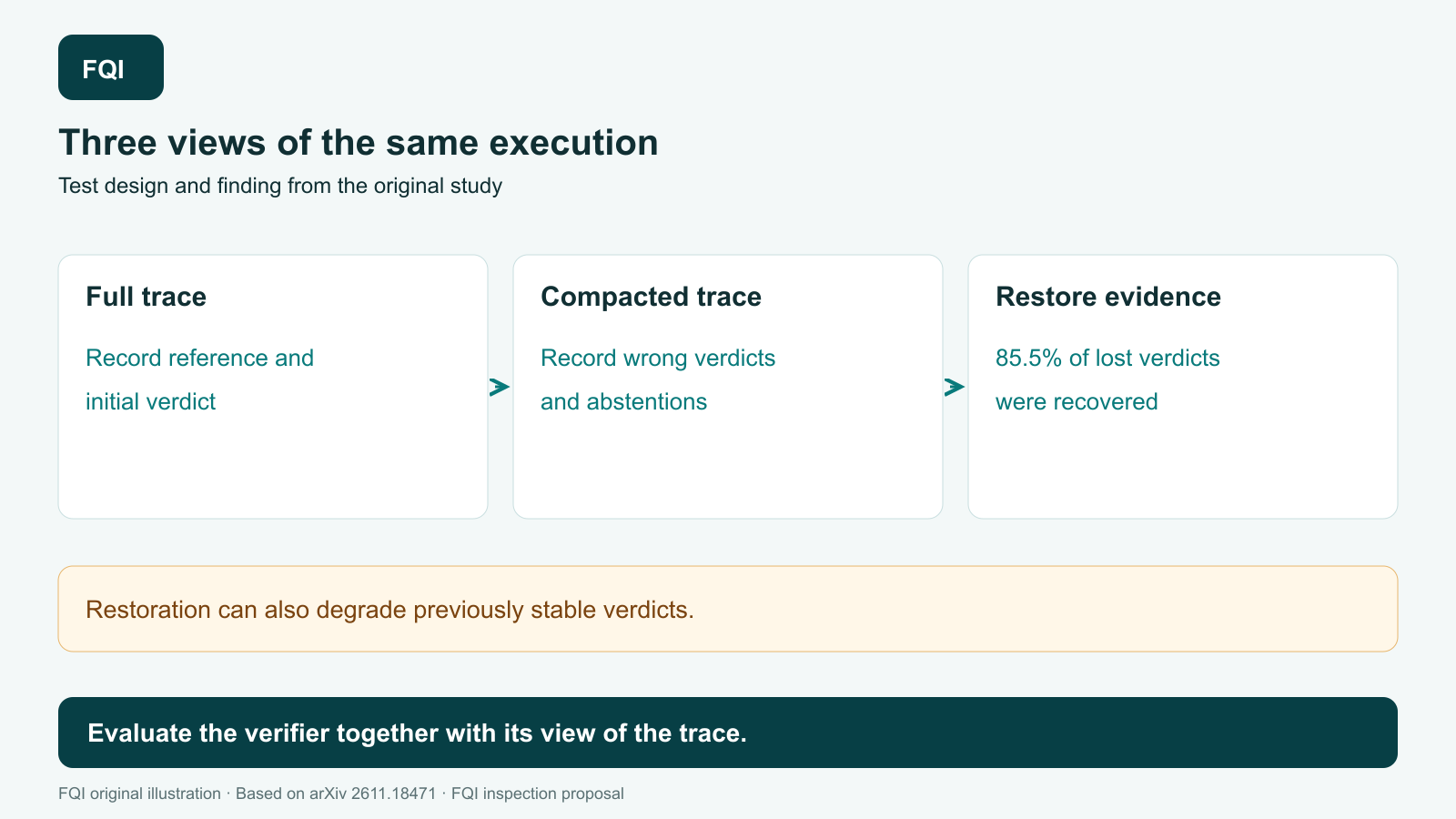
The researchers compare native, abstracted and restored views. The task, realized trajectory, outcome, reference answer and evaluation criterion remain fixed. They investigate four evaluation benchmarks, seven verifier backbones and four verification protocols. The denominator for transport failure consists of initially correct judgments. The roughly 31% figure refers to particular abstraction conditions, not all judgments across every protocol.
Restoring provenance recovered 85.5% of the abstraction-induced failures overall. There was movement in the opposite direction too. Of the judgments that survived abstraction, 5.2% degraded after evidence was restored. Examining only recovered cases would hide that effect. Evidence-seeking protocols were more prone to abstain, whereas direct verification more often produced an incorrect verdict. An abstention can trigger a manual check. An incorrect approval can prevent one.
A quality team could retain a completed order with a documented reference. When the trace interface changes, compare decisions on both views and count transitions between correct, wrong and undecidable. Then restore the missing receipts. If the original judgment returns, the next test can focus on that part of the display. Record why each change matters. Removing duplicate status messages and removing the only confirmation of a required inspection have different implications.
There is a further distinction for acceptance reporting. One reference describes what actually happened during the execution. Another question asks what conclusion a careful reviewer could justify from the available record. A compact view may fail the second test even when the underlying action was entirely correct. Recording both questions helps an investigator decide whether to change the logging interface or investigate the agent itself.
Limitations and risks
The study measures verifier behavior on benchmarks. It does not measure the cost of reinspection or the rate of operational damage. An omitted record can be restored only if it was captured in the first place. Repeated judgments by the same verifier may also vary.
FQI conclusion
For release of a compact trace view, specify what may disappear, which claims remain verifiable and when a reviewer needs the underlying events. The evidence interface can then be tested as part of the process change, alongside the model that reads it.
Sources & transparency
The study is an author preprint. The proposed operational checks are FQI interpretations. Do Verifier Judgments Survive Abstraction? Measuring Verification Transport for LLM Agent Evaluation · Version history
Codex assisted with drafting and checked the claims against the cited original sources. Johann Fischer authorized publication on 2026-11-16.