
Executive summary
When a safety policy keeps the same meaning, editing its wording alone should rarely change the verdict on a recorded case. A preprint tests this expectation for language models that judge other agents. Equivalent rewrites flipped up to 9.1 percent of verdicts above ordinary repeat-run variation. The comparison provides a practical acceptance test for an evaluator before it is trusted to score other systems.
FQI takeaway
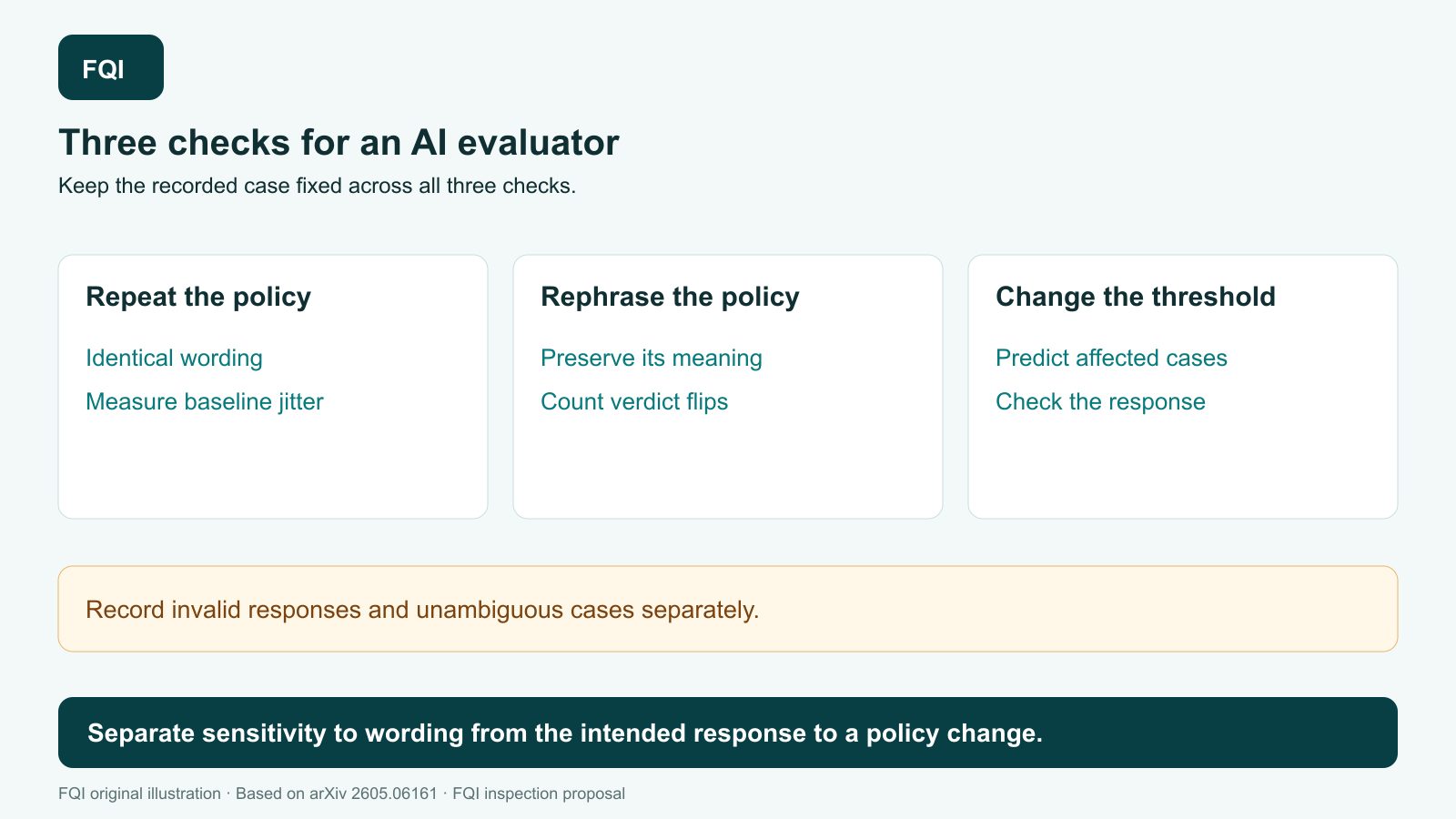
- Establish which wordings preserve the requirement before running the trial.
- Repeat the unchanged case with exactly the same rule.
- Separate flips on clear cases from responses to deliberate changes of threshold.
The principle at a glance
The evaluator sees a recorded trajectory and a rule. The researchers change either the presentation of the rule or its substantive threshold. An exception may move within the text without changing its scope. A deliberately narrower exception changes the set of permitted actions. A judge that always returns the same answer could score well on repeatability while overlooking the second type of change. Both comparisons are therefore necessary.
Deep dive
First the protocol measures how often the evaluator changes its mind on an identical case. This gives a baseline against which additional flips under rewording can be judged. The researchers also ask whether the changes concentrate on cases that were already ambiguous. Depending on the condition, 18 to 43 percent of observed flips under equivalent wording occurred on cases classified as unambiguous. This percentage describes the composition of the flips, not the error rate across all clear cases.
For a local trial FQI suggests a small archive of fully recorded cases. Two domain specialists can independently decide whether a rewrite preserves the original obligations and exceptions. If they disagree, clarify the rule first. Only then can that wording serve as a useful test of the evaluator. A second group contains deliberate changes with a predeclared list of boundary cases that should receive a different verdict.
Record invalid or unreadable responses as well. The paper shows for one model that treating invalid responses as potential flips can substantially change the result. Report both the number of valid pairs and the number for which only one response could be scored. A missing machine-readable decision is an operational outcome in its own right.
As a simplified example, consider a rule with an exception for traceable reference parts. Moving the exception within the text should preserve its scope. Restricting it to a named laboratory should change the treatment of cases from other laboratories. Marking the affected records in advance makes it possible to tell whether the judge understood a genuine change or reacted to word placement.
Limitations and risks
Equivalence needs domain judgement. A small shift in scope can make an apparently editorial change substantive. The study evaluates agent safety benchmarks. Each team must measure the frequency of such effects on its own audit rules. Consistency alone also leaves open the possibility that a stable verdict is wrong.
FQI conclusion
Keep a case list showing which edits flip clear decisions and which intended rule changes trigger the expected response. Together with ordinary accuracy, the list can inform a decision about putting a new rule version into service or returning it for clarification.
Sources & transparency
The methods, figures and limitations come from the authors’ publicly accessible paper. The proposed workplace test and simplified example are FQI interpretations. Study record. Original study.
Guidance from the National Institute of Standards and Technology (NIST) offers a framework for planning evaluation in the intended context of use. The numerical results in this brief come from the study. NIST evaluation guidance.
Artificial intelligence assisted preparation. Johann Fischer approved this article package for publication on 2026-11-06.