
Executive summary
A generated software test can accept the wrong solution. The consequence becomes particularly important when its verdict rewards a language model during training. HardTestGen checks generated tests against programs with a separate competitive-programming verdict. The authors report roughly eleven percentage points higher precision than the comparison tests. The operational meaning depends on which programs form the denominator.
FQI takeaway
- Compare test-suite verdicts with an independently defined reference.
- Among accepted programs, count those that also pass the reference check.
- Measure how often a correct program fails an unsuitable test.
The principle at a glance
A programming problem specifies the permitted inputs and expected outputs. Many implementations solve the ordinary examples. They may differ only at a boundary or on an unusual combination of valid values. More tests add little if they repeatedly exercise the same property. A mistaken expected output can also reject a valid implementation. The reliability of the suite therefore has two error directions.
Deep dive
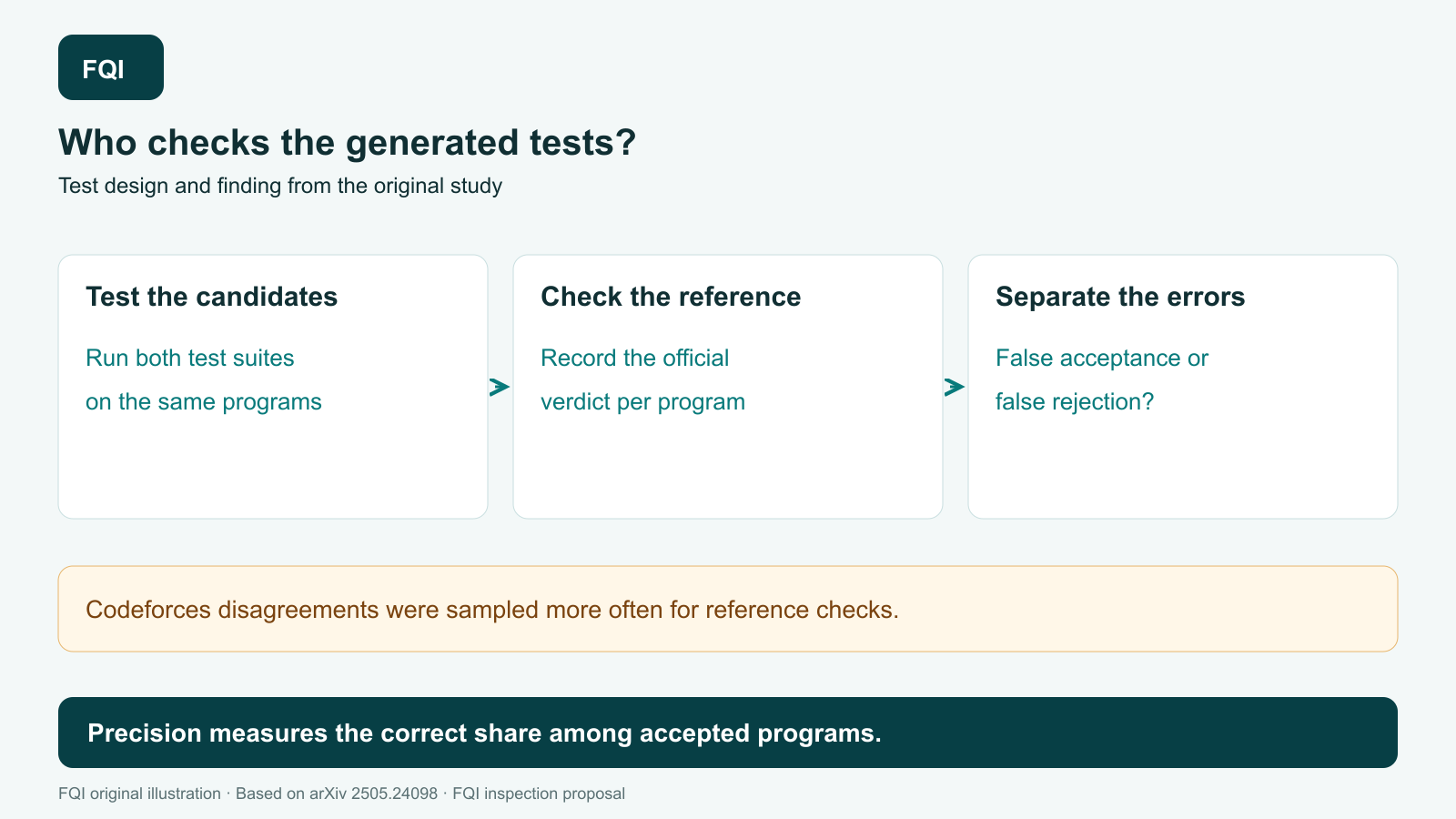
The authors assemble around 26,600 problems with synthetic tests. To evaluate the tests, they run language-model-generated solutions against different suites. For AtCoder, the reference uses released official tests. For Codeforces, the researchers submit selected candidates to obtain competition-platform verdicts. Across four difficulty levels they select 150 problems per level. Among candidate programs where the three suites agree they select 5% for submission. Among disagreements they select 50%.
Precision is the proportion of programs judged correct by the reference among programs the evaluated suite accepts. An advantage of about eleven percentage points applies to this comparison. It is not a speedup and cannot be read as an eleven-point improvement across all incoming jobs. Recall addresses the other direction by asking what share of reference-correct programs the suite accepts. A suite can perform differently on the two measures.
A software quality team might select well-specified calculations and assemble correct and incorrect implementations with independently reviewed expected behavior. Run the old and proposed suites on the same programs. For each program, record which suites accepted it and what the reference said. Repeated false acceptances in one range of inputs suggest a gap. Rejection of a correct solution calls for examining expected values or unnecessarily narrow tolerances. Keep the underlying requirement with each disputed case so that an ambiguous specification is not mistaken for a coding error.
For example, two programs might agree on ordinary orders yet differ on the first empty order. If the independent reference settles that boundary condition, the case can be retained as a practical regression test for future changes to the generated suite.
Limitations and risks
Competition tasks have relatively clear input and output formats. The results do not cover long-lived integrations or changing business requirements. An official verdict is a defined reference, not a mathematical proof. Sampling disagreements more frequently must also be disclosed before anyone interprets the observed conflicts as the frequency of errors in operation.
FQI conclusion
Qualify a test suite before using its verdict for automatic release or as a training reward. A report that identifies the reference, sampling rule and both error directions explains when a passing result is informative and which tasks need further examples from specialists.
Sources & transparency
The study is an author preprint. The proposed operational checks are FQI interpretations. HARDTESTGEN: A High-Quality RL Verifier Generation Pipeline for LLM Algorithmic Coding · Version history
Codex assisted with drafting and checked the claims against the cited original sources. Johann Fischer authorized publication on 2026-11-16.