
Executive summary
A coding agent can deliver the requested behaviour and fail a test that insists on one particular implementation. A study of software benchmarks uses two language models to identify possible gaps between the written task and the evaluation tests. The authors then rerun submitted changes after relaxing selected requirements. The results give quality teams a reason to review what a failed test actually establishes before accepting a ranking or revising a test.
FQI takeaway
- Trace each test condition to a requirement or an established convention.
- Ask for a concrete alternative implementation that satisfies the brief.
- Check both previously failing and previously passing examples after a test changes.
The principle at a glance
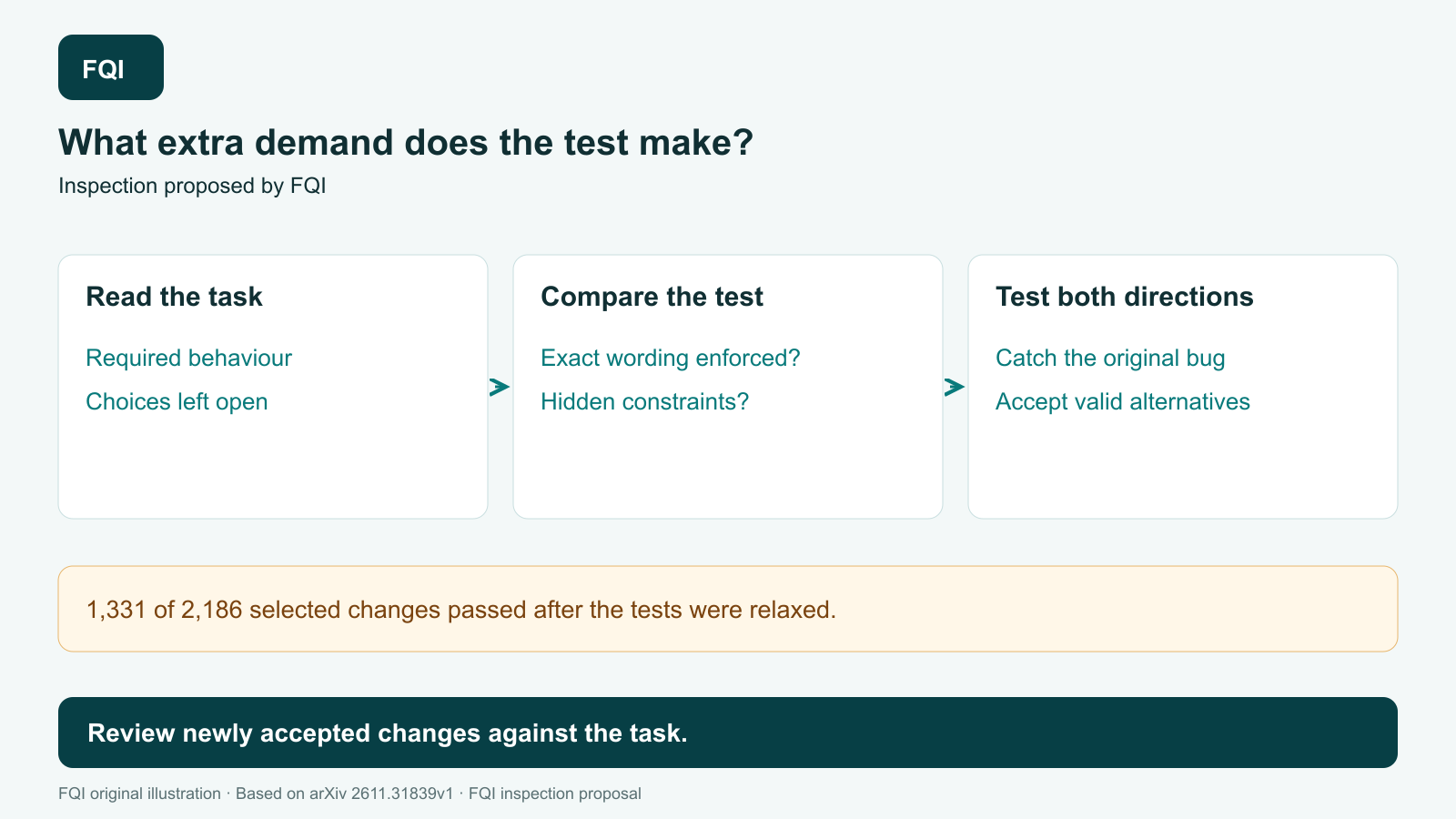
A task might require the software to handle an invalid date without crashing. A test could go further and demand a particular string as its return value. That value may be appropriate under an existing interface contract. If the contract leaves the choice open, the test can reject a reasonable solution. The distinction requires comparing specific test conditions with the specification available to the agent.
Deep dive
Two language models separately inspected the task and its test changes using a four-point scale. Both had to score the task at least three for the panel to flag it. On 206 held-out validation tasks, the panel flagged 100 of 112 cases previously identified as overspecified and four of 94 cases labelled acceptable. Those results concern a validation set with relatively clear examples.
Across the full collections, the models flagged 117 of 500 Verified tasks and 258 of 731 public Pro tasks. To examine what the flags meant in practice, the authors selected 2,186 previously failed patches on flagged Verified tasks. Candidates had failed evaluation tests while passing the regression tests in their submitted reports. A language model revised the tests without seeing the candidate patches. Among other checks, the revised tests still had to catch the unfixed code and accept the reference fix.
After the changes, 1,331 candidates passed, or about 61%. The denominator is this selected group, rather than every patch on the benchmark. Passing the revised test also leaves open the possibility that a genuine requirement was lost. A forced relaxation on unflagged controls allowed 29% of the selected control patches to pass. Inspection of several concentrated cases found real behaviour that had ceased to be tested.
For FQI, a review of one flagged test would begin with a written example of a valid implementation it rejects. A second example should deliberately violate the required behaviour. Run both against the old and revised tests. If the valid alternative passes and the invalid one still fails, the team has evidence about the particular change it proposes.
Limitations and risks
The graders had limited repository context and could miss existing conventions. The known acceptable validation examples came from Verified. The false-flag rate on Pro is therefore unknown. Executable regrading also covered Verified only, and only a sample of newly passing patches was inspected. Estimates of changes in leaderboard scores are upper bounds.
FQI conclusion
An acceptance test carries an implicit claim that its conditions follow from the task. Reviewing that claim can expose an error in the measuring instrument itself. FQI would treat a model’s flag as a request for a specific requirements review. A documented alternative, a preserved failure case and a review of newly accepted outputs give the team a basis for changing the test.
Sources & transparency
Spec-Test Coverage Gap: Detecting Overspecified Tests in SWE-Bench-Style Benchmarks · arXiv v1
Author preprint v1. FQI checked the cited sections of the original study. Workplace examples and inspection proposals are FQI interpretations. The experiments were not independently replicated.
Codex drafted the texts and checked them against the original study. Johann Fischer authorized publication on that basis on 26 November 2026.