
Executive summary
Artificial intelligence (AI) predictions can provide good overall uncertainty intervals while missing difficult cases too often. A study of ambulance travel-time estimation therefore compares coverage across operating contexts. The quality-management question is which groups the reported reliability actually covers. FQI recommends supplementing overall values with predefined subgroup checks and interval width. This retrospective regional study establishes neither better patient outcomes nor justification for automatic dispatch decisions.
FQI takeaway
- Report interval coverage and width together for relevant case groups.
- Justify data cleaning technically before calibration and preserve its record.
- Separate training, calibration and final evaluation data.
The principle at a glance
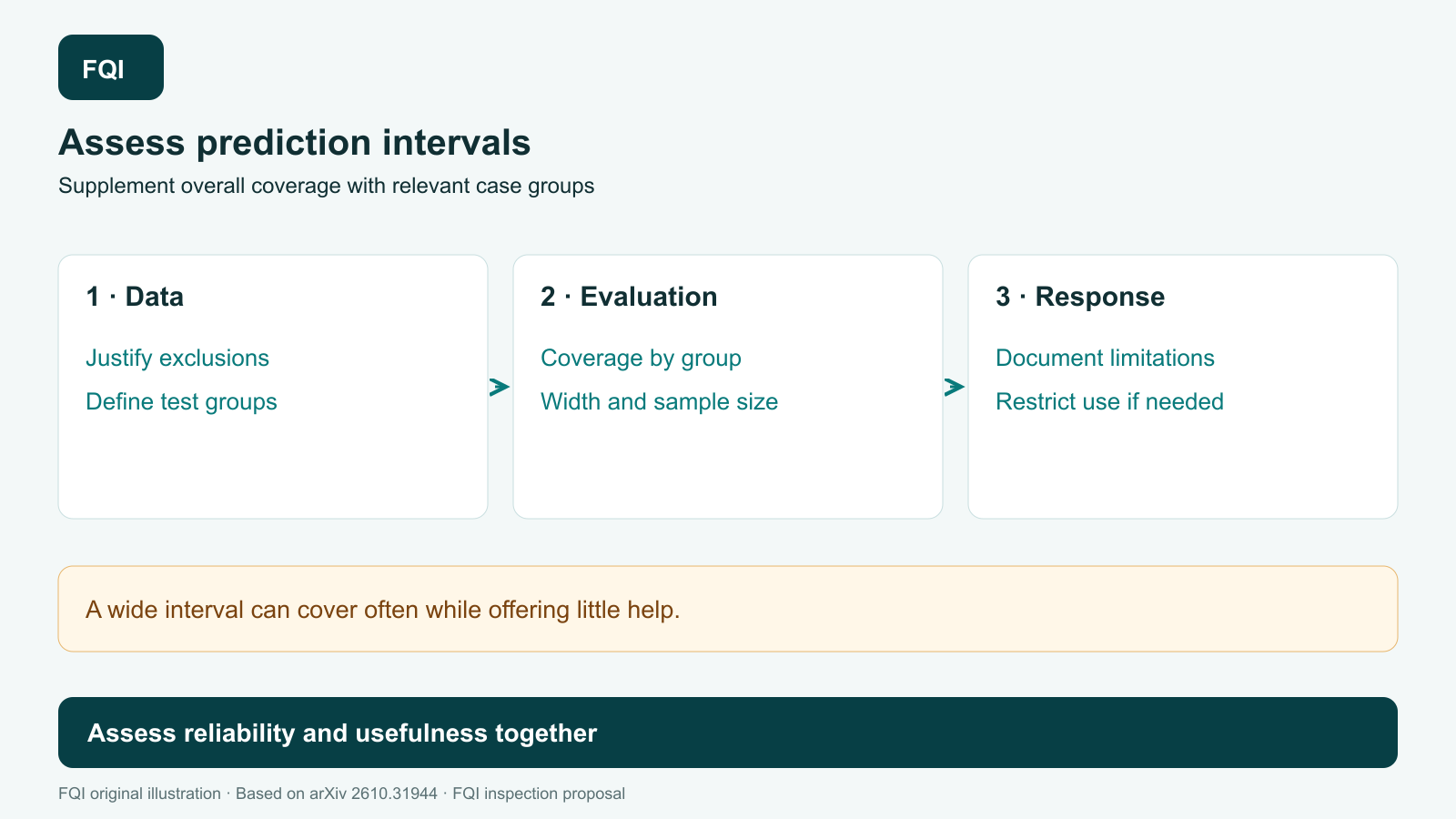
A prediction interval supplements a point estimate with a range of plausible outcomes. Coverage is the share of observed outcomes falling inside that range. A very wide interval may cover many outcomes while offering little decision support.
Conformal calibration uses held-out error examples to adjust such ranges. Its statistical statements depend on assumptions about case comparability. They do not automatically give identical reliability for every individual case or arbitrary subgroup.
Deep dive
The study uses two years of travel records from a Swedish region. It evaluates calibration approaches alongside point prediction. Global coverage can conceal differences by travel distance. An approach with adaptive intervals achieves more consistent empirical coverage across the examined distance groups, with somewhat wider ranges. The authors emphasize the limits of a regional retrospective evaluation.
FQI proposes transferring the evaluation structure to AI-based process-time predictions. A simplified example is estimating when a repeat inspection will finish. Before evaluating results, define relevant groups such as short and long inspection routes or frequent and uncommon workflows. Groups should reflect future decisions rather than being chosen after favorable outcomes are seen.
Report sample size, target coverage, observed coverage and typical interval width for each group. A small group with apparently perfect results remains uncertain. Where possible, also quantify uncertainty in estimated coverage. An overall average must not replace this information.
The data themselves require technical assessment before modeling. Implausible timestamps or combined locations can change the meaning of the target variable. Document excluded cases, reasons for exclusion and the remaining population. Otherwise an improved model metric following cleaning might simply describe an easier task.
Finally specify how inadequate coverage will be handled operationally. Options might include recalibration, a narrower use case or additional human assessment. The process determines the response; it should not be copied from one study value. Model changes and changes in the case mix are reasons to repeat the evaluation.
The test record should preserve the grouping rules and the data split. A subsequent revision can then be compared against the same relevant contexts without silently replacing difficult cases. New operating conditions should be marked explicitly so that their evidence is not inferred from an older overall score.
Limitations and risks
The source evaluates prediction quality and calibration, not the effect of a new dispatch rule on patients. Rare events outside observed conditions remain problematic. Even a well-calibrated interval can miss an individual outcome. Transfer to inspection workflows is FQI interpretation and was not investigated in the study. It needs local data, appropriate groups and evaluation independent of training.
FQI conclusion
Acceptance should ask more than how often an interval covers outcomes overall. It must determine whether ranges remain sufficiently reliable and usefully narrow in important cases. FQI recommends a small, predefined group report alongside every overall metric. It clarifies where the model helps, where extra assessment is needed and which conditions the observed reliability actually represents.
Sources & transparency
Methods, evaluation and limitations reviewed on 3 November 2026. Scientific preprint; no independent reproduction by FQI. Operational examples and inspection proposals are FQI interpretations, not additional experiments in the study. Artificial intelligence assisted preparation. Johann Fischer explicitly approved this article package for publication on 2026-11-04.